Creep Lyrics — Radiohead
Album: Pablo HoneyCouldn't look you in the eye,
You're just like an angel,
Your skin makes me cry;
You float like a feather,
In a beautiful world,
I wish I was special,
You're so f**kin' special;
But I'm a creep,
I'm a weirdo,
What the hell am I doin' here?
I don't belong here;
I don't care if it hurts,
I wanna have control,
I want a perfect body,
I want a perfect soul;
I want you to notice,
When I'm not around,
You're so f**kin' special,
I wish I was special;
But I'm a creep,
I'm a weirdo,
What the hell am I doin' here?
I don't belong here, ohhhh, ohhhh
She's running out again,
She's running,
She runs runs runs runs...
Runs...
Whatever makes you happy,
Whatever you want,
You're so f**king special,
I wish I was special;
But I'm a creep,
I'm a weirdo,
What the hell am I doin' here?
I don't belong here,
I don't belong here...
Song Overview
Review and Highlights
Quick summary
- Debut single from English band Radiohead, released September 21, 1992, later folded into the album Pablo Honey and its Collector’s Edition.
- Produced for this edition under the guidance of Chris Hufford, expanding on sessions originally captured at Chipping Norton Recording Studios in Oxfordshire.
- Became their signature global hit, peaking in the top ten across several countries and reaching the US Top 40, even as the band developed a love-hate relationship with it.
- Built on a soft verse / explosive chorus dynamic, with Jonny Greenwood’s infamous pre-chorus guitar “stabs” turning insecurity into a detonation.
- Widely synced in film and television, from the 1990s art film circuit to blockbuster franchises, often underscoring characters who feel like misfits in their own stories.

Heard in isolation, the track sounds deceptively simple: a handful of chords in G major, a mid-tempo pulse around 92 BPM, and a lyric written like a confession someone blurted out too late. What makes it stick is the collision between that fragile guitar arpeggio and Greenwood’s strafing distortion in the pre-chorus, like a self-loathing thought slamming into the back of your skull. The verses hover in a half-whisper, Thom Yorke pushing close to the mic, while the chorus explodes into a raw, almost shouted hook. That quiet-loud dynamic and slightly shambling live feel link it with early 90s alternative rock and grunge, but the song is more about tension than power-chord swagger.
The Collector’s Edition framing puts the single alongside live takes and an acoustic version, highlighting how portable the structure is. Strip it down to voice and guitar and you get a wounded barroom ballad. Put the full band back in, with Greenwood’s noisy eruptions and Colin Greenwood’s steady, almost mechanical bass, and it flips into an anthem for people who do not feel built for anthems. According to commentary in Grammy records and long-term chart data, it remains the band’s most commercially successful single and their highest-charting US hit, even as later albums turned them into critics’ darlings for very different reasons.
Screen & Media Placements
Cyclo (1995) - feature film - largely diegetic. The original recording plays over a nightclub sequence in Tran Anh Hung’s drama about a young bicycle courier in Ho Chi Minh City, roughly in the first half of the film. The track’s swirl of longing and grit underlines the club’s neon fog and the protagonist’s sense of being pulled through a world he cannot quite join.
Happily Ever After (2004) - feature film - non-diegetic / semi-diegetic. A scene with Johnny Depp and Charlotte Gainsbourg uses the song as a romantic-awkward underscore; the characters seem wrapped in their own melancholy while the track hums like an inner monologue. It pops up in the mid-section of the film, framing their tentative chemistry with a sense that nobody really belongs anywhere.
The Social Network (2010) - trailer - non-diegetic. The now-famous trailer for David Fincher’s film uses the eerie choral cover by Scala & Kolacny Brothers rather than the band’s own recording. The slowed, choir-only arrangement turns the lyric into an abstract lament for digital-age alienation, and, according to coverage in mainstream press, helped kick off a wave of trailer trends built on haunted pop covers.
The Zero Theorem (2013) - feature film - diegetic via cover. A smoky jazz reinterpretation sung by Karen Souza is woven into Terry Gilliam’s dystopian story, functioning as a lounge tune that mirrors the protagonist’s sense of not fitting inside a hyper-commodified world. Its presence in the soundtrack deepens the track’s association with offbeat, lonely characters.
The Book of Life (2014) - animated feature - diegetic cover. Diego Luna sings a stripped-down version of the chorus in a key emotional scene, using the melody as a kind of serenade. It works less as 90s slacker anthem and more as a vulnerable confession from a teenage boy who cannot quite live up to expectations.
Guardians of the Galaxy Vol. 3 (2023) - feature film - diegetic / semi-diegetic. An acoustic version by the band underscores the opening, playing almost in full as we track a dazed Peter Quill stumbling through Knowhere. The pairing of nostalgic 90s ballad and a drunken hero gives the song a new coat of cosmic sadness, and, according to production interviews, director James Gunn leaned into that floating, featherlike quality of the acoustic arrangement for the title sequence.
Creation History
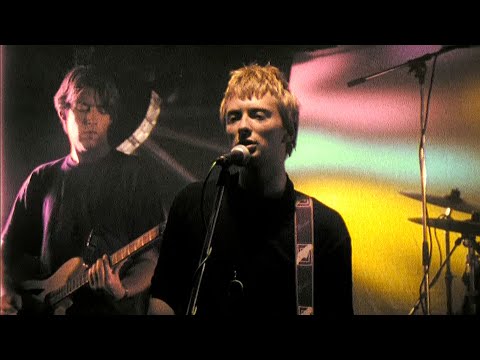
Yorke first wrote the core of the song in the late 1980s while at the University of Exeter, and the band recorded it during sessions at Chipping Norton Recording Studios in 1992. Producers Sean Slade and Paul Q. Kolderie reportedly captured a spontaneous, unguarded performance after asking the band to run through the track between takes for other songs; the group did not know they were being recorded. Jonny Greenwood’s famous pre-chorus “attack,” those violent guitar blasts before the chorus lands, began as an attempt to sabotage what he felt was a too-pretty ballad, but the producers loved how it jolted the arrangement. The single initially stumbled in the UK, considered too bleak by some radio programmers, but overseas airplay and a reissue turned it into a worldwide hit. The official video, directed by Brett Turnbull, keeps things simple: the band plays in a club to a mostly uninterested audience, which visually doubles the lyric’s feeling of invisibility.
Song Meaning and Annotations

Plot
At its simplest, the song tracks one night and one obsession. The narrator sees someone he adores and immediately folds in on himself. He cannot look her in the eye, frames her as an angel moving through a beautiful world, and reacts to her presence with a kind of stunned sadness. As the song unfolds, he fantasizes about self-improvement: a perfect body, a perfect soul, control over his feelings. The chorus pulls the camera back onto him, hammering the idea that he is an outsider, a misfit in the room who should not even be there.
In the bridge he imagines her leaving, running out the door, fleeing either his confession or just the suffocating atmosphere of his fixation. By the final verse he swings toward resignation: whatever makes her happy, whatever she wants, he will step aside. The last repeated line, that he does not belong, lands less like a simple pout and more like a verdict he has convinced himself of.
Song Meaning
Thom Yorke has described the lyric as coming from the perspective of a drunk man tailing someone he desires, never quite finding the courage to speak to her. That detail matters: it is not just shy admiration, it is someone hovering on the edge of creepy behavior who is painfully conscious of his own awkwardness. The repeated admissions in the chorus are self-labels he throws at himself before anyone else can.
Yorke also spoke, in early interviews, about struggling with what it meant to be a man in the 1990s. On one side, there is the expectation to be assertive and sexually confident; on the other, a distrust of macho bravado and a desire to avoid emotional harm. The narrator sits in that gap. He tries to assert a sexual persona and simultaneously recoils from it, which is why the song alternates between dreamy infatuation and self-directed contempt. Jonny Greenwood’s comment that the song is, in a way, happy, fits here: there is a faint sense of acceptance in recognizing who you are, even if that recognition hurts.
The track has often been framed as a slacker-era anthem, bracketed with songs like Nirvana’s “Smells Like Teen Spirit” and Beck’s “Loser.” But where those tracks lean into irony or abstract rage, this one is bluntly confessional. It speaks to anyone who has stood at the back of a room and decided, before anything even happened, that they are not allowed to participate.
Annotations
The opening verse lays out the power imbalance straight away. The narrator has seen this person before, so there is at least some prior contact or crush history, yet he still cannot meet her gaze. Calling her “just like an angel” is less a compliment to her and more an admission of his own fear. Angels, in this worldview, are untouchable; you do not flirt with them, you hide.
He looks at her “floating like a feather in a beautiful world,” as if she moves through a brighter, smoother reality than the one he occupies.
The feather image is important. It suggests weightlessness and ease, an existence gliding just above the mess of ordinary life. The unspoken corollary is that he, by contrast, trudges through something heavier and more tangled. In a line or two, he has created two worlds: hers, graceful and frictionless; his, clumsy and stuck. That exaggeration fuels his envy as much as his attraction.
“I wish I was special.”
On the surface this is a straightforward self-putdown, but it is doing more work. Later, he stacks up what he thinks “special” means: the perfect body, the perfect soul, effortless composure. Special here does not mean quirky or unique; it means flawless. He imagines her as complete, above need, while he knows himself as a bundle of lack and longing. The tragedy is that by turning her into a mirror for his own insecurity, he never really sees her as a person. He envies a fantasy and resents himself for falling short of it.
“But I’m a creep, I’m a weirdo, what the hell am I doing here?”
The chorus trains the spotlight directly on his self-contempt. While the verses circle around her and the world she floats through, the hook collapses back into an inventory of his supposed defects. The word “creep” is especially loaded. He is not only calling himself unattractive or shy; he is suggesting that his very presence is invasive, that he is out of bounds simply by being in the room. The way Yorke sings those lines, almost spitting and then sagging, underlines the internal whiplash between anger and shame.
“I don’t care if it hurts, I want a perfect body, I want a perfect soul.”
That couplet sounds like a bargain with some invisible judge: let me reshape myself, no matter the pain, and maybe then I will be worthy of notice. It is about control as much as aesthetics. He wants to control his feelings and his image so that he is never again humiliated by wanting someone “out of his league.” The exaggeration of “perfect soul” hints at the futility; no one has that, but he has convinced himself that only impossible perfection would make him acceptable.
“She is running out the door, she is running, she run, run, run…”
This bridge feels like a panic attack set to music. Whether he is remembering a real moment or imagining the worst case, the repetition of “run” is pure fear of abandonment. There is also an echo of the legal battles around the song’s chord sequence (which resembles “The Air That I Breathe”), giving the line a double life: on paper it is about her flight, in the song’s history it also marks the part that triggered lawsuits and retroactive songwriting credits.
“Whatever makes you happy, whatever you want.”
By the time he reaches this final verse, all the fantasy about self-improvement has deflated. He swings to a kind of martyr pose: he will get out of the way and let her have whatever she wants, whether or not that includes him. Because Yorke pushes his voice to the edge here, almost cracking, it sounds less like noble sacrifice and more like someone surrendering, not only to losing the girl but to a belief that he cannot be loved at all.

Rhythm, sound, and the emotional arc
Musically, the song rides a straight 4/4 pulse, but it never feels rigid. The tempo breathes slightly, as early recordings did before click tracks became mandatory. Greenwood’s guitar shifts from gentle arpeggios to those violent pre-chorus hits that sound almost like the tape is tearing. That contrast maps directly onto the emotional arc: quiet, obsessive watching; then sudden, self-lacerating outbursts. In the choruses, the band pulls into a noisy wall of sound more associated with grunge, but the harmony and melody are closer to a wounded pop ballad. Fans and critics have often described it as a fusion of alternative rock, grunge, and noise pop elements, with the distorted guitar functioning like a character in the story, not just accompaniment.
Language, idioms, and symbols
The lyric is built from ordinary language: nothing ornate, no obscure references. That plainness is deliberate. Lines like “What the hell am I doing here?” sound like something you would say to a friend outside a party you regret attending. The metaphors that do appear are simple yet sharp: angels, feathers, perfect bodies, running. They are the sort of images someone with a head full of pop culture might pick up and deploy without thinking. What gives them heft is the way Yorke leans into certain words, stretching “special” until it feels like a weight around his neck.
There is also a gender undercurrent. Yorke’s comments about masculinity in the 90s frame the narrator as someone trying to navigate a world where traditional macho scripts feel toxic, but newer models of sensitivity are still undefined. The result is paralysis: he cannot be the swaggering rock frontman, but he also cannot quite imagine a version of himself that is both vulnerable and confident. The song catches him mid-freeze.
Technical Information
- Artist: Radiohead
- Featured: None
- Composer: Thom Yorke, Jonny Greenwood, Ed O’Brien, Colin Greenwood, Philip Selway, Albert Hammond, Mike Hazlewood
- Producer: Chris Hufford (Collector’s Edition credit), with earlier sessions produced by Sean Slade and Paul Q. Kolderie
- Release Date: September 21, 1992 (original single)
- Genre: Alternative rock, grunge, post-grunge, noise pop
- Instruments: Lead vocal, backing vocals, electric guitars, bass guitar, drum kit, occasional piano in some versions
- Label: Parlophone, Capitol Records, XL Recordings
- Mood: Alienated, yearning, self-critical, cathartic
- Length: Approximately 3:56 (album version)
- Track #: 2 on Pablo Honey (and on Pablo Honey (Collector’s Edition))
- Language: English
- Album: Pablo Honey / Pablo Honey (Collector’s Edition)
- Music style: Quiet-loud alternative rock ballad blending jangly verse textures with explosive, heavily distorted choruses
- Tempo: Around 92 BPM in 4/4 time
- Key: G major (with modal coloration)
- Poetic meter: Loosely iambic lines with irregular stresses, mirroring conversational speech more than strict verse
Questions and Answers
- Who produced the track on the Pablo Honey Collector’s Edition?
- The Collector’s Edition credits emphasize Chris Hufford as producer for this version, building on the earlier sessions captured with Sean Slade and Paul Q. Kolderie at Chipping Norton Recording Studios.
- When was the single first released?
- The original single was released on September 21, 1992, several months before the full album Pablo Honey arrived in early 1993.
- Who wrote the song?
- The lyric is by Thom Yorke, while the composition credit is shared by the Radiohead members with Albert Hammond and Mike Hazlewood, reflecting the settlement over similarities to their song “The Air That I Breathe.”
- Why did Radiohead grow to dislike playing it live?
- At the height of its success the band found themselves playing the same four minutes every night while some audience members would leave as soon as it was over. Yorke has said it began to feel like it was no longer their song, more like a cover of their own past, which is one reason sets in later eras often dropped it or used it sparingly.
- Is the narrator supposed to be sympathetic or unsettling?
- Both. The track invites you to feel the sting of his self-hatred and social anxiety, but Yorke’s own description makes clear that this is also a portrait of someone whose attraction veers into following and fixating. That ambiguity is part of what keeps the lyric interesting decades later.
- How do the censored and uncensored versions differ?
- For radio, the line “You’re so fuckin’ special” was rerecorded as “You’re so very special.” Some listeners first heard only the clean take and were surprised to learn that the album uses the uncensored wording. The switch barely changes the rhyme, but the loss of the expletive slightly softens the character’s intensity.
- What happened with the lawsuit over the chord progression?
- The verse progression and melody resemble “The Air That I Breathe,” written by Albert Hammond and Mike Hazlewood and made famous by the Hollies. The publishers brought a claim, and the resolution added Hammond and Hazlewood as co-writers, which is why they appear in the official credits today.
- Why is the guitar so loud and abrasive in the chorus?
- Jonny Greenwood’s pre-chorus blasts and chorus rasp reportedly started as an attempt to rough up what he feared was a too-sentimental ballad. Instead, that jagged dynamic became the song’s calling card, mirroring the narrator’s sudden spikes of self-disgust cutting through his daydreams.
- How high did the song chart?
- It reached the UK Top 10 after a 1993 reissue, climbed into the top ten in countries such as Australia, France, Belgium, and New Zealand, and peaked in the mid-30s on the US Billboard Hot 100, remaining their best-charting American single.
- Has it received any major accolades?
- Among various honors, it won Best Single at the 1994 NME Awards and has appeared on multiple long-term lists, including VH1’s rundown of 1990s tracks and Rolling Stone’s updated “500 Greatest Songs of All Time.”
- Why does the song keep showing up in films and trailers?
- Directors and trailer editors reach for it when they want to telegraph outsider status in seconds. The lyric is specific enough to feel personal but broad enough to fit countless characters: lonely teenagers, washed-up heroes, social media misfits. The melody is instantly recognizable, and the dynamics lend themselves well to slow builds and sharp cuts.
Awards and Chart Positions
Upon its initial UK release, the single barely registered, but after being reissued in 1993 it surged into the national Top 10 and went on to become Radiohead’s most successful single worldwide. It reached the Top 10 in several territories, including the UK, Australia, Belgium, France, and New Zealand, and cracked the US Billboard Hot 100, peaking in the mid-30s and staying on the chart for around twenty weeks. In later decades, digital sales and streaming pushed it back onto international charts and even into year-end global rankings, underlining how strongly it continues to circulate.
Certification-wise, industry data shows multi-platinum status in multiple countries: high-level platinum awards in the UK, Canada, Italy, and New Zealand, with gold or better in markets like Australia. According to NME’s own awards history, the track also took home the NME Award for Best Single in 1994, while the Brit Awards that year nominated it for British Single of the Year. Rolling Stone’s later surveys placed it among the greatest debut singles and in updated versions of the “500 Greatest Songs of All Time,” and VH1 ranked it high on their list of 1990s tracks. As stated in a 2024 Billboard report, the official music clip has now passed the one-billion-view mark on YouTube, making it the first video from the band to enter that club.
| Region | Peak chart position (single) | Certification (selected) |
|---|---|---|
| United Kingdom | Top 10 (Official Singles Chart, 1993 reissue) | BPI multi-platinum |
| United States | Top 40 (Billboard Hot 100) | RIAA platinum (single) |
| France | Top 5 (national singles chart) | Multi-platinum (combined units) |
| Australia | Top 10 | ARIA gold |
| Canada | Top 40 (various charts) | Multi-platinum (Music Canada) |
| Global streaming era | Appears on Billboard Global 200 year-end tallies | Billions of streams and video views across platforms |
How to Sing Creep
From a vocalist’s point of view, this is a masterclass in restraint exploding into release. The song sits in G major, with a tempo around 92 BPM and a feel that allows for a bit of natural push and pull. Most male singers will find the core melody in a mid-range that spans roughly from low B in the second octave up to about B in the fourth, with optional higher ad libs. The main challenges are controlling the soft, almost mumbled verses, nailing the leap into the louder chorus, and doing it all without shredding your voice.
Step-by-step approach
- Lock in the tempo and groove. Set a metronome around 92 BPM and strum the basic chord loop (G–B–C–Cm in concert pitch). Sing the verse on a neutral syllable like “la” to get comfortable with where the phrases sit rhythmically. The groove should feel slightly lazy rather than rigid, as if you are dragging your feet across the floor.
- Shape the diction in the verses. Aim for soft consonants and a close-mic tone. Yorke almost swallows some words, which gives the sense that the narrator is muttering to himself. Practice speaking then singing lines like “When you were here before” and “You’re just like an angel” with minimal volume but clear pitch, keeping the jaw loose.
- Plan your breathing. Each verse is written as long, flowing sentences. Decide where you will breathe so you do not gasp before the chorus. A good rule is to take a deeper breath just before “I wish I was special” so you have enough air to ride through into the first “But I’m a creep.”
- Build into the chorus without over-squeezing. The chorus is louder and more intense but still lives in chest voice for most singers. Focus on lifting the soft palate and keeping the neck relaxed. Think of the phrase “I’m a weirdo” as one sustained arc rather than two separate words you attack.
- Handle the dynamic explosions. The band jumps dramatically when the distortion hits. To match that energy vocally, increase volume and edge, but do it by engaging support from the diaphragm and lower ribs rather than clamping the throat. Practicing the chorus on “nay” or “no” can help you find a forward, buzzy placement.
- Bridge and final verse: controlled desperation. In the “She’s running out the door” section, shorten your consonants and let the repetition of “run” accelerate slightly, like thoughts racing. In the last verse and chorus, allow more crack and grit if it feels natural, but stay inside what you can repeat safely.
- Microphone technique. If you are performing live with amplification, keep the mic closer for the verses to capture the intimacy, then pull it back slightly as you hit the biggest chorus notes. That physical movement helps you avoid distorting the front of house sound while preserving contrast.
- Common pitfalls. Many singers overdo the angst and start shouting early, which leaves nothing for the final chorus and risks vocal strain. Others underplay the verses and go off-pitch. Keeping a steady, almost plain delivery at first actually makes the climaxes hit harder.
Practice materials
- Start with a piano or clean guitar playing block chords so you can isolate pitch and rhythm before adding band dynamics.
- Work through the melody slowly, using a metronome at 70–75 BPM, then gradually raise it back to the original feel.
- Record yourself singing a cappella to check whether your pitch drifts on lines like “I want a perfect body, I want a perfect soul.”
- Once confident, rehearse with a backing track that closely follows the original arrangement so you can practice entering after Greenwood’s guitar hits without losing time.
Additional Info
According to NME magazine’s own retrospective award lists, this single arrived at a moment when UK rock was recalibrating after the first wave of grunge, and it quietly opened doors for the band to pursue stranger territory on later albums. As stated in a 2024 Rolling Stone feature on debut singles, the track is as famous for what came after it as for the song itself: without its success, the group would not have enjoyed the creative freedom that birthed The Bends, OK Computer, and beyond.
The song’s legacy is partly built on reinterpretations. Alanis Morissette famously sang it on tour with the band in the mid-90s, and Prince’s 2008 Coachella cover briefly turned it into his own shimmering hymn before being pulled from the internet. The choral arrangement by Scala & Kolacny Brothers gave it a second life in the 2010s, spreading through the trailer circuit, while Karen Souza’s smoky jazz version extended its reach into arthouse science fiction. Choirs, jazz bands, metal groups, bedroom producers, and television talent shows have all pulled the song into their worlds, which is as strong a proof as any that the underlying structure is robust.
Inside the band’s story, however, it became a kind of cage. Yorke has said that at one point he felt the group was being judged entirely on this one song, and that repeating it night after night felt like re-enacting a small slice of their past instead of moving forward. The B-side and EP title My Iron Lung is a direct, slightly bitter nod: the track kept them alive commercially while also making it hard to breathe creatively.
Key Contributors
| Subject | Verb | Object |
|---|---|---|
| Thom Yorke | wrote lyrics for | Creep |
| Thom Yorke | sings lead vocal on | Creep |
| Jonny Greenwood | plays lead guitar on | Creep |
| Jonny Greenwood | adds disruptive pre-chorus guitar bursts to | Creep |
| Ed O’Brien | provides rhythm guitar and backing vocals on | Creep |
| Colin Greenwood | anchors bass line for | Creep |
| Philip Selway | plays drums for | Creep |
| Chris Hufford | produces Collector’s Edition version of | Creep |
| Sean Slade | co-produces early recording sessions for | Creep |
| Paul Q. Kolderie | co-produces and mixes studio recording of | Creep |
| Radiohead | records debut album | Pablo Honey (featuring Creep) |
| Parlophone | releases UK single | Creep |
| Capitol Records | handles early US release of | Creep |
| XL Recordings | issues later catalog editions featuring | Creep |
| Chipping Norton Recording Studios | hosts main recording sessions for | Creep |
| Brett Turnbull | directs official music clip for | Creep |
Sources: Wikipedia discography and song entries; Billboard news report on streaming milestones; NME awards archive; Rolling Stone feature lists; film soundtrack databases and press coverage for Cyclo, The Social Network, The Zero Theorem, The Book of Life, and Guardians of the Galaxy Vol. 3.
A-Z Lyrics Universe