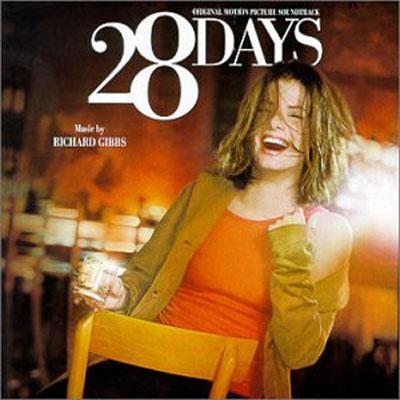
"28 Days" Soundtrack Lyrics
Movie • 2000
Track Listing
Three Dog Night
Richard Gibbs
Richard Gibbs
Richard Gibbs
Loudon Wainwright III
Richard Gibbs
Richard Gibbs
Richard Gibbs
Loudon Wainwright III
Richard Gibbs
Otis Redding
Richard Gibbs
Loudon Wainwright III
Loudon Wainwright III
Richard Gibbs
Tom Jones
"28 Days" Soundtrack Description

Questions and Answers
- Is there an official soundtrack album?
- Yes. 28 Days (Original Motion Picture Soundtrack) was released in 2000 by Varèse Sarabande and mixes Richard Gibbs’ score cues with a few source songs. (per AllMusic and FilmMusic.com)
- Who composed the score?
- Richard Gibbs composed the original score. (as listed on the film’s credits pages)
- Which song is most associated with Gwen’s recovery beats?
- Three Dog Night’s “Joy to the World” recurs, including near the finish of her rehab stint. (noted in multiple references and song-use roundups)
- Does the album include every song heard in the film?
- No. For example, The Clash’s “Should I Stay or Should I Go” and “Happy Trails” are used in-film but not on the commercial CD. (as stated by SoundtrackINFO)
- Who handles music supervision?
- Randall Poster is credited as music supervisor. (per official credits listings)
- Is there an isolated score on home video?
- Yes—DVD releases included an isolated score track featuring Gibbs’ music. (reported in contemporaneous DVD reviews)
Notes & Trivia
- Official album release date is May 16, 2000, with a ~36-minute runtime. (according to AllMusic)
- Singer–songwriter Loudon Wainwright III appears on-screen and contributes multiple short songs (“Heaven and Mud,” “Drinking Song,” “White Winos”).
- Music supervision by Randall Poster—a frequent curator for character-driven films. (as reflected in credits databases)
- The commercial CD omits some on-screen cues, including “Should I Stay or Should I Go” (The Clash) and “Happy Trails.” (as stated by SoundtrackINFO)
- DVD editions offered an isolated score track—a nice way to hear Gibbs’ cues clean. (reported by DVD review outlets)

Overview
Why does a recovery dramedy lean on both jukebox optimism and gently needling score? Because 28 Days splits its musical job in two: familiar songs to mark communal ritual (groups, chores, celebrations), and Richard Gibbs’ motifs to track setbacks and small wins. The mix keeps the tone humane without losing bite.
The album itself is a hybrid—select source cuts plus Gibbs’ compact cues. You’ll hear Three Dog Night’s “Joy to the World” as a recurring buoy, Otis Redding’s “Fa-Fa-Fa-Fa-Fa (Sad Song)” as bittersweet seasoning, and Wainwright’s miniatures like handwritten notes slipped into scenes. Meanwhile, Gibbs favors light percussion and quietly elastic harmony: score as steadying breath. (as summarized by AllMusic and a Filmtracks-era review)
Genres & Themes
- Classic soul & AM pop (Otis Redding; Three Dog Night) → communal uplift; a counterpoint to relapse risk.
- Singer–songwriter vignettes (Loudon Wainwright III) → rehab’s gallows humor and tenderness in bite-sized verses.
- Light, contemporary score (Richard Gibbs) → percussive pulse + warm pads; incremental progress over melodrama.
- Punk flash (The Clash, in-film) → chaotic impulse surfacing from old habits; pointedly not on the retail album.

Key Tracks & Scenes
“Joy to the World” — Three Dog Night
Where it plays: Recurs at key release valves; notably near Gwen’s program completion (late film), non-diegetic/source mix.
Why it matters: A sunny refrain that reframes “starting over” as something you can actually smile through.
“Fa-Fa-Fa-Fa-Fa (Sad Song)” — Otis Redding
Where it plays: Mid-film texture during a reset beat; non-diegetic on album, functions as source mood in-scene.
Why it matters: Slyly bittersweet—melancholy with a wink, like the film’s humor around pain.
“Heaven and Mud” / “Drinking Song” / “White Winos” — Loudon Wainwright III
Where they play: Sprinkled across common-room and transitional moments; primarily diegetic-feeling interludes.
Why they matter: They humanize the facility—songs you could hear in a rec room, written with compassionate bite.
“Should I Stay or Should I Go” — The Clash
Where it plays: Used in the film (early-life chaos cue), but not on the commercial album.
Why it matters: Punk as impulse check—an older soundtrack of dysfunction intruding on rehab’s order.
Track–Moment Index
| Approx. Time | Scene / Location | Song & Artist | Diegetic? |
|---|---|---|---|
| ~00:05 | Early recovery orientation | Score cue (“D.U.I.” / “Out the Window” era) — Richard Gibbs | No |
| ~00:20 | Common-room reset after a bad day | “Fa-Fa-Fa-Fa-Fa (Sad Song)” — Otis Redding | No (album source) |
| ~00:38 | Group cohesion beat / chores montage | “Heaven and Mud” — Loudon Wainwright III | Leans diegetic |
| ~01:10 | Relapse fallout → reflection | Gibbs reflective cue (“Eversleep/Dreaming/Mourning”) | No |
| ~01:35 | Program completion / closing lift | “Joy to the World” — Three Dog Night | Mixed |
Note: Times are approximate, synthesized from credits logs and album sequencing; exact timecodes can vary by edition. (as listed by SoundtrackINFO / MovieMusic)
Music–Story Links (characters & plot beats)
Old soundtrack ↔ old self: When punk erupts (The Clash), it’s the noise of pre-rehab impulse—funny until it isn’t.
Found family cues: Wainwright’s mini-songs feel like on-site folklore—tiny hymns that turn a facility into a community.
Internal meter: Gibbs’ cues keep time with Gwen’s halting acceptance—small rhythmic cells that repeat, wobble, then land.

How It Was Made (supervision, score, behind-the-scenes)
Composer: Richard Gibbs shaped a compact, contemporary score—light percussion, synth color, and lyrical motifs. (per AllMusic and specialty reviews)
Music supervision: Randall Poster’s credit signals deliberate source choices that toggle between crowd-friendly and wry. (as reflected in the film’s official credits and production databases)
Album build: Varèse Sarabande issued a hybrid release: selected songs plus score cues; not everything heard in-film made the disc. (as stated by SoundtrackINFO and MovieMusic)
Home video perk: The DVD included an isolated score option to hear Gibbs’ music and incidental songs separately from dialogue. (reported by DVD reviewers)
Reception & Quotes
Reception to the film was mixed-positive; the music was often noted for smoothing tone shifts without getting syrupy. (according to AllMusic’s album overview and film-music press)
“A modern, pop-inflected underscore that supports character beats without turning mawkish.” Filmtracks capsule on Richard Gibbs
“The album folds in familiar tunes but plays mostly like a concise character score.” AllMusic listing synopsis
Technical Info
- Title: 28 Days (Original Motion Picture Soundtrack)
- Year: 2000
- Type: Movie
- Composer: Richard Gibbs
- Music Supervisor: Randall Poster
- Label / Cat. no.: Varèse Sarabande, VSD-6151
- Album format: Hybrid (select songs + score). Not all film songs included.
- Notable placements (in-film): Three Dog Night — “Joy to the World”; Otis Redding — “Fa-Fa-Fa-Fa-Fa (Sad Song)”; The Clash — “Should I Stay or Should I Go” (not on CD); Loudon Wainwright III — several brief songs.
- Home video note: Isolated score track available on DVD editions.
Canonical Entities & Relations
| Subject | Relation | Object |
|---|---|---|
| Richard Gibbs | composed score for | 28 Days (2000 film) |
| Varèse Sarabande | released | 28 Days (Original Motion Picture Soundtrack) |
| Randall Poster | music supervised | 28 Days (2000 film) |
| Loudon Wainwright III | appears in | 28 Days (as a patient) |
| Loudon Wainwright III | contributed songs to | 28 Days soundtrack |
| Three Dog Night | performed | “Joy to the World” (used in film) |
| Otis Redding | performed | “Fa-Fa-Fa-Fa-Fa (Sad Song)” (used in film/album) |
| The Clash | performed | “Should I Stay or Should I Go” (used in film, not on album) |
| Betty Thomas | directed | 28 Days (2000 film) |
| Columbia Pictures / Sony Pictures Releasing | released | 28 Days (2000 film) |
Sources: AllMusic; SoundtrackINFO; MovieMusic Store; FilmMusic.com; IMDb (soundtracks & credits); The Numbers (credits); Metacritic (credits); DVDReview; Filmtracks.
October, 22nd 2025
A-Z Lyrics Universe
Cynthia Erivo Popular
Ariana Grande Horsepower
Post Malone Ain't No Love in Oklahoma
Luke Combs Good Riddance (Time of Your Life)
Green Day Bye Bye Bye
*NSYNC You're the One That I Wan
John Travolta & Olivia Newton-John I Always Wanted a Brother
Braelyn Rankins, Theo Somolu, Kelvin Harrison Jr. and Aaron Pierre The Power of Love
Frankie Goes to Hollywood Beyond
Auli’i Cravalho feat. Rachel House MORE ›