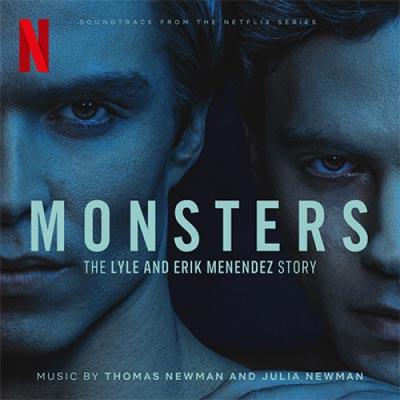
"Monsters: The Lyle and Erik Menendez Story" Soundtrack Lyrics
TV • 2024
Track Listing
Kenny G
Milli Vanilli
Milli Vanilli
Milli Vanilli
Vanilla Ice
The Adventures of Stevie V
Snap!
Eartha Kit
Crowded House
Future
Masta Maudz
Milli Vanilli
"Monsters: The Lyle and Erik Menendez Story (Soundtrack from the Netflix Series)" – Album Guide to Tracks and Key Scenes
Overview
What kind of soundtrack uses a disgraced pop duo to score a double parricide and still finds room for a humming, almost liturgical score? The music for Monsters: The Lyle and Erik Menendez Story answers that by leaning into contradiction: glossy chart hits sit right beside a cold, minimal hum that sounds like guilt, shame and courtroom air-conditioning all at once.
The series retells the Menendez case through multiple points of view, and the soundtrack mirrors that fractured perspective. Early episodes lean on late-80s and early-90s radio staples — Milli Vanilli, Kenny G, Vanilla Ice — the exact songs the real brothers reportedly loved and literally played at their parents’ memorial. The needle-drops feel almost too on-the-nose, which is the point: the music underlines how image-obsessed, media-saturated and surreal the case became, even as it deals with abuse and murder.
Against this, Thomas Newman and Julia Newman’s score creeps in with low piano tones, tremolo strings and that now-famous humming motif. Where the pop songs belong to the public story — the tabloid trial, the cameras, the gossip — the score belongs to the private one: lonely prison nights, therapy sessions, flashbacks that may or may not be true. Over nine episodes, the album’s 37 cues move from brittle, almost procedural textures into more wounded, intimate writing as Erik’s testimony deepens and the “Rashomon” structure closes in.
Stylistically, the soundtrack moves in phases. Smooth jazz and adult-contemporary pop (“Songbird”) sketch the aspirational Beverly Hills veneer. Eurodance and New Jack Swing hooks (Milli Vanilli, Snap!) mark the brothers’ swagger, spending spree and self-mythologising. Christmas standards (“Santa Baby”, “Rockin’ Around the Christmas Tree”) are weaponised to show the gloss on a poisonous family system. Later, the melancholy alt-rock of “Don’t Dream It’s Over” becomes a theme for collapse and denial, while the humming score grows louder every time the script returns to abuse and trauma.
How It Was Made
Ryan Murphy and Ian Brennan brought in Thomas Newman and his daughter Julia Newman after their work together on Feud: Capote vs. the Swans, asking them to build a sound that could handle sharp tonal swings: true-crime horror one minute, tabloid absurdity the next. According to interviews, the brief was not to “decorate” scenes but to keep reminding viewers that beneath the spectacle there is a family annihilated and two young men claiming years of abuse.
Julia Newman devised the show’s central humming motif almost by accident, playing low fifths on the piano and recording herself humming over them. The team originally planned to re-record the vocal, but the raw take stayed. The editor and composers later described it as the sonic spine of the show — it returns whenever we re-enter the murders or Erik’s testimony, shifting from ominous to mournful as episodes go on.
Thomas Newman’s contribution sits in the interstices: he threads nervous ostinatos and glassy textures under long dialogue scenes, especially in the one-shot courtroom hour “The Hurt Man”. The scoring there avoids melodrama; instead you get subtle harmonic pressure and that hum, slowly tightening the emotional vise around Erik and Leslie Abramson as the camera pushes closer.
For the needle-drops, the production leaned on music supervisors Amanda Krieg Thomas and Anna Romanoff. As recounted in trade coverage, they combed through era-accurate hits but kept returning to the irony of Milli Vanilli — a duo exposed as frauds — being idolised by two young men accused of living a lie. “Ice Ice Baby”, “Dirty Cash (Money Talks)” and “Don’t Dream It’s Over” were chosen as much for their lyrical subtext and cultural baggage as for their chart-history accuracy.
The official soundtrack album, released by Netflix Music on 13 September 2024, focuses entirely on score: 37 cues, just over 72 minutes, covering everything from sleek Beverly Hills dinner music (“Hotel Bel Air”) to jagged trial sequences (“Showtime”) and the claustrophobic prison tracks that close the season.
Tracks & Scenes
Below are some of the most significant song placements and how they play on screen. Times are approximate episode timecodes rather than full cue sheets, but they match published soundtrack guides.
“Songbird” — Kenny G
Where it plays: Episode 1, “Blame It on the Rain”, around 00:00. The series opens in a limousine as Lyle and Erik glide through Los Angeles night streets, cocooned in soft saxophone. The track is diegetic, coming from the car system, turning the limo into a moving advert for the life their parents’ money buys. The camera lingers on their matching clothes, the city lights and the artificial calm before we know what they have done.
Why it matters: The ultra-smooth instrumental sets the tone for Beverly Hills opulence and denial. It also quietly ties Jose’s record-industry success to the soundtrack of his sons’ downfall.
“Girl You Know It’s True” — Milli Vanilli
Where it plays: Still in Episode 1, roughly 00:01. As “Songbird” rolls straight into Milli Vanilli, the limo scene becomes more chaotic. Lyle complains about the driver, jokes with Erik and blurts out how much he loves the band; it is played loud and diegetic, practically a third character in the car. The editing cuts between their banter and outside traffic, amplifying the sense of young men playing at being untouchable rock stars.
Why it matters: The choice of a lip-sync scandal band is pointed. The song’s title and history foreshadow a season about performance versus truth — a recurring theme in both the trial and the show’s Rashomon structure.
“Girl I’m Gonna Miss You” — Milli Vanilli
Where it plays: Episode 1, around 00:07. At Jose and Kitty’s funeral, Lyle delivers his eulogy while this breakup ballad plays over a montage of photos and mourners. The track is non-diegetic at first but quickly blends with the in-world memorial audio, blurring whether we hear it as the brothers did or as the show’s commentary. We watch relatives’ uneasy faces as Lyle quotes the lyrics, effectively dedicating a failed-love song to his murdered parents.
Why it matters: Editors and critics have called this sequence out as one of the show’s most uncomfortable tone shifts. The song underlines both the absurdity and the cruelty of the moment; it is darkly funny, but only because we know what the brothers have done.
“Blame It on the Rain” — Milli Vanilli
Where it plays: Episode 1, first around 00:29 and returning later in the hour. The track drops as Erik talks about using fake ID, then recurs over car-ride transitions and moments where they try to spin narratives about the murders. Each reprise is non-diegetic, used over cuts between interrogations, shopping and public performances of grief.
Why it matters: On the nose, yes — the song’s hook is basically the brothers’ first defence strategy. Repeating it three times in one episode turns the pop chorus into an accusation: how many times can these kids shift responsibility before it breaks?
“Happy Birthday to You” — Cast
Where it plays: Episode 2, “Spree”, around 00:41. Erik meets Craig at a restaurant while other diners sing “Happy Birthday to You” at a nearby table. The song is fully diegetic; we mostly hear fragments over background chatter as Detective Les Zoeller watches from a surveillance car outside. The juxtaposition is cruelly mundane — an off-key birthday song over the slow tightening of a homicide investigation.
Why it matters: By choosing the most generic celebratory song imaginable, the series points up how ordinary life goes on around sensational crime. It also stresses Erik’s isolation: celebration is happening within reach, but not for him.
“Ice Ice Baby” — Vanilla Ice
Where it plays: Episode 2’s shopping-spree montage. As the beat kicks in, the brothers stride through boutiques and jewellery stores after the murders, loading up on Rolexes, suits and armfuls of designer clothes. Lyle snorts coke in a bathroom, barks at staff and urges Erik to buy everything “in every colour”, while the camera whips through racks and mirrors. The song is largely non-diegetic but mixed loud, turning the spree into a music-video-like set-piece.
Why it matters: The track marks the peak of their post-murder high. Using one of 1990’s most ubiquitous rap hits lets the scene flirt with black comedy — “party song as evidence exhibit” — while also underlining how money and image briefly make them feel invincible.
“Dirty Cash (Money Talks)” — The Adventures of Stevie V
Where it plays: Episode 3, “Brother, Can You Spare a Dime?”, around 00:10. We cut to Lyle in prison finishing a phone call as this club track starts. The scene moves into a transition montage: doors clanging, guards escorting inmates, the brothers talking through glass. The song plays non-diegetically over imagery of institutional routine, with the lyrics about money echoing in viewers’ heads rather than on screen.
Why it matters: After the spree, this is the hangover track. Pairing a dance-floor anthem about cash with grim prison visuals highlights how financial motives, legal fees and media deals now surround the brothers as tightly as concrete walls.
“The Power” — Snap!
Where it plays: Still in Episode 3, around 00:22. Erik is questioned by a guard, then reads a smuggled note from Lyle about a possible escape plan. We jump from close-ups of Erik’s face to wider shots of the yard and corridors while the unmistakable “I’ve got the power” hook punctuates the sequence from off-screen speakers.
Why it matters: The track scores a moment where the brothers briefly imagine taking control of their narrative again. It also plays as bitter irony — whatever “power” they had now exists mostly in headlines, lawyers’ offices and TV specials, not in their own hands.
“Santa Baby” — Eartha Kitt
Where it plays: Episode 6, “Don’t Dream It’s Over”, around 00:04. Kitty talks about needing a “tune-up” before Christmas, and the episode cuts to her undergoing cosmetic procedures while Eartha Kitt purrs through the speakers. The music is diegetic in some shots (playing in the clinic) and then shifts into non-diegetic over a montage of holiday preparations.
Why it matters: The choice is viciously apt. A flirtatious, materialist Christmas standard scores scenes that show Kitty’s own insecurities and Jose’s habit of gifting cars and status symbols instead of emotional safety.
“Rockin’ Around the Christmas Tree” — Brenda Lee
Where it plays: Still in Episode 6, around 00:06. The Menendez family celebrate Christmas in their mansion; decorations, matching outfits and an absurdly large tree fill every frame. The song plays from a home stereo as Jose presents Kitty with a Mercedes Benz, while the brothers hover on the edges of shot, half kids, half accessories.
Why it matters: It is an aggressively normal song for a deeply abnormal household. The sequence uses the track’s cheeriness to highlight how generosity can function as control in abusive families.
“Don’t Dream It’s Over” — Crowded House
Where it plays: Episode 6, around 00:09, with a reprise near the hour mark. Jose receives a call about his sons’ legal situation, and the song threads through phone calls, tense silences and shots of the brothers in different spaces. It returns later to bridge a montage of court preparation and media coverage, the chorus floating above shots of the family slowly imploding.
Why it matters: It is arguably the emotional needle-drop of the series. A wistful, ambiguous lyric about barriers and denial underscores a family that refuses to fully face what is happening until it is far too late.
“Juice” — Future
Where it plays: Episode 8, “Seismic Shifts”, in the run-up to O.J. Simpson’s arrival at the jail. Contemporary trap production crashes into the period setting as guards talk about a VIP inmate and use O.J.’s “Juice” nickname, while Erik listens from his cell. The track is non-diegetic but deliberately on-the-nose, sliding over quick cuts of cellblock clean-up and whispered speculation.
Why it matters: The anachronistic song choice is a gag and a thesis sentence: the series connects the Menendez brothers’ story to the wider true-crime media boom that O.J. helped supercharge.
“Satanz Bible” — Masta Maudz
Where it plays: Later in the season (Episode 8/9), over footage of true-crime media and Dominick Dunne’s coverage. The track’s dark, horror-adjacent trap sound plays against TV clips and commentary, functioning as an outsider’s soundtrack to the brothers’ notoriety. It sits largely non-diegetic, more essayistic than emotional.
Why it matters: This is the show tipping into meta-commentary. The song’s title and soundscape underline how the Menendez story has become a kind of pop-culture ritual, re-scripted and re-sold across decades.
“I’m Gonna Miss You” — Milli Vanilli (Prison reprise)
Where it plays: Episode 9, around 00:43. Erik sits alone in his cell as a buzzer blares and guards prepare to transfer the brothers. The song returns non-diegetically, then seems to bleed into the sound design as Erik and Lyle are moved, separated and processed through corridors and gates.
Why it matters: Bringing back the funeral song here is brutal symmetry. The first time, Lyle uses it to play the grieving son; the last time, it scores the state formally ending the brothers’ shared life.
Notes & Trivia
- The real Menendez memorial reportedly did use “Girl I’m Gonna Miss You”, which is why the show leans so hard into that specific Milli Vanilli track.
- Editors extended the funeral sequence in post because the clash between the song and the situation played even more disturbingly than expected.
- The series shows the murder scene twice; only the second pass uses the humming score, to force viewers to feel the emotional weight instead of the tabloid shock.
- The official album contains only score; all the needle-drops live on separate “music from” playlists and third-party compilations.
- Episode titles often echo songs (“Blame It on the Rain”, “Don’t Dream It’s Over”), even when those tracks appear only in part of the episode.
- For a story set in 1989–1996, the soundtrack sneaks in contemporary tracks like Future’s “Juice” to comment on how the case echoes into present-day true-crime culture.
- Netflix promoted the show with a dedicated Spotify playlist combining the score with source songs, rather than relying on the score album alone.
Music–Story Links
The soundtrack does more than decorate; it argues with the images. Milli Vanilli’s songs — especially “Blame It on the Rain” and “Girl You Know It’s True” — are constantly linked to the brothers’ self-presentation. Every time the show cuts from those glossy hooks to evidence, transcripts or therapy sessions, it undercuts the idea that their lives were ever as simple as a pop chorus.
Kenny G’s “Songbird” and other smooth textures play whenever the Menendez lifestyle itself is foregrounded: limos, mansions, holiday parties. The music highlights Jose’s success in entertainment and how that industry polish seeps into his parenting, his control tactics and the way the brothers think about fame. It is the soundtrack of the “perfect” family image that both prosecution and defence later weaponise.
The Ice Ice Baby spree sequence links consumption to coping. When Lyle barks “spend our way into happy feelings” over the Vanilla Ice beat, the scene literalises the idea that they are trying to buy their way out of trauma and fear. The camera’s hyperactive movement and the song’s relentless loop make the boys look like extras in someone else’s MTV fantasy, not genuine masterminds.
In contrast, the score in “The Hurt Man” almost never lets up, but it stays restrained. Newman’s hum and sparse piano writing track Erik’s testimony about abuse, while the absent pop songs emphasise how far we are now from the performative comfort of opening episodes. When the series later returns to needle-drops, they feel contaminated by that courtroom monologue; it is much harder to hear Milli Vanilli as just a joke.
“Don’t Dream It’s Over” acts as a pivot. Tying it to phone calls and legal updates links Jose’s refusal to accept his sons’ vulnerability to the broader denial in the family. By the time we hear it near the episode’s end, the song’s reassurance sounds hollow, undercut by what we know is coming.
Reception & Quotes
Critical reaction to the music split along the same lines as reaction to the show itself. Many reviewers felt the period needle-drops were audacious but effective, turning real-world details like the funeral playlist into weapons of black comedy. Others argued that the soundtrack sometimes tipped the tone from pointed to flippant, especially when paired with the show’s more sensational visual choices.
The score, on the other hand, drew fairly consistent respect. Newman’s humming motif and the austere writing in “The Hurt Man” episode were singled out as some of the series’ most controlled, humane elements. Even reviewers who disliked the series’ ethics or length often admitted the music did a lot of heavy lifting in keeping the brothers’ trauma visible amid all the spectacle.
The period-specific tracks, from Milli Vanilli to Vanilla Ice, do as much storytelling as the script — sometimes more.
— trade coverage summary
Newman’s score hums like a bad memory you cannot shake, especially in the single-take courtroom episode.
— TV music commentary
It is a show torn between empathy and exploitation; the soundtrack sits right on that fault line.
— critic’s capsule review
On the listener side, the standalone album performed solidly for a TV score: it rolled out worldwide on major platforms, with playlists on Spotify, Apple Music and Amazon highlighting individual cues like “North Elm”, “The Juice” and “Skeleton”. Fans of Thomas Newman’s earlier work picked it up as a sort of darker cousin to his American Beauty and Skyfall textures.
Interesting Facts
- The score album dropped six days before the series, an unusual move that let early listeners sit with the hum and motifs before seeing any images.
- MusicBrainz lists the album as a single worldwide digital release on 13 September 2024 under Netflix Music, with no physical edition announced.
- Amazon and Apple Music both clock the album at 37 tracks and just over 1 hour 12 minutes, making it one of Newman’s denser TV works.
- The Spotify “official playlist” folds in the licensed songs, effectively creating an unofficial second volume that collects “Ice Ice Baby”, “Dirty Cash”, and others.
- “North Elm”, the opening cue on the album, references the real Beverly Hills address where the murders took place.
- “The Juice” on the score album is a cue title, not Future’s track; the show plays with that double meaning by also using the rap song later in the season.
- The series uses modern hip-hop (“Juice”, “Satanz Bible”) only in later episodes, mirroring how the brothers’ case kept resurfacing in 21st-century media.
- Music supervisor Amanda Krieg Thomas has worked on several other Murphy projects and has talked about treating the Menendez needle-drops almost like a “Greek chorus” commenting on the action.
- Anna Romanoff, who also supervised, comes from a background in both prestige TV and teen musicals, which may explain how comfortable the show is with tonal whiplash between horror and pop gloss.
Technical Info
- Title: Monsters: The Lyle and Erik Menendez Story (Soundtrack from the Netflix Series)
- Year: 2024
- Type: Television soundtrack / score album for a Netflix true-crime anthology season
- Primary composers: Thomas Newman, Julia Newman
- Music supervisors: Amanda Krieg Thomas, Anna Romanoff (needle-drops and clearances)
- Album label: Netflix Music, LLC
- Album format: Digital release (streaming and download), 37 tracks, approx. 72 minutes
- Release date (album): 13 September 2024 (worldwide digital)
- Release date (series): 19 September 2024 on Netflix, nine episodes
- Series creators/showrunners: Ryan Murphy, Ian Brennan (second season of the Monster anthology)
- Key needle-drop songs: “Songbird”, “Girl You Know It’s True”, “Girl I’m Gonna Miss You”, “Blame It on the Rain”, “Ice Ice Baby”, “Dirty Cash (Money Talks)”, “The Power”, “Don’t Dream It’s Over”, “Juice”, “Satanz Bible”
- Notable cues (score): “North Elm”, “Hum”, “Hotel Bel Air”, “Leslie”, “Showtime”, “The Juice”, “Skeleton”
- Availability: Streaming on major platforms (Spotify, Apple Music, Amazon Music) under Thomas Newman & Julia Newman; songs appear separately in curated playlists.
Questions & Answers
- Why does the show use so many Milli Vanilli songs?
- Because the real case did. The brothers genuinely loved the group and played them at the memorial, so the series leans into that irony instead of softening it.
- Is every song from the series on the official soundtrack album?
- No. The album is purely score. Licensed songs like “Ice Ice Baby”, “Dirty Cash” and “Don’t Dream It’s Over” appear on separate playlists and commercial releases.
- What is the humming sound in the score supposed to represent?
- Julia Newman’s hummed motif stands in for buried memory and ongoing trauma. It tends to appear around flashbacks, testimony and the re-staging of the murders.
- Why does a period piece suddenly use modern rap tracks like “Juice” and “Satanz Bible”?
- Those placements are deliberately anachronistic. They link the 1990s story to contemporary true-crime culture and the ongoing media afterlife of the Menendez case.
- Can you follow the series’ story just by listening to the score album?
- You will not get every plot beat, but you can feel the arc: glossy opening textures, the tense hum of the middle episodes, and the bleak, resigned cues at the end.
Canonical Entities & Relations
| Thomas Newman | composed the score for | Monsters: The Lyle and Erik Menendez Story (Soundtrack from the Netflix Series) |
| Julia Newman | co-composed the score for | Monsters: The Lyle and Erik Menendez Story (Soundtrack from the Netflix Series) |
| Ryan Murphy | co-created and showran | Monsters: The Lyle and Erik Menendez Story (Netflix series) |
| Ian Brennan | co-created and showran | Monsters: The Lyle and Erik Menendez Story (Netflix series) |
| Amanda Krieg Thomas | served as music supervisor on | Monsters: The Lyle and Erik Menendez Story (Netflix series) |
| Anna Romanoff | served as music supervisor on | Monsters: The Lyle and Erik Menendez Story (Netflix series) |
| Netflix | released | Monsters: The Lyle and Erik Menendez Story worldwide via streaming |
| Netflix Music, LLC | released | Monsters: The Lyle and Erik Menendez Story (Soundtrack from the Netflix Series) digital album |
| Milli Vanilli recordings | are featured as needle-drops in | Monsters: The Lyle and Erik Menendez Story (Netflix series) |
| Vanilla Ice’s “Ice Ice Baby” | underscores a shopping spree in | Episode 2 “Spree” of Monsters: The Lyle and Erik Menendez Story |
| Crowded House’s “Don’t Dream It’s Over” | underscores family and legal tension in | Episode 6 “Don’t Dream It’s Over” |
| Future’s “Juice” | appears in | Episode 8 “Seismic Shifts” of Monsters: The Lyle and Erik Menendez Story |
Sources: Wikipedia, Vague Visages, The Wrap, Radio Times, SoundtrackOST, Bolavip/Spoiler, MusicBrainz, Apple Music, Spotify, Amazon Music, Vanity Fair, Sunway Echo Media, Netflix promotional materials and trade interviews.
November, 16th 2025
A-Z Lyrics Universe
Cynthia Erivo Popular
Ariana Grande Horsepower
Post Malone Ain't No Love in Oklahoma
Luke Combs Good Riddance (Time of Your Life)
Green Day Bye Bye Bye
*NSYNC You're the One That I Wan
John Travolta & Olivia Newton-John I Always Wanted a Brother
Braelyn Rankins, Theo Somolu, Kelvin Harrison Jr. and Aaron Pierre The Power of Love
Frankie Goes to Hollywood Beyond
Auli’i Cravalho feat. Rachel House MORE ›