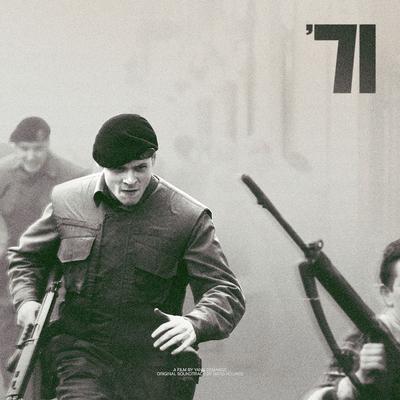
"71" Soundtrack Lyrics
Movie • 2014
Track Listing
Elmore James
Arthur Alexander
Wanda Jackson
Solomon Burke
Aphex Twins
Butch Moore
Lee Hazelwood
Jack Scott
"71" Soundtrack Description
Questions and Answers
- Who composed the score for '71?
- David Holmes wrote the original score — a tense, minimalist-electronic palette with guitar and percussion textures. (according to PRS for Music’s M Magazine)
- Is there an official score album?
- Yes. '71 (Original Soundtrack) was released by Touch Sensitive Records in October 2014 on vinyl and digital. (as listed on Discogs)
- Does the movie also use pre-existing songs?
- It does. Needle-drops include Elmore James’ “The Sky Is Crying,” Arthur Alexander’s “You Better Move On,” Solomon Burke’s “Cry to Me,” and Aphex Twin’s “Gwely Mernans.” (as noted by IMDb Soundtracks and WhatSong)
- Is the album a continuous suite or individual cues?
- Digital releases often present a long-form suite (one continuous 30+ minute program), while the vinyl splits the score across sides with titled cues. (according to Touch Sensitive / retailer notes)
- Did the score win awards?
- Yes — David Holmes won the 2015 Ivor Novello Award for Best Original Film Score for '71. (as reported by The Guardian)
- Where can I stream the score?
- It’s available on major platforms and Bandcamp under Touch Sensitive Records. (according to Touch Sensitive Records)
Notes & Trivia
- Holmes wrote much of the score before shooting; director Yann Demange likes to film with key musical ideas in place — a Morricone/Leone-style workflow. (according to Touch Sensitive Records)
- Stated influences include John Carpenter’s pulse writing and Tony Conrad’s droning string textures — you can hear both in the siren-like pads. (as described by Touch Sensitive Records)
- Vinyl edition (Touch Sensitive TSR001) arrived December 2014 as a hand-numbered pressing with download card. (as listed on Discogs)
- The film’s source cues span blues, country, soul and experimental electronica — a stark contrast to the score’s monochrome tension. (as noted by IMDb Soundtracks)
- The score later earned Holmes an Ivor Novello for Best Original Film Score. (as reported by The Guardian)
Overview
What does survival sound like when a city is split in two? Holmes answers with a score that breathes like a hunted heartbeat: low drones shifting under splintered guitar, toms that land like boots in a stairwell, and synths that tremble on the edge of feedback. It’s spare on melody, heavy on pressure — the musical equivalent of holding your breath as a door latch clicks.
The licensed songs — Elmore James, Arthur Alexander, Solomon Burke, Aphex Twin — aren’t nostalgic wallpaper but flashes of lived space: bar jukeboxes, radio bleed, a room’s private ritual. Against that diegetic color, the score stays cold and clear-eyed, mapping Gary Hook’s sprint through back alleys and betrayals. The result is a soundtrack that refuses easy heroics and instead keeps you in the moment-by-moment calculus of staying alive. (as stated in the 2014 Guardian review)
Genres & Themes
- Minimalist electronics ↔ Surveillance panic: Pulses and drones mimic the sensation of being tracked — rhythm as footfall.
- Post-rock guitar & toms ↔ Fight-or-flight: Dry drums and chime-guitars turn corners into cues; attacks bloom, then recede.
- Deep-heritage soul/blues needle-drops ↔ Ordinary life intruding: Warm voices and vintage grooves remind us this is a neighborhood, not a movie set.
- Ambient/noise textures ↔ Fog of war: Smears of synth/strings blur allegiance and geography — you feel lost with the protagonist.
Key Tracks & Scenes
“’71 (Main Suite)” — David Holmes
Where it plays: Long-form score suite spans chase/stalking passages across the mid-film (non-diegetic).
Why it matters: A continuous arc that trades themes for texture; it’s the film’s nervous system. (according to Touch Sensitive / digital listings)
“Gwely Mernans” — Aphex Twin
Where it plays: Interior sequence with a hushed, uneasy lull (diegetic placement as source-like ambience).
Why it matters: The modern electronic drone sits uneasily inside a 1971 setting, amplifying disorientation. (as listed on WhatSong)
“The Sky Is Crying” — Elmore James
Where it plays: Bar/room setting as respite pivots back to danger (diegetic).
Why it matters: Slide guitar ache mirrors the film’s grief undercurrent. (as noted by IMDb Soundtracks)
“You Better Move On” — Arthur Alexander
Where it plays: Transitional interior scene (diegetic).
Why it matters: Soft-voiced country-soul irony against street-level brutality. (IMDb Soundtracks)
“Cry to Me” — Solomon Burke
Where it plays: Low-light room sequence, characters reeling (diegetic).
Why it matters: Burke’s intimacy collapses the public battle into private fallout. (IMDb Soundtracks)
Track–Moment Index (compact)
| Song / Cue | Scene / Moment | Diegetic? | Approx. time |
|---|---|---|---|
| ’71 (Main Suite) — David Holmes | Chase/stalking passages | No | Mid film |
| Gwely Mernans — Aphex Twin | Hushed interior / uneasy lull | Source-like | Mid-late |
| The Sky Is Crying — Elmore James | Bar/room interlude | Yes | Early-mid |
| You Better Move On — Arthur Alexander | Quiet transitional scene | Yes | Mid |
| Cry to Me — Solomon Burke | Intimate aftermath | Yes | Late |
Music–Story Links (characters & plot beats as connected to songs)
- When Hook slips from soldier to ghost, Holmes’s drones flatten harmony into pressure — music that says “don’t be seen.”
- Blues and soul cues humanize rooms the plot might skim past; a jukebox needle-drop turns an “objective” space into someone’s living space.
- Aphex Twin’s ambient presence skews time — a deliberate temporal jolt that doubles the character’s disorientation.
- The drum-and-chime writing marks thresholds (doors, corners, stairwells); each motif is a crossed line with stakes attached.
How It Was Made (supervision, score, behind-the-scenes)
Holmes and Demange worked iteratively, with cues written before production so the camera could “chase” the music’s pulse on set. It’s an old-school idea (think Leone/Morricone) executed with modern electronics and mic’d percussion. Touch Sensitive’s notes cite John Carpenter and Tony Conrad as touchstones. (according to Touch Sensitive Records and retailer summaries)
The album’s release story splits by format. Vinyl (TSR001) arrived December 2014 as a limited, hand-numbered edition. Digital releases emphasize a long-form suite — a single 30+ minute program that mirrors the film’s one-night structure. (as listed on Discogs and Apple Music)
Reception & Quotes
The film earned wide critical praise; the score, in particular, was repeatedly singled out for its taut restraint and physical sense of space. Holmes took home the Ivor Novello for Best Original Film Score in 2015. (as reported by The Guardian and PRS for Music’s M Magazine)
“Holding it all together is David Holmes’s terrific score… plaintive melodies emerging from a bedrock of discord and disquiet.” The Guardian (2014 review)
“Pensive music score [that] moves believably within the action.” RogerEbert.com (review)
Technical Info
- Title: ’71 (Original Soundtrack)
- Year: 2014
- Type: Movie (original score + licensed songs in film)
- Composer: David Holmes
- Label / Cat. no.: Touch Sensitive Records — TSR001 (vinyl)
- Release notes: Vinyl issued Dec 2014; digital suite version available (one continuous program, ~30–35 minutes).
- Selected licensed placements (in film): Elmore James — “The Sky Is Crying”; Arthur Alexander — “You Better Move On”; Solomon Burke — “Cry to Me”; Aphex Twin — “Gwely Mernans”; Jack Scott — “Burning Bridges.”
- Awards: Ivor Novello Award — Best Original Film Score (2015).
- Availability: Vinyl and digital (Bandcamp/major streamers); region availability may vary.
Canonical Entities & Relations
| Subject | Relation | Object |
|---|---|---|
| David Holmes | composed | ’71 (Original Soundtrack) |
| Yann Demange | directed | ’71 (2014) |
| Touch Sensitive Records | released | ’71 (Original Soundtrack) — 2014 |
| Elmore James | performed | “The Sky Is Crying” (used in film) |
| Arthur Alexander | performed | “You Better Move On” (used in film) |
| Solomon Burke | performed | “Cry to Me” (used in film) |
| Aphex Twin | performed | “Gwely Mernans” (used in film) |
| Jack O’Connell | starred as | Gary Hook (’71) |
Sources: Touch Sensitive Records; Discogs; WhatSong; IMDb Soundtracks; The Guardian; PRS for Music’s M Magazine; RogerEbert.com.
The sole soldier was accidentally forgotten by his squad during dealing up with riots in England back in 1971. The history of the humanity and inhumanity of the various representatives of the race of our species. This is also about what can be done in the name of survival, and what others can make in the name of chaos. The film has received numerous awards and many critics commendably estimated its production, acting and the plot. Typically, such accolades mark those films where there is some kind of a war and the very humane protagonist, who immediately calls empathy to himself, by his nice character and those actions that he performs in the beginning, to bribe the viewer and make him feel the great warmth to the depicted personality. The music is chosen entirely authentic to spirit of the times, which are displayed on the screen. You will find in the collection such famous masters as Solomon Burke and Elmore James. The whole collection of the genre is almost entirely pop of old-style, as it was from 1950 to about the mid of 1985's. Old school in two words (e.g., Burning Bridges or Walking The Streets In The Rain). Slow flows of almost all the songs create a relaxed feeling. Or, as the calm before the storm, or as a real relaxation, which occurs everywhere in everyday life. In the collection there are some big hits, for example, Right Of Wrong, which give a complete picture of what music had the time of the depicted events. The plot of the film is simple at first glance – the person needs to survive only one night. But the first part of involved people do not help him and the second half, on the contrary, makes something good, even sometimes with a threat to their own lives. These high-quality and full-bodied motion pictures come out every few years, so you should definitely watch it.October, 22nd 2025
Visit '71' profile on IMDb, more info on WikipediaA-Z Lyrics Universe
Cynthia Erivo Popular
Ariana Grande Horsepower
Post Malone Ain't No Love in Oklahoma
Luke Combs Good Riddance (Time of Your Life)
Green Day Bye Bye Bye
*NSYNC You're the One That I Wan
John Travolta & Olivia Newton-John I Always Wanted a Brother
Braelyn Rankins, Theo Somolu, Kelvin Harrison Jr. and Aaron Pierre The Power of Love
Frankie Goes to Hollywood Beyond
Auli’i Cravalho feat. Rachel House MORE ›