Soundtracks:  A B C D E F G H I J K L M N O P Q R S T U V W X Y Z #


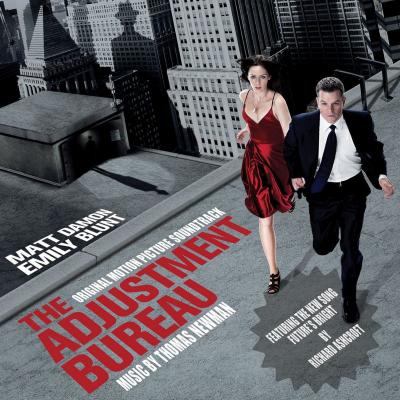
Adjustment Bureau, The Album Cover

"Adjustment Bureau, The" Soundtrack Lyrics

Movie • 2011

Track Listing


"Adjustment Bureau, The" Soundtrack: Description.

Adjustment Bureau, The lyrics, 2011
Adjustment Bureau, The — soundtrack trailer, 2011

What this soundtrack feels like

Short version — it’s Thomas Newman drawing a city map with vibraphone pins and string threads, weaving fate and romance into a single, breath-held line. The 2011 film may be a high-concept chase through doors that don’t behave, but the score keeps reaching for the human pulse under the cosmology. I remember the first cue that truly landed—quiet piano, a sighing string pad, then that sly rhythmic figure that feels like a second hand starting to sprint. You lean forward, the way you do when you feel watched…or guided. Not menacing, exactly. More like a gentle nudge from the universe saying, hey, this way. And yes, the songs help. A couple of needle-drops flick the film from metaphysical thriller to big-city love story for a minute. The contrast works. The score is the architecture; the songs are the scuffed shoes echoing through it.

Track Highlights

Doorways, rain, and that heartbeat-motif

The film turns New York into a maze of shortcuts—hats on, turn the knob, step from a courthouse to a baseball stadium like you cut a scene mid-sentence. Newman answers with pulsed ostinatos: marimba or muted piano repeating a cell until it starts to glow. When the agents flick doors open, the music gets glassy—high strings like fogged windows—and you feel the plan tightening around David and Elise.

Elise’s thread

There’s a gentler cue that keeps circling back, a fragile, lyrical line for Elise—violin leaning into piano, hesitant then brave. It doesn’t shout romance; it suggests choice, the kind that costs you something. Every time it returns, the city feels a notch more personal, less myth and more two people trying.

Chase cues that don’t grandstand

Instead of wall-to-wall percussion, Newman lets air in. The rhythm is there—footsteps, escalators, a train’s flicker—but mixed with woodwinds that question what’s happening, not just amplify it. You get speed without the movie yelling “Run!”

The song that walks you out

One cut in particular—Richard Ashcroft’s “Are You Ready?”—plays like a doorway in its own right. After all the cosmic bureaucracy and rule-breaking, the song feels like the film shrugging and smiling: okay, choose anyway. It’s not subtle, but it is earned.

Musical Styles & Themes

  • Textural minimalism: Repeating figures that accumulate tension, like rain filling a glass.
  • Urban translucence: Shimmering strings, piano harmonics, and mallet percussion that make the city seem see-through—every building a possible exit.
  • Romantic restraint: When the love theme arrives, it’s almost embarrassed to be heard; that’s why it works. No bombast, just resolve.
  • Orchestral with electronic lace: Acoustic core, electronic edges. Little pulses, faint synth beds, nothing that timestamps it too hard.
  • Motive logic: “Plan” motifs (precise, clocklike) vs. “choice” motifs (slightly asymmetrical, human). You can hear when fate is winning the scene.

Plot & Characters: why the music fits like a key

David Norris is a rising New York politician who meets Elise Sellas, a contemporary dancer, in the sort of wrong-room moment you tell friends later because it sounds scripted. It is, in a way. There’s a hidden organization—call them caseworkers of destiny—who nudge events to match “the Plan.” Hats on, doors open to anywhere. David wasn’t supposed to see Elise again; he does. Often. The Bureau keeps trying to separate them gently at first, then firmly. They warn him: choose love and you won’t become who you’re meant to be. Choose your career, and you’ll lose her. The chase is literal (through museums, across rooftops, inside civic labyrinths) and philosophical: free will versus design. By the end, after a breathless run through door after door as if the whole city were a filing cabinet, David and Elise force a rewrite of the Plan, or maybe just earn the right to write it themselves.

How the cues lock to scenes

  • Meet-cute in the wrong place: hushed piano and soft strings, like a secret whispered against an election-night roar.
  • Bus reunion: an uptick—marimba pulse under street noise, the sound of coincidence stretching into intention.
  • First Bureau reveal: glassy textures, plucked figures, a sense of something administrative yet supernatural.
  • Rain workaround: percussion dials back, woodwinds flicker—nature interrupting the Plan’s circuitry, as if the music itself glitches.
  • Final sprint through doors: ostinato blossoms into harmony; the theme finally stands upright. Choice, declared.

Production Notes

Composer

Thomas Newman, long-time architect of emotionally precise scores, leans into his signature palette—vibraphone, prepared piano touches, subtle electronics, warm but wary strings. It’s city music that never mistakes scale for meaning.

Director & adaptation

George Nolfi directs from his adaptation of a Philip K. Dick short story, trimming the paranoia into a love story frame. The score keeps that balance—mysterious but oddly tender.

Recording & sonic footprint

You can hear the space in it—close-miked piano hammers, breath in the woodwinds, a room large enough to hold the moral question without echoing it to death.

Behind the Scenes: the little human beats

Sometimes the best parts of a big-thesis movie are the small production choices. The Bureau’s doors demand a rhythmic language—music that suggests possible elsewhere without blasting a synth brass fanfare. Newman builds that with mallets and soft pulses, so when a character grabs a hat and bolts, the cue nudges your chest forward rather than shoving you. The film also loves movement: Elise is a dancer, David is always in transit. The score tracks bodies in motion—stairs, sidewalks, echoing hallways—never static, rarely grandstanding. If you’ve ever walked Manhattan aimlessly and felt like the city might redirect you, this is that feeling, bottled.
“It’s a love story disguised as a chase movie.”—the sort of line you hear in press rooms because, here, it’s actually true

Reception & Social Proof

Critical vibe

Critics tended to single out the score’s translucent tension—how it keeps things moving without turning sentiment syrupy. Even folks who came for the sci-fi mechanics stayed for the human pulse under the machinery.

Fans, in the wild

Some fans treat this album as a thinking-walk staple: put it on, step into your neighborhood like it’s full of secret doors. Others cling to the love theme because it’s not manicured within an inch of its life; it’s earnest, slightly rough, which fits two people trying to out-argue destiny.

FAQ

Who composed the score for “The Adjustment Bureau”?
Thomas Newman, bringing his signature minimalist textures and reflective piano writing.
Are there notable songs alongside the score?
Yes—most notably Richard Ashcroft’s “Are You Ready?”, which caps the film with a lift toward choice and risk.
What’s the film’s core theme and how does the music reflect it?
Free will versus design. The music contrasts clocklike pulses (the Plan) with more human, asymmetrical phrases (choice).
Is the soundtrack purely orchestral?
Primarily orchestral, but with understated electronic elements and mallet percussion threading the edges.
Does the album work outside the film?
It does—especially for late-night walks or focus sessions; it’s propulsive without shouting.

Technical Info

  • Soundtrack Title: The Adjustment Bureau (Original Motion Picture Soundtrack)
  • Year: 2011
  • Type: Movie score with select songs
  • Composer: Thomas Newman
  • Featured Artist: Richard Ashcroft (song placement)
  • Primary Genres: Film Score, Minimalism, Orchestral, Ambient
  • Running Mood: Suspenseful, ruminative, quietly romantic
  • Notable Instruments: Piano, strings, vibraphone/mallets, subtle electronics, woodwinds

Cast

Principal Cast (2011)

Leads
  • Matt Damon — David Norris, charismatic politician with a stubborn streak for choosing his own life.
  • Emily Blunt — Elise Sellas, contemporary dancer whose courage jolts the Plan off its rails.
The Bureau
  • Anthony Mackie — Harry Mitchell, the sympathetic caseworker wrestling with orders and conscience.
  • John Slattery — Richardson, dapper mid-level authority with a dry, rulebook stare.
  • Terence Stamp — Thompson (“the Hammer”), an enforcer who argues the brutal arithmetic of fate.
Supporting
  • Michael Kelly — Charlie Traynor, David’s friend and advisor anchoring the political side of the story.
  • Additional ensemble — campaign teams, dancers, caseworkers, New Yorkers who accidentally hold doors to impossible places.

Quotes & Little Truths

“All I have are the choices I make.”—David, in spirit if not exact punctuation
“We are the people who make sure things happen according to plan.”—An agent trying to sound comforting and failing

Why this soundtrack sticks

It’s the feeling of stepping through a door you’ve used a hundred times and finding sunlight falling at a new angle. That’s Newman’s trick here. He scores the hinge—that little gasp when possibility opens—and then lets two people decide.

September, 23rd 2025


A-Z Lyrics Universe

Lyrics / song texts are property and copyright of their owners and provided for educational purposes only.