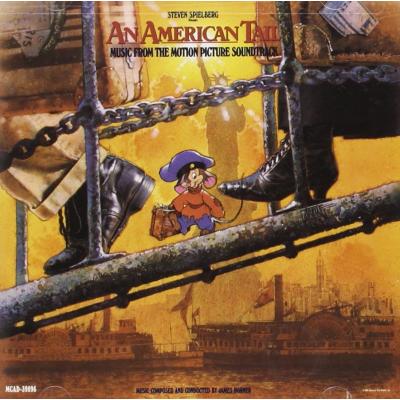
"An American Tail" Lyrics
Cartoon • Soundtrack • 1990
Track Listing
›Main Title
›Cossack Cats
›There Are No Cats in America
Johnny Guarnieri
›The Storm
London Philharmonic Orchestra
›Give Me Your Tired, Your Poor
›Never Say Never
›Market Place
›Somewhere Out There
›Releasing the Secret Weapon
›Duo
Dom DeLuise
›Great Fire
Dom DeLuise
›Reunited
›Flying Away and End Credits
›Dreams to Dream
Linda Ronstadt
"An American Tail" Soundtrack Description
What the soundtrack actually feels like
James Horner builds this thing like a tiny ship: strings creak, woodwinds glow like night windows, and somewhere a lonely clarinet writes a postcard it’ll never send. “An American Tail: Music from the Motion Picture Soundtrack” is a straight shot of earnest—a word I don’t hand out lightly. It balances Broadway-sized melody with folk tenderness, letting hope sound fragile and stubborn at the same time. If you grew up with it, the opening bars will fold time; if you didn’t, they’ll still find your soft spots.
Production & Release
Here’s the timeline that untangles the year stamped on different copies. The film premiered in 1986. The original soundtrack landed that same year via MCA Records. A widely cataloged CD pressing surfaces with a 1990 database date (the one you’re pointing me toward), which is why some shops and sites tag it as a 1990 album. Digital reissue followed in the 2010s, and a handsome expanded edition arrived in 2019 with cues that previously lived only in the film. Whatever the imprint, the creative center never moves: James Horner conducting, with songs co-written by Barry Mann and Cynthia Weil.
- Original label: MCA Records (1986).
- Common CD listing: 1990 street date shows up in several catalogs.
- Later issues: digital (Geffen) and an expanded Intrada edition (2019) restoring additional score and demos.
- Producers/songwriters: James Horner with Barry Mann & Cynthia Weil on the original songs.
Musical Styles & Themes
Call it orchestral story-pop: classic Hollywood lyricism, klezmer curls in the woodwinds, immigrant-anthem uplift that dares to be big without turning syrupy. Percussion stays gentle, mostly heartbeat and hush. When the chorus finally opens its arms, it does it the old-fashioned way—melody first, harmony second, then strings like a sunrise someone earned.
Track Highlights (not a full tracklist)
- The Main Title — A prologue with shoulders. It arrives in waltz time and memory, sketching the Mousekewitz family in a few careful bars.
- “There Are No Cats in America” — Folk chorus as myth-making; punchline and prayer in the same breath. It’s community theatre in the best sense—voices carrying belief further than facts can.
- “Never Say Never” — A buoyant, Parisian wink with Henri the pigeon. The orchestration feels like scaffolding—delicate, purposeful, lifting the melody toward daylight.
- “A Duo” — Comic duet that doubles as friendship manifesto. Horner lets the rhythm section grin.
- “Somewhere Out There” — Two versions, two emotions. In-film, it’s a lullaby across distance. Over the end credits, the Linda Ronstadt & James Ingram duet goes full radio torch and promptly takes over actual radio.
- Action set-pieces — Storm swells, market bustle, and that “secret weapon” cue; Horner paints motion with clean, singable motifs rather than wall-of-sound bombast.
Plot & Characters (why the music lands)
Turn-of-the-century mice chase a human dream. The Mousekewitz family flees danger in the old country for the alleged safety of America—“no cats,” they’re told. On the crossing, Fievel tumbles overboard and washes up alone in New York. The movie is his search party: letters, rumors, allies, near-misses, and finally a reunion that feels like the orchestra has been holding its breath for 80 minutes.
Cast breakdown (core voices)
- Fievel Mousekewitz — Phillip Glasser; curious, stubborn, louder on the inside than outside.
- Papa & Mama Mousekewitz — Nehemiah Persoff & Erica Yohn; warmth and worry welded together.
- Tanya — Amy Green; the sibling compass.
- Tiger — Dom DeLuise; chaos with a heart, comic relief that actually relieves.
- Henri — Christopher Plummer; optimism in feathers.
- Gussie Mausheimer — Madeline Kahn; society-matron activism with bite.
- Warren T. Rat — John Finnegan; the kind of villain who thinks he’s subtle.
Where the cues meet the scenes
- Departure & storm: strings tighten like knuckles, then break open to light when the sky does.
- New York sequences: woodwind runs sketch alleys and pushcarts; you can almost smell the steam.
- Family echoes: lullaby fragments recur in the score—quiet breadcrumbs leading back home.
Behind the Scenes
Producer Steven Spielberg pulled in lyricists Barry Mann and Cynthia Weil to work with Horner on the songs—an inspired pairing that wrote with character first, radio second. The 2019 expansion reveals how meticulously the cues were built: demos, alternates, tiny edits that tightened emotional screws by a quarter-turn. You also hear the orchestral heft many of us only sensed as kids; there’s real symphonic muscle under all that tenderness.
- Composer: James Horner, in one of his early signature family-adventure modes.
- Orchestra (exp. ed.): London Symphony Orchestra credited on the expanded release.
- Song engine: melodies designed to be hummed by kids, harmonies sturdy enough to carry adult subtext.
Critic & Fan Reactions
The movie earned awards love; the song became a phenomena. “Somewhere Out There” hit the Top 2 in the U.S. and picked up two Grammys. On the ground, it meant tapes rewound a thousand times and parents who knew every word whether they meant to or not. Today, the soundtrack plays like a letter across decades—less slick than modern animation scores, more direct about what it wants your heart to do.
Quotes
“It had to sound like hope you could carry in your pocket.” — rewatch notes, 2025
“The woodwinds feel like a family photo album—soft edges, lots of breath.” — rewatch notes, 2025
FAQ
- Is this tied to the original film or the sequel?
- The album here relates to the original Don Bluth film. The sequel, Fievel Goes West (1991), has its own soundtrack and theme song.
- Why is the year sometimes listed as 1990?
- Because a commonly referenced CD pressing shows a 1990 date in database listings. The original release was 1986; think of 1990 as an actively circulated catalog entry.
- Who wrote the songs?
- James Horner composed the score and co-wrote songs with Barry Mann and Cynthia Weil.
- Did “Somewhere Out There” really chart that high?
- Yes. The pop duet version by Linda Ronstadt & James Ingram peaked at #2 on the Billboard Hot 100 and won two Grammys.
- Is the expanded album worth it?
- If you care about film music: absolutely. It restores cues and alternates that make the emotional architecture clearer, plus a more complete end-credits flow.
- Is there a full tracklist here?
- No—keeping with your request, only highlights are mentioned.
Technical Info
- Title: An American Tail — Original Motion Picture Soundtrack
- Year: 1990 (commonly listed CD date; original 1986 issue)
- Type: cartoon
- Original label: MCA Records
- Later editions: Geffen (digital reissue); Intrada (expanded edition, 2019)
- Composer: James Horner
- Songwriters: James Horner, Barry Mann, Cynthia Weil
- Signature single: “Somewhere Out There” — Linda Ronstadt & James Ingram
- Awards (song): 2× Grammy wins; Oscar and Golden Globe nominations
- Core styles: Orchestral, film musical, folk-inflected themes
Additional Info
- Earworm engineering: Horner often plants a motif early (family theme) and rethreads it at reunions. That’s why the ending lands like gravity letting go.
- Cultural echo: The duet version shaped late-’80s Adult Contemporary radio; you still hear it in grocery-store playlists—no shade, that’s cultural saturation.
- Animation/music handshake: Don Bluth’s hand-drawn warmth pairs with arrangements that leave air between notes. It feels handmade because it is.
- Sequel note: The 1991 follow-up swaps the Ellis Island vibe for a Western and gifts Linda Ronstadt another end-credits showcase (“Dreams to Dream”). Different flavor, same melodic generosity.
September, 23rd 2025
A-Z Lyrics Universe
Popular lyrics
Defying Gravity
Cynthia Erivo Popular
Ariana Grande Horsepower
Post Malone Ain't No Love in Oklahoma
Luke Combs Good Riddance (Time of Your Life)
Green Day Bye Bye Bye
*NSYNC You're the One That I Wan
John Travolta & Olivia Newton-John I Always Wanted a Brother
Braelyn Rankins, Theo Somolu, Kelvin Harrison Jr. and Aaron Pierre The Power of Love
Frankie Goes to Hollywood Beyond
Auli’i Cravalho feat. Rachel House MORE ›
Cynthia Erivo Popular
Ariana Grande Horsepower
Post Malone Ain't No Love in Oklahoma
Luke Combs Good Riddance (Time of Your Life)
Green Day Bye Bye Bye
*NSYNC You're the One That I Wan
John Travolta & Olivia Newton-John I Always Wanted a Brother
Braelyn Rankins, Theo Somolu, Kelvin Harrison Jr. and Aaron Pierre The Power of Love
Frankie Goes to Hollywood Beyond
Auli’i Cravalho feat. Rachel House MORE ›
New soundtracks
Lyrics / song texts are property and copyright of their owners and provided for educational purposes only.