Soundtracks:  A B C D E F G H I J K L M N O P Q R S T U V W X Y Z #

List of artists: A B C D E F G H I J K L M N O P Q R S T U V W X Y Z #


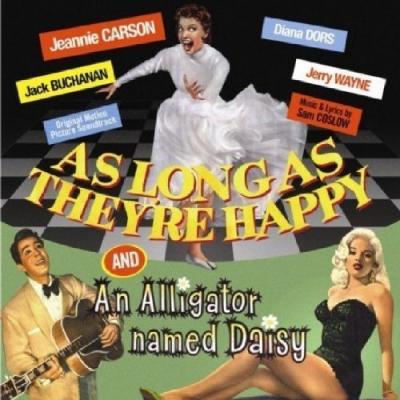
As Long as They're Happy Album Cover

"As Long as They're Happy" Lyrics

Musical • Soundtrack • 1955

Track Listing

Main Title Lyrics

Orchestra

You Started Something Lyrics

Jerry Wayne

I Don't Know Whether To Laugh Or Cry Over You Lyrics

Jerry Wayne

Quiet Little Rendezvous Lyrics

Jeannie Carson

Be My Guest Lyrics

Jerry Wayne

My Crazy Little Mixed Up Heart Lyrics

Jeannie Carson

Hokey-Pokey Polka Lyrics

Diana Dors

Cry Lyrics

Jack Buchanan

Liza's Eyes Lyrics

Jerry Wayne

I Don't Know Whether To Laugh Or To Cry Over You Lyrics

Jack Buchanan

My Crazy Little Mixed Up Heart Lyrics

Jeannie Carson

I Don't Know Whether To Laugh Or Cry Over You Lyrics

Jeannie Carson

In Love For The Very First Time Lyrics

Jeannie Carson

Your First Love Was Your Last Lyrics

Ronnie Stevens

Midnight Madness Lyrics

Jeannie Carson

The Crocodile Crawl Lyrics

Ken Mackintosh

A Kiss and Cuddle Lyrics

Diana Dors

A Shoulder To Weep On Lyrics

Jeannie Carson

Close Your Eyes Lyrics

Jeannie Carson

I Feel So Mmm Lyrics

Diana Dors


"As Long as They're Happy" Soundtrack Description

The British “crying-crooner” satire that doubles as a time-capsule album

I hit play expecting froth and found craft. The music for As Long as They’re Happy lands like a wink that knows its harmony—songs written to rib a pop craze, wrapped in a studio-orchestra glow. You get brisk novelty numbers, a couple of proper ballads, and interludes that feel like someone opened the theatre curtains early. The film teases the Johnnie Ray phenomenon; the soundtrack gives that tease a melody, then lets a pro band color in the margins.

Production & Context

This is a 1955 British musical-comedy directed by J. Lee Thompson, adapted from Vernon Sylvaine’s hit West End play. The screen update kept marquee charm (Jack Buchanan returning to suave-duty) and added a pop-culture hook: an American heartthrob singer, “the Crying Crooner,” descending on an English household and turning sense into static. Behind the music, two names matter. First, Stanley Black—credited with the film’s music direction—brings the big-band-to-cinema polish. Second, Sam Coslow—veteran songwriter—penned the original songs that everyone keeps humming. Decades later, the cues and numbers were compiled on disc (paired with An Alligator Named Daisy) so the whole thing could live like an album instead of a memory.

Musical Styles & Themes

Three threads run through the listening:
  • Show-tune briskness: Coslow writes compact, stage-ready songs—clean setups, quick payoffs, rhyme schemes that snap shut like a coin purse.
  • Studio-orchestra sheen: Black’s camp—strings, woodwinds, and brass in neat tailoring—keeps the comedy feeling plush. Even the gags get good lighting.
  • Parody with affection: a pastiche of sob-ballad drama (tears, tremolo, spotlight) that pokes fun without sneering. The music is the joke—and the alibi.
Underneath, the album keeps circling one idea: celebrity crush as family earthquake. Fast numbers sell the frenzy; ballads sell the fantasy; reprises tidy the living room after the squeals.

Track Highlights & Scene Pairings

No full tracklist—we’re staying with the spine.
  • “You Started Something” (Jerry Wayne): our crooner’s calling card. Light on its feet, instantly singable, it frames Bobby Denver as both dream and disruption. On screen it reads like a smile that overstays.
  • “I Don’t Know Whether to Laugh or Cry (Over You)” (multiple reprises): the premise in one hook—half swoon, half sob. Each reprise tweaks the joke: sometimes heartfelt, sometimes purposely over-egged.
  • “My Crazy Little Mixed-Up Heart” (Jeannie/Jeannie Carson): fizzy adolescent rush sung like a diary with exclamation points. It sells sister-dynamics better than dialogue does.
  • “Hokey-Pokey Polka” (Diana Dors & Jack Buchanan): novelty sparkle with a wink; choreography you can hear. The record keeps the grin even without the picture.
  • “Be My Guest” (Jerry Wayne): the hospitality number that doubles as a power move—sugar on the surface, spotlight control underneath.
  • “Cry” (Jack Buchanan): a straight-faced tilt at the very style the film is ribbing. The joke only lands because the arrangement behaves itself.
  • “Main Title/Ouverture” (orchestra): brass announces farce with good manners; woodwinds signpost the house-rules before the plot breaks them.

Plot & Characters

A stockbroker, John Bentley, runs a tidy home until American chart idol Bobby Denver gets misdirected into his living room. Three daughters (of varying ages, opinions, and crush velocities) and one long-suffering wife later, chaos arrives in waves: doorbells, fainting fits, confusion, then plans to restore peace. The soundtrack shadows each beat: romantic patter for frantic crushes, loungey croon for the celebrity bubble, and nimble orchestration for Dad’s rising blood pressure.
Cast breakdown (1955, principal)
  • Jack Buchanan — John Bentley (the unamused paterfamilias with immaculate timing)
  • Jerry Wayne — Bobby Denver (the “Crying Crooner,” very aware of his eyelashes)
  • Brenda De Banzie — Stella Bentley (household ballast)
  • Janette Scott — Gwen Bentley (youngest, most besotted)
  • Jeannie Carson — Pat Bentley (song-ready middle sister)
  • Susan Stephen — Corinne Bentley (the driest wit in the room)
  • Diana Dors — Pearl Delaney (guest-star fizz; steals her minutes)
  • Joan Sims — Linda (faints on cue when the crooner croons)
  • Plus Athene Seyler, Hugh McDermott, David Hurst, Gilbert Harding (as himself), and uncredited surprises like Norman Wisdom popping in like confetti.
How the music tags them
  • Bobby Denver: strings that lean in and a microphone made of velvet; every cadence engineered for applause.
  • Gwen/Pat/Corinne: ascending lines, patter rhythms, and “shuffle-the-furniture” codas—teen energy with choreography.
  • John Bentley: brisk orchestral cues that tidy the room after the chorus; little comic fanfares for wounded dignity.
  • Pearl Delaney: brass with lipstick; entrances that sound like spotlights turning.

Behind the Scenes

The play ran 370 performances in the West End, so the film inherited an audience and timing. Producer Raymond Stross bought the rights fast, keeping Buchanan in place and initially dreaming (publicly) of a Sinatra for the crooner slot before landing Jerry Wayne—who’d been Sky Masterson in the London Guys and Dolls. J. Lee Thompson shoots in Eastmancolor at Pinewood and fills the edges with a who’s-who of British character talent. On the music side: Stanley Black is credited with music direction; Sam Coslow writes eight songs designed to be short, sharp, and eminently reprise-able. In the record bins, the material appeared across HMV 10-inch vinyl/EPs in the ’50s and later as a tidy CD coupling, which is how most folks hear it now.

Quotes

“A hearty and good-hearted romp, without much attention to storyline.”Variety
“Frantic farce… a patchy but sometimes funny star vehicle.”Leslie Halliwell
“The film can’t fail to please farce lovers.”Picture Show

Critic & Fan Reactions

Then: critics shrugged at the plotting but tipped hats to performances and to the timely ribbing of sob-sing culture. Now: soundtrack collectors and British-cinema devotees treat the songs like postcards from a very specific industry moment—stage stars sliding onto color film, a London studio band playing Hollywood, and a pop fad getting roasted while it’s still hot. The modern CD reissue made it easy to hear the gags land without the visuals, which only flatters Coslow’s economy and Black’s polish.

Technical Info

  • Type: Musical film (British)
  • Title: As Long as They’re Happy
  • Year: 1955
  • Director: J. Lee Thompson
  • Based on: the 1953 play by Vernon Sylvaine
  • Music direction: Stanley Black
  • Songs: Sam Coslow (eight originals written for the film)
  • Principal cast (selected): Jack Buchanan, Jerry Wayne, Brenda De Banzie, Janette Scott, Jeannie Carson, Susan Stephen, Diana Dors, Joan Sims
  • Runtime (film): ~91 minutes
  • Original record issues: HMV/Gramophone Company 10-inch/EP era releases; later compilation on CD (paired with An Alligator Named Daisy)

FAQ

Is this a full-blown musical or a comedy with songs?
Somewhere between. The play’s farce bones remain, but Coslow’s numbers and Black’s orchestral treatment thread through enough scenes to feel like a musical proper.
Who actually wrote the songs?
Sam Coslow. The screen credit and later album notes point to him for the original numbers, with Stanley Black credited for the film’s musical direction and orchestral polish.
Was Bobby Denver based on a real singer?
He’s a loving jab at the 1950s “crying crooner” craze (think Johnnie Ray). The film has fun with the fan hysteria and the sob-style delivery.
Can I hear the soundtrack today?
Yes—the selections circulate on a CD coupling with An Alligator Named Daisy, gathering the key songs and several orchestral cues.
Does Diana Dors sing on the album?
She does—most memorably on the frothy “Hokey-Pokey Polka,” opposite Jack Buchanan, plus a bonus single on certain reissues.
Any surprising cameos on the film side?
Plenty—Gilbert Harding as himself, Joan Sims, Charles Hawtrey, and even a blink-and-miss uncredited Norman Wisdom.

Additional Info

  • Jerry Wayne (Bobby Denver) had just played Sky Masterson in London’s Guys and Dolls, so the mic swagger wasn’t borrowed—it was baked in.
  • Producer Raymond Stross reportedly chased transatlantic casting for the crooner before settling on Wayne; the role works better as a type than a cameo anyway.
  • The play’s long run (370 performances) meant the film inherited timing and gags already sharpened in front of paying audiences.
  • Collectors watch for HMV ten-inch pressings; everyone else is fine with the later CD that corrals the cues and the key songs in one place.
  • Best quick listen? “You Started Something” → “My Crazy Little Mixed-Up Heart” → “Hokey-Pokey Polka” → the “Laugh or Cry” reprise. That’s the arc, compact.

September, 24th 2025


A-Z Lyrics Universe

Lyrics / song texts are property and copyright of their owners and provided for educational purposes only.