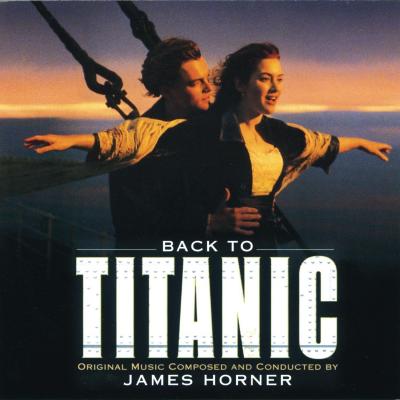
"Back To Titanic" Soundtrack Lyrics
Movie • 1998
Track Listing
›Titanic Suite (Instrumental)
Cambridge Choristers of King's College
›Irish Party in Third Class
Gaelic Storm
›Alexander's Ragtime Band (Instrumental)
I Salonisti
›Portrait (Instrumental)
James Horner
›Jack Dawson's Luck (Instrumental)
›Building Panic (Instrumental)
James Horner
›Nearer My God to Thee (Instrumental)
I Salonisti
›Come Josephine, In My Flying Machine
Maire Brennan
›Lament (Instrumental)
James Horner
›Shore Never Reached (Instrumental)
The London Symphony Orchestra
›My Heart Will Go On (Dialogue Mix)
Celine Dion
›Nearer My God to Thee (Instrumental)
Eileen Ivers
›Epilogue-The Deep and Timeless Sea
Cambridge Choristers of King's College
"Back To Titanic" Soundtrack Description

"Back To Titanic" Soundtrack: Description
Background
What this album adds that the first one didn’t
- Big-picture storytelling via the two suites, not just cues trimmed to film edit points.
- Source music married to narrative memory: Irish dance and parlor tunes placed intentionally, not as novelties.
- Performers foregrounded—voices and instruments named, timbres you can pick out like characters.
Track Highlights & Scene Pairings
No complete tracklist here—you’ve got it—but these moments still echo:- “Titanic Suite” A 19-minute panorama. Themes braid and unbraid; Sissel’s vocal threads in like foghorn light. It’s the film’s heart without the film’s cuts—breathing room at last.
- “An Irish Party in Third Class” The dance scene that sold half the audience on Jack’s world. Fiddles fly, bodhrán thumps, and you feel floorboards flexing under boots. It’s joy without apology.
- “The Portrait” Horner at the piano, unguarded. Simple lines, bare hands—no orchestra to hide behind. The intimacy matches the scene’s hush and heat.
- “A Building Panic” The mechanical churn of disaster; orchestral blocks move like bulkheads. It doesn’t scream—just marches forward with terrible certainty.
- “Come Josephine, in My Flying Machine” A century-old tune sung with a modern ache. Hope in a melody tinier than the ocean, which is exactly why it lands.
- “My Heart Will Go On (with dialogue)” Love theme plus voices from the film, the memory pressed between glass. Sentimental? Sure. Also effective.
- “Epilogue – The Deep and Timeless Sea” Not an encore so much as acceptance. The hymn, the love, the loss—all present, all quieter. You walk out not triumphant, but whole.
| Scene/Memory | How the music reframes it |
| The third-class dance | Folk set turns into social x-ray—class, heat, oxygen. The track carries scuffed shoes and laughter you can’t pack away. |
| The drawing | Piano solo shrinks the ship to a room; every note is a breath you either take or miss. |
| The collision and aftermath | Motivic cells stack like steel plates. No melodrama—just the slow tilt into cold water. |
| Old Rose’s recall | The epilogue paints memory as architecture: choir like windows, strings like stairwells, a voice moving through. |
Musical Styles & Themes
- Symphonic recollection—long-form suites that let themes converse. Less cutting, more unfolding.
- Celtic-inflected color—uilleann pipes, fiddle, whistle, and dance forms we already associate with Jack’s side of the ship.
- Hymnody & choir—King’s College voices used as light rather than weight; sacred color shading secular love.
- Source music as world-building—I Salonisti’s salon pieces and steerage jigs aren’t asides; they are the ship’s two soundscapes.
- Vocalise as time machine—Sissel’s wordless melodies blur distance; the music feels “now” and “then” at once.
Production & Behind-the-Scenes
- Composer/producer—James Horner kept the wheel, shaping the album as its own narrative rather than a studio sweepings bin.
- New recordings—London Symphony Orchestra with the Choristers of King’s College captured the new suites and select cues at AIR Studios Lyndhurst Hall in London—roomy acoustics, plush detail.
- Featured performers—Sissel (vocalise), Eileen Ivers (fiddle), Eric Rigler/Tony Hinnigan (pipes/whistles), Máire Brennan (lead on that turn-of-the-century song), Gaelic Storm (steerage band), I Salonisti (first-class salon ensemble).
- Design choice—including one version of the love theme with film dialogue. It risks corn; it earns context.
- Why a second album?—there was simply more story to tell in music: the long arc, the parlor and pub, the true end.
Plot & Characters
You know the film: star-crossed lovers on a doomed ship; class systems creak; ice doesn’t care. What this album does is tilt the focus to how it’s remembered—especially by Rose, who narrates as if memory were a climate more than a chronology.Character reads (and what the music does with them)
Rose DeWitt Bukater
Strings and soprano shape her inner weather: dignity, rebellion, the ache of endurance. The suites revolve around her gravity.Jack Dawson
Fiddle, pipes, and dance energy mark his world. When those colors dye the orchestra, you feel his presence in rooms he never entered.Cal Hockley
Salon music as surface sheen—controlled tempos, polite ornament. It’s the sound of money keeping score.Old Rose
The choir steps in here: age without brittleness, memory with light around the edges.Critic & Fan Reactions
- Commercially, it was no small shadow—debuted strong and climbed higher the next week. It went platinum in the U.S., racked up certifications across Europe, Canada, and Japan.
- Score fans took to the long cues. The 19-minute suite and the epilogue weren’t just extensions; they felt like the way this music always wanted to breathe.
- Casual listeners gravitated straight to the hits—“Irish Party,” “Portrait,” the dialogue-laced love theme—then circled back for the slow, ocean-sized stuff.
Quotes
“Music was such an integral part of the dramatic and emotional impact of ‘Titanic’… I felt compelled to encourage James to create a second album.” — James Cameron
“I composed the two suites as one single musical entity… a symphony in two movements, based on Rose and her memories.” — James Horner
“Sony… gave him carte blanche for the second CD. Together, we assembled ‘Back to Titanic.’” — James Horner
Technical Info
- Release date: August 25, 1998
- Label: Sony Classical / Sony Music
- Type: Movie soundtrack (sequel/companion to the 1997 album) with newly recorded suites and select source cues
- Recording: AIR Studios Lyndhurst Hall, London; new performances by the London Symphony Orchestra and the Choristers of King’s College
- Key performers: Sissel (vocalise), Eileen Ivers (fiddle), Máire Brennan (vocal), Gaelic Storm, I Salonisti, Eric Rigler & Tony Hinnigan (pipes/whistles)
- Notable inclusions: “Titanic Suite,” “The Portrait,” “An Irish Party in Third Class,” “A Building Panic,” “Come Josephine, in My Flying Machine,” “My Heart Will Go On (with dialogue),” “Epilogue – The Deep and Timeless Sea”
- US charts: Billboard 200 peak No. 2 (following a No. 7 debut)
- Certifications: RIAA Platinum (US); multi-territory awards including Canada 3×Platinum, Japan Platinum, UK Gold, Germany Gold, Switzerland Gold, Netherlands Platinum, France 2×Gold, Australia Gold
- Reissue note: Bundled with the original album in the 2012 Collector’s Anniversary Edition for the film’s 3D re-release
FAQ

- Is this just unused score from the first album?
- No. It mixes previously unreleased material with newly recorded suites and carefully chosen source pieces.
- Who’s singing those wordless lines?
- Sissel, the Norwegian soprano whose timbre became the score’s breath and halo.
- Does it include music from the steerage party?
- Yes. The Irish dance set appears here in album form, performed by the same band you see on screen.
- Is “The Portrait” the same as in the film?
- It’s a focused piano performance—lean and intimate—matching the scene’s tenderness without orchestral dressing.
- Where was the new material recorded?
- In London, with the LSO and King’s College Choristers, captured in AIR Lyndhurst’s generous acoustic.
- How did it perform commercially?
- It reached No. 2 in the US and earned platinum/gold certifications across multiple countries.
Additional Info
- The follow-up album effectively canonized “The Portrait” piano version—later releases kept that intimacy front and center.
- Those Irish sets weave traditional tunes inside Horner’s architecture; if you recognize “John Ryan’s Polka” or “Blarney Pilgrim,” that’s not an accident.
- The epilogue title isn’t coy. It’s a thesis: memory outlives metal; love outlives maps.
- If you only know the radio hit, try the suite end to end at night. No shuffle, just tide.
September, 24th 2025
A-Z Lyrics Universe
Popular lyrics
Defying Gravity
Cynthia Erivo Popular
Ariana Grande Horsepower
Post Malone Ain't No Love in Oklahoma
Luke Combs Good Riddance (Time of Your Life)
Green Day Bye Bye Bye
*NSYNC You're the One That I Wan
John Travolta & Olivia Newton-John I Always Wanted a Brother
Braelyn Rankins, Theo Somolu, Kelvin Harrison Jr. and Aaron Pierre The Power of Love
Frankie Goes to Hollywood Beyond
Auli’i Cravalho feat. Rachel House MORE ›
Cynthia Erivo Popular
Ariana Grande Horsepower
Post Malone Ain't No Love in Oklahoma
Luke Combs Good Riddance (Time of Your Life)
Green Day Bye Bye Bye
*NSYNC You're the One That I Wan
John Travolta & Olivia Newton-John I Always Wanted a Brother
Braelyn Rankins, Theo Somolu, Kelvin Harrison Jr. and Aaron Pierre The Power of Love
Frankie Goes to Hollywood Beyond
Auli’i Cravalho feat. Rachel House MORE ›
New soundtracks
GOAT
Supergirl
Avatar: Fire and Ash
Nativity 2: Danger in the Manger!
How to Train Your Dragon (Movie)
Wicked: For Good. The Original Score
Wicked: For Good
Candyman
From the World of John Wick. Ballerina
Kiss of the Spider Woman (Movie)
Sinners
TRON: Ares
F1 The Album
Red Clay
Zootopia 2
ZOMBIES 4: Dawn of the Vampires
KPop Demon Hunters
MORE ›
Lyrics / song texts are property and copyright of their owners and provided for educational purposes only.