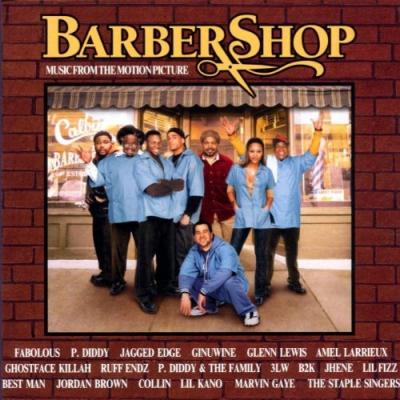
"Barbershop" Soundtrack Lyrics
Movie • 2002
Track Listing
›The Speech (Intro)
Cedric The Entertainer & Ice Cube
›Trade It All (Part 2)
Fabolous, P. Diddy & Jagged Edge
›Stingy
Ginuwine
›What's Come Over Me?
Glenn Lewis & Amel Larrieux
›Love Session
Ghostface Killah (feat. Ruff Endz)
›And We
P. Diddy, Black Rob, Big Azz, Ko-Kaine, G. Dep, Foxy Brown, Craig Mack
›Could've Been You
3LW
›Baby Girl (Terri's Theme)
B2K
›Sneaky
Jhene (feat. Lil Fizz Of B2K)
›I See You
Best Man
›Better To Leave
Jordan Brown
›Baby, Baby, Baby
Collin
›Ben
Lil Kano
›Got To Give It Up (Part 1)
Marvin Gaye
›I'll Take You There
The Staple Singers
›Big Booty Girls (Outro)
Ice Cube, Michael Ealy, Leon Collier Jam, Ray Thomps
"Barbershop" Soundtrack Description

FAQ
- Is there an official soundtrack album?
- Yes — released August 27, 2002 as BarberShop (Music From the Motion Picture), a hip-hop/R&B compilation tied to the film’s release.
- Who composed the score?
- Terence Blanchard composed the original score, adding jazzy, organ-kissed cues between songs.
- What song diffuses the near fight outside the shop?
- Marvin Gaye’s “Got to Give It Up (Part 1),” used diegetically — it turns tension into a sidewalk dance break.
- What track makes everyone in the shop start bobbing their heads?
- EPMD’s “You Gots to Chill,” a classic built on Zapp/Kool & the Gang samples, spins in the shop and unites the room.
- Which song plays while Isaac cuts Jimmy’s hair?
- Mr. Cheeks’ “Lights, Camera, Action!” — a swagger cue under a key chair-time moment.
Additional Info
- The album hit #1 on Billboard’s Top Soundtracks and #29 on the Billboard 200; lead single “Stingy” (Ginuwine) reached #33 Hot 100 / top-10 R&B.
- Label credits list Sony Music Soundtrax/Epic; the disc accompanied the film’s U.S. release on September 13, 2002.
- Music supervision: Paul Stewart; original score by Terence Blanchard.
- Recording work for songs stretched across Battery Studios, Daddy’s House, Hit Factory and other early-2000s hubs.
- The mix leans heavily on Chicago soul/funk staples (Marvin Gaye, Tyrone Davis, James Brown) alongside then-current R&B and rap.
- Available on major streamers today; digital editions vary by region.

Overview
Why does Marvin Gaye crash a neighborhood squabble — and why does it work? Because Barbershop treats music like community glue. The soundtrack floats between crate-dug soul and radio-ready R&B/hip-hop so the shop can feel both timeless and of-its-moment. Across a single Chicago day, songs mostly play on radios and in rooms, not from the heavens. That choice matters: diegetic cuts turn customers into a chorus and barbers into DJs. Where the songs stop, Terence Blanchard’s warm, jazz-tinged score quietly carries the conversations, keeping the floor humming.Genres & Themes
- 70s soul & funk → neighborhood cohesion: danceable grooves (“Got to Give It Up”) lower the temperature and pull folks outside to move together.
- Golden-era hip-hop → shop rhythm: head-nod classics (EPMD) mirror the cut-and-reply banter of the chairs.
- Turn-of-the-century R&B → romance & reflection: sleek mid-tempos (“Stingy”) color softer beats between dust-ups.
- Jazzy score cues → character intimacy: organ and small-combo textures keep personal stakes close, never showy.

Key Tracks & Scenes
- “Got to Give It Up (Part 1)” — Marvin Gaye
- Where it plays: Diegetic; a tense exchange outside melts into a neighborhood dance moment as the track takes over.
- Why it matters: Converts conflict to release; the song models the film’s thesis that shared groove can reset a room.
- “You Gots to Chill” — EPMD
- Where it plays: In-shop spin; barbers and customers start nodding along, beat syncing the room.
- Why it matters: A hip-hop evergreen built on Zapp/Kool & the Gang samples — perfect shorthand for collective head-space.
- “Lights, Camera, Action!” — Mr. Cheeks
- Where it plays: During Isaac’s cut on Jimmy — diegetic energy while skill and bravado meet in the chair.
- Why it matters: Underscores acclimation and respect in real time; swagger without drowning dialogue.
- “Stingy” — Ginuwine
- Where it plays: Featured as the album’s lead single; used non-diegetically in promotion/needle-drops around softer character beats.
- Why it matters: The radio hit that carried the album — a glossy counterweight to the shop’s gritty classics.
- “In the Mood” — Tyrone Davis
- Where it plays: Heard in the film as part of the shop’s soul bed.
- Why it matters: A Chicago staple that roots the movie’s sound in local tradition.
Music–Story Links (characters & plot beats as connected to songs)
- When street heat rises, “Got to Give It Up” flips bodies from squared-off to side-stepping — the narrative literally changes tempo.
- Isaac’s chair win lands over “Lights, Camera, Action!”; the beat narrates his confidence arc as hands and clippers find rhythm.
- Shop-floor unanimity snaps into place with “You Gots to Chill”; the sample-heavy groove mirrors the film’s collage of voices.
- R&B singles like “Stingy” soften edges around domestic stakes, letting romance and responsibility coexist between comic flourishes.

How It Was Made (supervision, score, behind-the-scenes)
- Score: Terence Blanchard, with small-group colors and Hammond B-3 organ in the toolkit, threading cues between needle-drops.
- Music supervision: Paul Stewart coordinated clearances and selections that mix catalog soul/funk with contemporary hip-hop/R&B.
- Recording pipeline (songs): sessions and mixes travelled through early-’00s strongholds like Battery Studios, Daddy’s House, Hit Factory, and more.
- Design choice: Keep most songs diegetic — radios and room systems — so music feels like a shop fixture, not a narrator.
Reception & Quotes
- Critics praised the film’s conversational rhythm and how music sustains the day-in-the-life flow; fans gravitated to the album’s blend of classics and then-new radio cuts.
“There is a kind of music to their conversations… they play with one another like members of an orchestra.” Roger Ebert
“An amiable and entertaining comedy…” The Hollywood Reporter
“…stocks more quality players than the entire film cast.” The Austin Chronicle (music column)
Technical Info
- Title: BarberShop (Music From the Motion Picture)
- Year: 2002
- Type: movie
- Composers (score): Terence Blanchard
- Music supervision: Paul Stewart
- Selected notable placements: “Got to Give It Up (Part 1)” (Marvin Gaye); “You Gots to Chill” (EPMD); “Lights, Camera, Action!” (Mr. Cheeks); “Stingy” (Ginuwine); “In the Mood” (Tyrone Davis)
- Release context: Soundtrack dropped August 27, 2002; film opened September 13, 2002 (U.S.).
- Label / album status: Sony Music Soundtrax / Epic; officially released on CD and digital; currently streamable.
- Availability / chart notes: Peaked #1 Top Soundtracks, #9 Top R&B/Hip-Hop Albums, #29 Billboard 200; “Stingy” reached #33 Hot 100.
September, 26th 2025
A-Z Lyrics Universe
Popular lyrics
Defying Gravity
Cynthia Erivo Popular
Ariana Grande Horsepower
Post Malone Ain't No Love in Oklahoma
Luke Combs Good Riddance (Time of Your Life)
Green Day Bye Bye Bye
*NSYNC You're the One That I Wan
John Travolta & Olivia Newton-John I Always Wanted a Brother
Braelyn Rankins, Theo Somolu, Kelvin Harrison Jr. and Aaron Pierre The Power of Love
Frankie Goes to Hollywood Beyond
Auli’i Cravalho feat. Rachel House MORE ›
Cynthia Erivo Popular
Ariana Grande Horsepower
Post Malone Ain't No Love in Oklahoma
Luke Combs Good Riddance (Time of Your Life)
Green Day Bye Bye Bye
*NSYNC You're the One That I Wan
John Travolta & Olivia Newton-John I Always Wanted a Brother
Braelyn Rankins, Theo Somolu, Kelvin Harrison Jr. and Aaron Pierre The Power of Love
Frankie Goes to Hollywood Beyond
Auli’i Cravalho feat. Rachel House MORE ›
New soundtracks
GOAT
Supergirl
Avatar: Fire and Ash
Nativity 2: Danger in the Manger!
How to Train Your Dragon (Movie)
Wicked: For Good. The Original Score
Wicked: For Good
Candyman
From the World of John Wick. Ballerina
Kiss of the Spider Woman (Movie)
Sinners
TRON: Ares
F1 The Album
Red Clay
Zootopia 2
ZOMBIES 4: Dawn of the Vampires
KPop Demon Hunters
MORE ›
Lyrics / song texts are property and copyright of their owners and provided for educational purposes only.