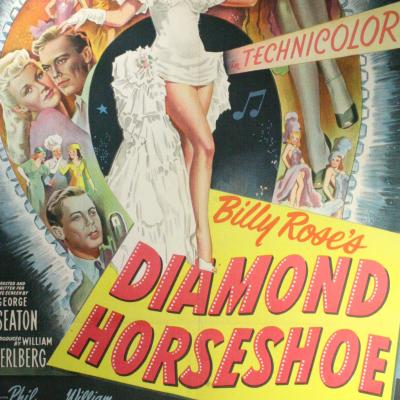
"Billy Rose's Diamond Horseshoe" Soundtrack Lyrics
Musical • 1945
Track Listing
"Billy Rose's Diamond Horseshoe" Soundtrack Description
Questions and Answers
- Is there an official soundtrack album from 1945?
- No dedicated 1945 OST album is known; individual songs (e.g., Dick Haymes’ “The More I See You”) were issued as singles and later appear on compilations.
- Which new standards did the film introduce?
- Harry Warren & Mack Gordon’s “The More I See You” (introduced by Dick Haymes) and “I Wish I Knew” became enduring standards.
- Who handled the film’s music behind the scenes?
- Songwriters Harry Warren (music) & Mack Gordon (lyrics); Alfred Newman served as Fox music director; Herbert W. Spencer orchestrated/arranged; David Buttolph provided additional music.
- Where was it set and filmed?
- Inside Billy Rose’s famed Diamond Horseshoe nightclub, recreated in Technicolor at 20th Century-Fox; the real club operated beneath Manhattan’s Paramount Hotel.
- Does “The More I See You” recur beyond the serenade?
- Yes. It’s introduced by Haymes and recurs as opening/overture material and incidental cues across scenes.
- Can I stream the key numbers today?
- Yes. Various performances and recordings (e.g., Dick Haymes singles; later covers) are widely available on major platforms.
Additional Info
- “The More I See You” and “I Wish I Knew” were written specifically for the film and issued on 78 rpm singles in 1945.
- Haymes introduces “The More I See You” on screen; the melody also appears under the opening credits as an overture motif.
- The picture’s musical numbers were staged to evoke the real Diamond Horseshoe’s lavish revues under impresario Billy Rose.
- Alfred Newman oversaw music at Fox during this period; Herbert W. Spencer’s orchestrations lean brighter and jazzier than his later symphonic work.
- The venue portrayed in the film is the same basement space later revived as Sony Hall—still beneath the Paramount Hotel in Times Square.
- Expect medley-style stage numbers (“Welcome to the Diamond Horseshoe,” “Cooking Up a Show”) alongside crooner ballads.
- “The More I See You” became a pop staple and jazz standard; Chris Montez’s 1966 cover reignited its chart life (as stated in several chart histories).
Overview
Why does a nightclub movie play like a pop song factory? Because Billy Rose’s Diamond Horseshoe pairs Fox’s Technicolor spectacle with new material from ace songwriters Harry Warren and Mack Gordon. The score slides between show-club razzle (“Welcome to the Diamond Horseshoe”) and velvet ballads that let Dick Haymes croon opposite Betty Grable.
The film treats the club as a narrative engine: numbers aren’t detours, they’re plot currency. Romantic feints, father–son tension, and show-biz temptations surface mid-routine. That’s why its signature ballad, “The More I See You,” threads the whole movie—overture, serenade, reprise—until it feels like the characters are living inside a tune (as noted in the AFI Catalog and film summaries).
Genres & Themes
- Big-band showpieces → social glitter: brass and bright reeds signal the Diamond Horseshoe’s high-society fantasy.
- Crooner ballads → intimate confessions: Haymes’ warm baritone turns public serenades into private vows.
- Latin-flavored interludes → escapist sparkle: cues like “In Acapulco” dab tropical hues onto backstage intrigue.
- Reprise-as-commentary → story stitching: returning motifs (“The More I See You”) mark shifting loyalties and softening stances.
Key Tracks & Scenes
“The More I See You” — Dick Haymes
Where it plays: Introduced by Haymes in-club as a direct serenade to Grable’s character; the melody also features in the opening overture and returns as incidental underscoring.
Why it matters: Establishes the film’s romantic thesis and becomes the leitmotif for Haymes’ pursuit.
“I Wish I Knew” — Betty Grable &/or Dick Haymes
Where it plays: Staged on the Diamond Horseshoe floor; often presented in duet or echo format between leads.
Why it matters: Counter-melody to the main love theme: a wondering, slightly bluesy hesitation that deepens the courtship arc.
“Welcome to the Diamond Horseshoe” — Ensemble
Where it plays: Early show number that acts as a house anthem, greeting the audience and diegetically opening the night’s bill.
Why it matters: Frames the club as a character; showcases the revue aesthetic and the film’s production scale.
“In Acapulco” — Betty Grable (featured) & Chorus
Where it plays: Mid-film fantasy set piece with tropical staging.
Why it matters: A color-and-costume showcase that lets editing and choreography push narrative time forward.
“Cooking Up a Show” — Ensemble (with comic bits)
Where it plays: Backstage-to-stage montage.
Why it matters: Winks at the mechanics of revue-building—costumes, gags, quick tempo lifts—mirroring the protagonists’ improvisations in love and work.
| Track–Moment Index | Scene Description | Approx. Time | Length | Diegesis |
|---|---|---|---|---|
| The More I See You | Opening motif under credits; later, Haymes’ onstage serenade to Grable | 00:00 / mid-film | ~1:00 (overture) / ~3:00 (serenade) | Non-diegetic (overture) / Diegetic (serenade) |
| I Wish I Knew | Club performance that trades lines between leads | First half | ~3:00 | Diegetic |
| Welcome to the Diamond Horseshoe | House-opening spectacle with chorus and emcee | Early first act | ~2:30 | Diegetic |
| In Acapulco | Tropical-themed dance/vocal showcase | Mid-film | ~2:30 | Diegetic/Fantasy staging |
| Cooking Up a Show | Backstage-to-stage build, comic business included | Later first half | ~2:00 | Diegetic montage |
Note: Exact timestamps vary by print; scene placements verified via AFI/IMDb documentation and surviving media releases.
Music–Story Links (characters & plot beats as connected to songs)
- When Joe Jr. (Haymes) swaps med school for the mic, “The More I See You” reframes his rebellion as romance—music arguing his case better than dialogue.
- Bonnie (Grable) answers with “I Wish I Knew”, a protective-lid tune: the lyric stance keeps distance even as the melody leans in.
- Club anthems (“Welcome…”) reassert the venue’s power; every reprise reminds us the house wins until personal stakes finally out-sing management squabbles.
- “In Acapulco” lets the pair play-act a warmer climate—fantasy geography for testing trust without Manhattan gossip within earshot.
How It Was Made (supervision, score, behind-the-scenes)
Fox paired Warren & Gordon for new songs while Alfred Newman, as studio music director, steered music direction across departments. Herbert W. Spencer’s orchestrations punch the brass and saxes; he’s credited (sometimes uncredited) as orchestrator/arranger on the film, with David Buttolph contributing additional score cues. The real Diamond Horseshoe—Billy Rose’s basement nightclub at the Paramount Hotel—fed the film’s design; Fox paid for the right to use the club’s name and built full-scale sets to emulate its spectacle (AFI notes). (according to the AFI Catalog)
Reception & Quotes
The film rode Betty Grable’s box-office pull and the club’s cachet; critics often single out the stage numbers and Haymes’ ballads. “The More I See You” quickly left the screen for radio and charts, then returned in waves through covers into the 1960s (as discussed in chart retrospectives). (as noted by the AFI Catalog)
“Haymes introduced two gorgeous Warren–Gordon songs… ‘I Wish I Knew’ and ‘The More I See You.’” Golden Age Film Scores liner notes
“Filmed in Technicolor in Billy Rose’s Diamond Horseshoe… the original score by Harry Warren and Mack Gordon introduced ‘The More I See You.’” Film reference summaries
Technical Info
- Title: Billy Rose’s Diamond Horseshoe (a.k.a. Diamond Horseshoe)
- Year: 1945 (New York opening: May 2; Los Angeles opening: May 18)
- Type: Musical (Technicolor)
- Primary songwriters: Harry Warren (music), Mack Gordon (lyrics)
- Music direction: Alfred Newman (studio music director)
- Orchestration/arrangements: Herbert W. Spencer (credited/uncredited); additional music by David Buttolph
- Key placements: “The More I See You” (overture motif; Haymes serenade), “I Wish I Knew” (lead feature), “Welcome to the Diamond Horseshoe,” “In Acapulco,” “Cooking Up a Show”
- Label/album status: No contemporaneous OST LP; songs issued on singles and later anthologies
- Venue context: Set in Billy Rose’s Diamond Horseshoe (Paramount Hotel, NYC), later revived as Sony Hall
Canonical Entities & Relations
| Subject | Relation | Object |
|---|---|---|
| Harry Warren | composed songs for | Billy Rose’s Diamond Horseshoe (1945) |
| Mack Gordon | wrote lyrics for | “The More I See You,” “I Wish I Knew” |
| Dick Haymes | introduced on screen | “The More I See You” |
| Alfred Newman | served as | Music Director at 20th Century-Fox |
| Herbert W. Spencer | orchestrated for | Diamond Horseshoe (1945) |
| David Buttolph | composed | additional music (uncredited) |
| 20th Century-Fox | produced and released | Diamond Horseshoe (1945) |
| Billy Rose’s Diamond Horseshoe | located beneath | Paramount Hotel (NYC) |
| Sony Hall | now occupies | former Diamond Horseshoe space |
Sources: AFI Catalog; IMDb Soundtrack & Full Credits; Wikipedia film & song entries; Golden Age Film Scores liner notes; Vanity Fair (club history); Sony Hall venue profile. (as noted by the AFI Catalog) (according to Vanity Fair)
October, 23rd 2025
A-Z Lyrics Universe
Cynthia Erivo Popular
Ariana Grande Horsepower
Post Malone Ain't No Love in Oklahoma
Luke Combs Good Riddance (Time of Your Life)
Green Day Bye Bye Bye
*NSYNC You're the One That I Wan
John Travolta & Olivia Newton-John I Always Wanted a Brother
Braelyn Rankins, Theo Somolu, Kelvin Harrison Jr. and Aaron Pierre The Power of Love
Frankie Goes to Hollywood Beyond
Auli’i Cravalho feat. Rachel House MORE ›