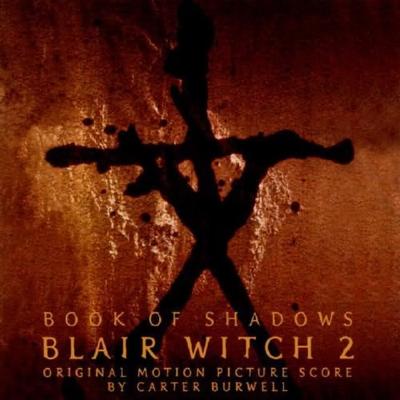
"Blair Witch 2: Book of Shadows" Soundtrack Lyrics
Movie • 2000
Track Listing
Godhead
P.O.D.
Tony Iommi f/ Dave Grohl
Rob Zombie
System of a Down
Slaves on Dope
Marilyn Manson
Death in Vegas
Project 86
Nickelback
U.P.O.
Steaknife
At the Drive-in
Elastica
Marilyn Manson
"Blair Witch 2: Book of Shadows" Soundtrack Description
Questions and Answers
- Is there an official 2000 soundtrack album for Book of Shadows: Blair Witch 2?
- Yes. A various-artists compilation was released on October 17, 2000 by Posthuman Records (Marilyn Manson’s imprint) with Priority Records handling distribution.
- Is there a separate original score album?
- Yes. Carter Burwell’s score album came out October 24, 2000 on Milan (sometimes credited alongside Flash Cut Records), later reissued and bundled with the DVD+CD.
- What song plays over the end credits?
- Poe’s “Haunted” underscores the end credits (it plays in the film but is not on the V/A album).
- Which track scores the campfire party scene?
- Queens of the Stone Age’s “Feel Good Hit of the Summer” — the drug-chant anthem heard during the campfire revelry.
- Does the compilation include every song used in the movie?
- No. Several cues in the film (e.g., Poe’s “Haunted,” Marilyn Manson’s “Disposable Teens”) don’t appear on the commercial V/A CD.
- Who composed the eerie diegetic-sounding textures (wood/rock/wind)?
- Composer Carter Burwell built looped textures from slapping water, scraping rocks, and sampled wind—expanded with guitarist David Torn and percussionist Geoffrey Gordon.
Notes & Trivia
- The V/A soundtrack dropped first (Oct 17, 2000), one week before the score album (Oct 24, 2000) — a classic “songs first, score second” rollout (according to AllMusic).
- Marilyn Manson served as an executive producer on the compilation; his label Posthuman partnered with Priority for the release (as reported by ABC News in 2000).
- Poe’s “Haunted” plays over the end credits but is absent from the retail V/A album — a frequent fan gripe that persists in forums and databases.
- Composer Carter Burwell’s process began with “Rock Water Wind,” built from found sound (rocks, wind, water) rather than traditional orchestral textures — a very Burwell move (as stated on Burwell’s official notes).
- Fans still point to the campfire scene needle-drop (“Feel Good Hit of the Summer”) as the movie’s most memorable licensed cue.
Overview
Why does a sequel famous for chaos lean so heavily on songs that punch in straight lines? Because Book of Shadows wears its contradiction proudly: a collage of alt-metal, industrial, and electronica for shock-cuts and parties, then an artful, textural score when the woods close in. The split isn’t an accident; it maps the movie’s tug-of-war between media circus and myth.
The various-artists disc plays like a turn-of-the-millennium time capsule—Rob Zombie, System of a Down, QOTSA—while Carter Burwell’s score traces a different path, sculpting atmosphere from found sounds and low-register unease. The result is messy but distinctive: club-ready aggression for human noise, dark ambient for the forest’s voice (according to Filmtracks’ review of Burwell’s approach).
Genres & Themes
- Industrial/alt-metal → media frenzy, aggression, and denial; guitars act as armor when the crew insists nothing supernatural happened.
- Post-grunge & nu-metal edges → underline 2000-era angst; choruses turn panic into posture.
- Dark ambient & electro-acoustic score → the woods as a living mechanism: wind/rock/water loops imply cycles, traps, and memory.
- Trip-hop/beat fragments → transitional paranoia; aural “smudges” for lost time and corrupted tapes.
Key Tracks & Scenes
“Haunted” — Poe
Where it plays: End credits; non-diegetic. Approx. at film’s close (~01:25:00, depending on cut).
Why it matters: Melancholy closure that reframes the preceding hysteria as grief and aftermath; a fan-favorite placement that oddly isn’t on the retail compilation.
“Feel Good Hit of the Summer” — Queens of the Stone Age
Where it plays: Campfire party sequence after the group returns; non-diegetic source-like blast. Approx. mid-film (~00:30:00–00:35:00).
Why it matters: The blunt drug-mantra reads like denial in chorus form, a counter-spell against what the woods may have done.
“Disposable Teens” — Marilyn Manson
Where it plays: Featured in the film’s mix (not on the V/A disc). Heard around early montage/pickups in some edits/broadcasts; non-diegetic.
Why it matters: A mission statement for the film’s media-satire angle—rebellion as branding.
“Funny Farm” — Carter Burwell
Where it plays: As they review the “missing hours” on Jeff’s computer; non-diegetic score cue. Approx. late-mid film (~00:50:00).
Why it matters: Ticking unease against corrupted footage; the cue’s quiet loops make paranoia feel procedural.
Track–Moment Index (approximate)
| Song / Cue | Artist / Composer | Scene / Description | Approx. Time | Length Heard | Diegetic? |
|---|---|---|---|---|---|
| Haunted | Poe | End credits roll; emotional decompression | ~01:25:00 | 2–3 min (edit-dependent) | No |
| Feel Good Hit of the Summer | Queens of the Stone Age | Campfire party with the group celebrating | ~00:33:00 | ~1–2 min | No (plays like source) |
| Disposable Teens | Marilyn Manson | Used in film/marketing; absent from album | varies by cut | brief | No |
| Funny Farm | Carter Burwell | Watching the “missing hours” files | ~00:50:00 | ~0:45–1:00 | No |
Music–Story Links (characters & plot beats)
- When the group returns from the woods and parties, QOTSA’s chant-hook works as collective amnesia. It’s not just a banger; it’s narrative denial set to a stomp.
- Burwell’s loops become the “voice” of the woods; the non-melodic materials (wind, rock, water) blur the line between ambience and omen.
- Poe’s “Haunted” lands after the film’s accusations and reversals, tilting the ending from outrage to loss — the human cost behind the tabloid noise.
- Manson’s “Disposable Teens,” whether heard in film edits or marketing, echoes the sequel’s media-culture critique: performance, provocation, headlines.
How It Was Made (supervision, score, behind-the-scenes)
The song album arrived via Posthuman/Priority, executive-produced in part by Marilyn Manson; it leans hard into alt-metal and industrial flavors of 2000. The score was recorded in New York, with Burwell producing and crafting electro-acoustic beds from environmental sounds, then layering performances by David Torn (guitars) and Geoffrey Gordon (percussion). The score album landed on Milan one week after the V/A compilation, and later got a re-release alongside home video. As a side note, Burwell acknowledges that the found-sound concept grew out of his earlier piece “Rock Water Wind” (as stated on Carter Burwell’s official site; according to AllMusic’s listing for dates and formats).
Reception & Quotes
Critical takes split along the movie’s fault lines: some reviewers praised Burwell’s restraint while knocking the bombastic needle-drops, others enjoyed the time-capsule wallop of the compilation. The album/score pairing remains a snapshot of turn-of-the-millennium horror aesthetics (as noted by Filmtracks, and AllMusic’s capsule review of the score).
“Though this score isn’t Burwell’s best, it still sustains an ominous, suspenseful air.” AllMusic (Heather Phares)
“The insertion of heavy-metal songs didn’t win any style points.” Filmtracks review
Technical Info
- Title: Book of Shadows: Blair Witch 2 — Music from and Inspired by the Motion Picture (V/A); Blair Witch 2: Book of Shadows (Original Motion Picture Score)
- Year: 2000
- Type: Movie
- Release dates: V/A compilation — Oct 17, 2000; Score — Oct 24, 2000
- Labels: Posthuman/Priority (V/A); Milan (Score)
- Composer: Carter Burwell (score); featured players David Torn (guitar), Geoffrey Gordon (percussion)
- Notable placements: Poe — “Haunted” (end credits, in film only); Queens of the Stone Age — “Feel Good Hit of the Summer” (campfire); Marilyn Manson — “Disposable Teens” (in film/marketing, not on V/A CD)
- Formats/availability: CD and digital (both albums); score later reissued and included with some DVD+CD bundles
- Style tags: Industrial, alternative metal, post-grunge, dark ambient, electro-acoustic score
Canonical Entities & Relations
| Subject | Relation | Object |
|---|---|---|
| Joe Berlinger | directed | Book of Shadows: Blair Witch 2 (2000) |
| Marilyn Manson | executive-produced | V/A soundtrack album |
| Posthuman Records | released | V/A soundtrack (with Priority Records) |
| Carter Burwell | composed/produced | Original Motion Picture Score |
| Milan Records | released | Burwell’s score album (2000) |
| Poe (Anne “Poe” Danielewski) | performed | “Haunted” (end credits in film) |
| Queens of the Stone Age | performed | “Feel Good Hit of the Summer” (campfire scene) |
Sources: AllMusic; ABC News; Filmtracks; Carter Burwell official site; IMDb Soundtracks; Wikipedia (album/score pages); SoundtrackINFO.
October, 24th 2025
A-Z Lyrics Universe
Cynthia Erivo Popular
Ariana Grande Horsepower
Post Malone Ain't No Love in Oklahoma
Luke Combs Good Riddance (Time of Your Life)
Green Day Bye Bye Bye
*NSYNC You're the One That I Wan
John Travolta & Olivia Newton-John I Always Wanted a Brother
Braelyn Rankins, Theo Somolu, Kelvin Harrison Jr. and Aaron Pierre The Power of Love
Frankie Goes to Hollywood Beyond
Auli’i Cravalho feat. Rachel House MORE ›