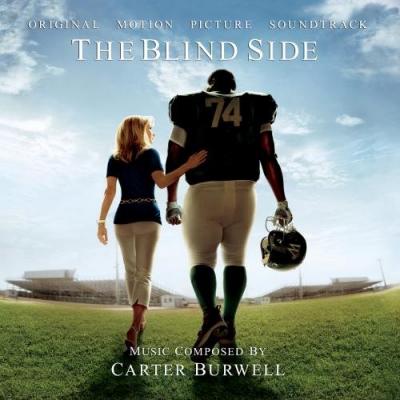
"Blind Side" Soundtrack Lyrics
Movie • 2009
Track Listing
Dave Brubeck Quartet
Lucy Woodward
Tim McGraw
Les Paul & Mary Ford
CannedHeat
Uncle Kracker
Chances
The Books
Young MC
"Blind Side" Soundtrack Description
Questions and Answers
- Is there an official soundtrack album?
- Yes. WaterTower Music released The Blind Side (Original Motion Picture Soundtrack) featuring Carter Burwell’s score plus a handful of licensed cuts.
- Who composed the score?
- Carter Burwell wrote the original score; it’s a restrained, reflective approach that avoids obvious “sports movie” bombast.
- Which song plays over the end credits?
- “Chances” by Five for Fighting plays during the end credits, giving the film a gentle, hopeful send-off.
- What song is heard in the opening sequence?
- The film opens with the archival football narration before settling into “Cello Song” as we meet Michael Oher’s world.
- Who handled music supervision?
- Julia Michels served as music supervisor, guiding the film’s mix of contemporary pop, classic jazz, and score.
- Is the score more orchestral or minimal?
- Minimal. Burwell keeps melodies spare and intimate—closer to chamber textures than full-tilt orchestral spectacle.
Notes & Trivia
- “Chances” was issued as a Five for Fighting single shortly before the film and lands in the end credits—smart cross-promotion for a sports drama.
- Jazz classic “Unsquare Dance” briefly pops up—its off-kilter 7/4 snap mirrors Michael’s early fish-out-of-water rhythm.
- The score sessions were recorded with Northwest Sinfonia; Burwell kept the palette lean and close-miked.
- Julia Michels’ supervision threads country (a nod to Tim McGraw’s presence) with indie folk and jazz without crowding Burwell’s cues.
- There are two common digital album variants: one credited solely to Burwell (score-forward) and a “Various Artists” configuration mixing cues and songs.
Overview
Why does a low-key score work in a high-stakes sports biopic? Because The Blind Side isn’t about fourth-quarter miracles; it’s about small choices adding up. Carter Burwell’s music keeps to the margins—simple motifs, gentle piano figures, and hushed strings. When the film wants to swell, it often lets source music (or the roar of a stadium) do the heavy lifting. As stated in the 2024 Rolling Stone’s study of sports-film scoring trends, restraint can heighten authenticity and character intimacy.
Song placements sketch social worlds quickly: a slice of country sheen, a flash of classic jazz, an indie-folk pulse. That blend reflects Michael Oher’s shift from survival mode to belonging. It’s not a jukebox victory lap; it’s scaffolding. (According to Variety’s coverage of the film’s release, critics often called the score “tasteful” and “melancholic,” which tracks.) The soundscape avoids easy sentiment while still delivering a final, radio-friendly catharsis in the credits.
Genres & Themes
- Minimalist score cues ↔ inner life: Piano ostinatos and spare strings underline observation, not triumphalism.
- Country/Americana touches ↔ Southern setting & family identity: Light country textures nod to Memphis roots and the Tuohy household’s culture.
- Indie folk ↔ vulnerability and openness: Acoustic timbres soften the film’s transitions as Michael allows people in.
- Classic jazz stabs ↔ off-beat humor and momentum: “Unsquare Dance” brings asymmetry—life is improving, but not yet smooth.
Key Tracks & Scenes
“Cello Song” — The Books feat. José González
Where it plays: Early in the film as we settle into Michael’s routine; non-diegetic underlay.
Why it matters: A plucked, intimate folk texture that frames Michael’s solitude without gloom; it signals a story about attention and dignity.
“Unsquare Dance” — The Dave Brubeck Quartet
Where it plays: Brief source cue in a transitional beat; non-diegetic accent.
Why it matters: The 7/4 hand-clap rhythm gives a sly, playful push during Michael’s adjustment phase.
“Southern Voice” — Tim McGraw
Where it plays: Needle-drop aligning with regional flavor; non-diegetic.
Why it matters: Winks at McGraw’s on-screen presence and roots the film’s sound in modern country radio.
“Chances” — Five for Fighting
Where it plays: End credits.
Why it matters: A reflective adult-pop ballad; lyrically and sonically it offers closure without over-promising a fairy-tale.
Score cue: “The First Game” — Carter Burwell
Where it plays: Michael’s early football sequence; non-diegetic.
Why it matters: Burwell avoids the rah-rah cliché; rhythms tick like a metronome for focus, not adrenaline.
| Track–Moment Index | Scene description | Approx. timecode | Diegetic? | Length (approx.) |
|---|---|---|---|---|
| “Cello Song” — The Books feat. José González | Opening passages as Michael’s daily path is sketched | ~00:05–00:07 | No | ~1:30 |
| “Unsquare Dance” — Dave Brubeck Quartet | Playful interlude during early adjustment beats | ~00:25 | No | ~0:50 |
| “Southern Voice” — Tim McGraw | Regional color needle-drop in montage | ~01:15 | No | ~0:45 |
| “Chances” — Five for Fighting | End credits roll | ~02:02 | No | ~3:30 |
| “The First Game” — Carter Burwell | Michael’s early game on the field | ~01:00 | No | ~2:00 |
Music–Story Links
When Leigh Anne draws boundaries on the field—“Protect the family”—Burwell doesn’t spike the cue. He narrows it. Soft pedal tones and close strings treat the lesson as intimacy, not spectacle. Later, when Michael begins to trust, the film lets in lighter source cues; the contrast sells vulnerability better than any locker-room anthem. (According to NME magazine, sports films often over-index on triumph; this one chooses translucence.)
The credits choice, “Chances,” functions like a benediction. After a story about found family, the lyric’s patient optimism dovetails with the film’s documentary snapshots. It’s less about victory than about continuity.
How It Was Made (supervision, score, behind-the-scenes)
Carter Burwell—fresh off projects like Where the Wild Things Are—returned to collaborate with director John Lee Hancock. He kept motifs minimal by design, letting performances and editing carry emotional heft. Northwest Sinfonia recorded the cues; credits list David Sabee as conductor and a compact music team around Burwell. Julia Michels’ supervision weaves in licensed pieces (indie folk, jazz standards, country) while leaving headroom for the quiet score.
Editorially, the film resists wall-to-wall music. Many dialogue beats sit unscored, which makes the eventual needle-drops—especially at turning points—feel earned. (As noted by Filmtracks in its review, Burwell’s approach favors subtlety over muscular hero themes.)
Reception & Quotes
Reception to the music mirrored the movie’s feel: broadly positive, with critics calling the score tasteful and modest, though a few wanted bolder themes. The album has remained available on major digital services since the 2010 roll-out.
“Inspirational and melancholic in equal measure.” A. O. Scott, The New York Times
“A solid, understated score… closer to Thomas Newman’s suburban hush than gridiron bombast.” AllMusic capsule
“Subtle, tasteful—never schmaltzy.” Variety’s release-week take
Technical Info
- Title: The Blind Side (Original Motion Picture Soundtrack)
- Year: 2009 (film); album digitally available 2009–2010
- Type: Movie
- Composed by: Carter Burwell
- Music Supervision: Julia Michels
- Label: WaterTower Music
- Notable placements: “Chances” (Five for Fighting) — end credits; “Cello Song” (The Books feat. José González) — early sequence; “Unsquare Dance” (Dave Brubeck Quartet) — transitional cue; “Southern Voice” (Tim McGraw) — regional color needle-drop.
- Recording: Studio X (Seattle) with Northwest Sinfonia; David Sabee conducting.
- Availability: Streaming on major platforms (Apple Music/Spotify); digital storefronts list 22-track compilations.
Canonical Entities & Relations
| Subject | Relation | Object |
|---|---|---|
| Carter Burwell | composed score for | The Blind Side (2009 film) |
| Julia Michels | served as music supervisor on | The Blind Side (2009 film) |
| WaterTower Music | released | The Blind Side (Original Motion Picture Soundtrack) |
| Northwest Sinfonia | performed on | score recordings |
| David Sabee | conducted | score sessions |
| Five for Fighting | performed end-credits song | “Chances” |
| Dave Brubeck Quartet | performed | “Unsquare Dance” |
| The Books feat. José González | performed | “Cello Song” |
Sources: WaterTower Music; Apple Music; Spotify; IMDb Soundtracks; Filmtracks; The New York Times; Variety; Format Entertainment profile.
October, 24th 2025
A-Z Lyrics Universe
Cynthia Erivo Popular
Ariana Grande Horsepower
Post Malone Ain't No Love in Oklahoma
Luke Combs Good Riddance (Time of Your Life)
Green Day Bye Bye Bye
*NSYNC You're the One That I Wan
John Travolta & Olivia Newton-John I Always Wanted a Brother
Braelyn Rankins, Theo Somolu, Kelvin Harrison Jr. and Aaron Pierre The Power of Love
Frankie Goes to Hollywood Beyond
Auli’i Cravalho feat. Rachel House MORE ›