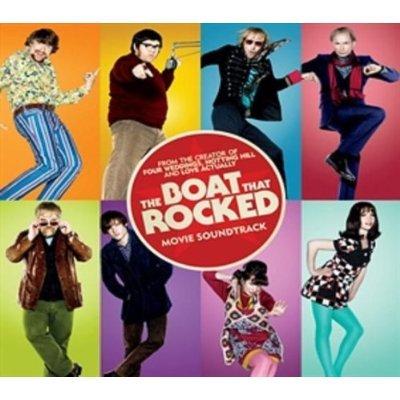
"Boat That Rocked" Soundtrack Lyrics
Movie • 2009
Track Listing
Duffy
The Kinks
The Turtles
Beach Boys
John Fred And Playboys
Martha Reeves & The Vandellas
Smokey Robinson
Herb Alpert
Tommy James
Jeff Beck
The Who
The Troggs
Boxtops
The Hollies
Chris Andrews
Paul Jones
Tremeloes
Skeeter Davis
The Who
Cream
Jimi Hendrix
Procul Harem
Otis Redding
Junior Walker
Supremes
The Turtles
Easybeats
The Bystanders
The Kinks
Cat Stevens
Moody Blues
Dusty Springfield
Lorraine Ellison
The McCoys
The Isley Brothers
David Bowie
"Boat That Rocked" Soundtrack Description
Questions and Answers
- Is there an official soundtrack album for the film?
- Yes. A 2-CD compilation was issued in the UK as The Boat That Rocked (March 30, 2009) and in North America as Pirate Radio (November 10, 2009). The US edition drops a few UK tracks and reorders some cuts.
- Does the movie include songs from outside the 1960s?
- It cheekily does: David Bowie’s 1983 hit “Let’s Dance” turns up alongside the core ’60s needle-drops—part of the film’s playful, feel-good collage approach.
- Who handled music supervision and clearances?
- Veteran supervisor Nick Angel oversaw the wall-to-wall period music, coordinating licensing and placement across the film’s many cues.
- Is there much original score, or is it all songs?
- It’s overwhelmingly song-driven. The film uses minimal original scoring; additional music contributions are credited to composer Steven Price. No separate score album was released.
- Which version of the film has more music?
- The UK cut (The Boat That Rocked, ~135 min) plays longer and breathes with more music radio vignettes; the US cut (Pirate Radio) trims ~20 minutes of story and, by feel, some song moments.
- Did the soundtrack chart?
- Yes—particularly strong in Oceania, where it peaked at #3 in both Australia and New Zealand.
- What’s one standout placement fans always mention?
- The Who’s “I Can See for Miles” — an on-brand, post-mod blast that the film uses to underline its love letter to ’60s radio swagger.
Notes & Trivia
- The North American album (Pirate Radio) omits several UK-album cuts—most notably “Crimson and Clover,” “The Letter,” “The End of the World,” and “Hang On Sloopy.”
- UK release date for the soundtrack: March 30, 2009; US release: November 10, 2009.
- Despite a 1966 setting, the mix winks at anachronism with Bowie’s 1983 “Let’s Dance.”
- Music supervision by Nick Angel (Working Title stalwart). (as noted by trade coverage)
- Additional music by Steven Price (years before his Oscar for Gravity).
- The compilation’s Oceania run was robust, peaking at #3 in Australia and New Zealand.
- The UK cut of the film runs roughly twenty minutes longer than the US edit; more room for DJ bits and needle-drops.
Overview
Why does a 1966 pirate-radio comedy blast a 1983 Bowie single and still feel perfectly right? Because The Boat That Rocked treats pop as emotion, not homework. It’s a jukebox narrative: wall-to-wall classic singles that stage-manage momentum, time, and feeling on a creaking ship where love, rebellion, and dead-of-night dedications share the same frequency. (according to The New York Times review, the movie is “carpeted with wall-to-wall tunes”)
Instead of a thematic score guiding us, the soundtrack behaves like the station itself—DJs needle-dropping The Kinks, The Beach Boys, Martha & the Vandellas, Smokey Robinson, and The Who to cue joy, lust, and mischief. The selections aren’t crate-digger deep cuts; they’re crown jewels, sequenced for maximum vibe. In other words: the film borrows the grammar of radio, and the album preserves it.
Worth noting: the soundtrack exists in two official configurations (UK and US), one a little more catholic in its song spread, the other tightened for the regional release. Fans often chase the UK set for completeness; collectors prize the promo seven-inch boxes that highlight marquee titles.
Genres & Themes
- British Beat & Mod pop (The Kinks, The Who) ↔ swagger, rule-breaking humor, us-vs-them camaraderie.
- Girl-group & Motown (Martha & the Vandellas, Smokey Robinson & the Miracles) ↔ romantic shout-outs, late-night dedications, shipboard crushes.
- Sun-dappled American pop (The Beach Boys) ↔ fantasy of freedom at sea; radio as a beach you can carry anywhere.
- Psychedelic edges & guitar heroes (Jimi Hendrix, Procol Harum) ↔ the movie’s bigger-than-life climax beats and memory-burn moments.
- Power ballad catharsis (“Stay With Me Baby” in its modern cover) ↔ heartbreak, grand gestures, and, yes, lip-sync drama.

Key Tracks & Scenes
“All Day and All of the Night” — The Kinks
Where it plays: Early radio-energy montage as Radio Rock’s irreverent voice hits the air; non-diegetic booster shot for swagger.
Why it matters: Establishes the film’s beat-group backbone and the DJs’ mission statement: play it loud, play it now.
“Wouldn’t It Be Nice” — The Beach Boys
Where it plays: A bright-eyed sequence underscoring youthful longing and flirtation aboard ship.
Why it matters: That opening harp and vocal stack does instant character work—earnest, idealistic, a little naïve.
“Dancing in the Street” — Martha & the Vandellas
Where it plays: Party sequence in cramped quarters; diegetic records spinning while the crew and guests cut loose.
Why it matters: Radio here is communion; the Motown backbeat becomes the heartbeat of the boat.
“I Can See for Miles” — The Who
Where it plays: A mid-film surge that frames the station’s audacity and the government’s glare.
Why it matters: Thunderous drums + sneer = manifesto. It’s the film’s most on-the-nose mod power move.
“Let’s Dance” — David Bowie
Where it plays: Used as an exuberant, knowingly anachronistic needle-drop to supercharge momentum.
Why it matters: The era-jump underlines the movie’s thesis: great radio collapses time if the song fits the feeling.
Track–Moment Index (selected)
| Song | Scene / Moment | Diegetic? | Approx. Timing | Notes |
|---|---|---|---|---|
| All Day and All of the Night — The Kinks | Opening “meet the DJs” radio montage | No | Early film | Signature beat-group punch sets tone |
| Dancing in the Street — Martha & the Vandellas | Shipboard party in the cramped mess | Yes | First act | Spun by a DJ on-air; call-and-response energy |
| I Can See for Miles — The Who | Defiant broadcast / state pressure cross-cut | No | Mid-film | One of the film’s most-cited needle-drops |
| Let’s Dance — David Bowie | Adrenalized montage, mood kick | No | Late-mid | Purposeful anachronism; pure vibe |
| Stay With Me Baby — Duffy | Heart-on-sleeve emotional beat | No | Late film | Modern cover mirrors Lorraine Ellison’s ’66 original |
Music–Story Links (characters & plot beats as connected to songs)
- Beat-group bravado → outsider solidarity: Kinks/Who cuts aren’t background—they define Radio Rock as an alternative public square, all elbows and eyeliner.
- Motown as glue: The ship’s friendships are literally mixed like a Motown single: shared groove, tight harmonies, irresistible forward motion.
- Ballads for vulnerability: “Ooo Baby Baby” and “Stay With Me Baby” score romantic gambles and collapses, exposing soft centers beneath clowning DJs.
- American surf pop as escape hatch: The Beach Boys sell the fantasy that the North Sea can feel like California—radio as geography hack.
How It Was Made (supervision, score, behind-the-scenes)
Working Title’s in-house music brain trust tapped Nick Angel to wrangle rights and tone; his remit covered a dense roster of British Invasion, Motown, and psych-era classics. The end result feels like a pirate-era Now That’s What I Call Radio mix, but with placements tailored to character beats rather than chart history. (as trade reports note)
As for original cues, the production leaned on songs first; composer Steven Price contributed additional music to stitch transitions, a footnote that makes perfect sense given how aggressively the film lets singles do the storytelling.
Reception & Quotes
The film drew mixed notices, but even skeptics saluted the compilation’s pleasures. The album performed best in Australia and New Zealand, reflecting the enduring pull of classic-rock anthologies.
“Stuffed with playful character actors and carpeted with wall-to-wall tunes.” Manohla Dargis, The New York Times
“The saving grace…is the extensive ’60s-dominated soundtrack.” Consequence (Cinema Sounds)
“Star-studded cast and fantastic rock songs… Curtis’ love for 1960s music shines through.” Vogue
Critics also pointed out the US recut’s tighter pacing, which inevitably trims some music-hang time. (according to trade summaries)
Availability: The official 2-CD album remains streamable and purchasable in both its UK (The Boat That Rocked) and US (Pirate Radio) configurations. (as stated in label listings)
Technical Info
- Title: Boat That Rocked (aka Pirate Radio in North America)
- Year: 2009
- Type: Movie soundtrack (compilation; various artists)
- Original score: Minimal; additional music by Steven Price (no separate score album)
- Music supervision: Nick Angel
- Label(s): Mercury Records (UK); Universal Republic (North America)
- Release context: UK soundtrack March 30, 2009; US album November 10, 2009
- Selected notable placements: The Kinks “All Day and All of the Night”; Martha & the Vandellas “Dancing in the Street”; The Who “I Can See for Miles”; David Bowie “Let’s Dance”
- Chart/Availability notes: Peaked at #3 (Australia ARIA) and #3 (New Zealand); widely available on major streaming platforms and as digital download/CD.
Canonical Entities & Relations
| Subject | Relation | Object |
|---|---|---|
| Working Title Films | produced | The Boat That Rocked (film) |
| Richard Curtis | wrote & directed | The Boat That Rocked |
| Nick Angel | supervised music for | The Boat That Rocked |
| Steven Price | provided additional music for | The Boat That Rocked |
| Mercury Records | released | The Boat That Rocked (soundtrack, UK) |
| Universal Republic | released | Pirate Radio (soundtrack, North America) |
| David Bowie | performed | “Let’s Dance” (used in film/album) |
| The Kinks | performed | “All Day and All of the Night” (used in film/album) |
| The Who | performed | “I Can See for Miles” (used in film/album) |
Sources: The New York Times; Variety; Screen Daily; IMDb (soundtracks/credits); Wikipedia (film & soundtrack); Discogs; Apple Music; MusicBrainz; Consequence.
October, 25th 2025
A-Z Lyrics Universe
Cynthia Erivo Popular
Ariana Grande Horsepower
Post Malone Ain't No Love in Oklahoma
Luke Combs Good Riddance (Time of Your Life)
Green Day Bye Bye Bye
*NSYNC You're the One That I Wan
John Travolta & Olivia Newton-John I Always Wanted a Brother
Braelyn Rankins, Theo Somolu, Kelvin Harrison Jr. and Aaron Pierre The Power of Love
Frankie Goes to Hollywood Beyond
Auli’i Cravalho feat. Rachel House MORE ›