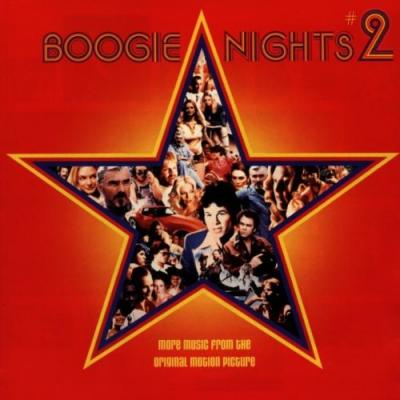
"Boogie Nights vol. 2" Soundtrack Lyrics
Movie • 1998
Track Listing
Three Dog Night
Elvin Bishop
Hot Chocolate
KC & the Sunshine Band
Charles Wright & the Watts 103rd Street Rhythm Band
Sniff 'N' the Tears
The Move
Rick Springfield
Sound Experience
Ohio Players
Apollo 100
"Boogie Nights vol. 2" Soundtrack Description
Questions and Answers
- Is there an official second soundtrack album for Boogie Nights?
- Yes. It’s titled Boogie Nights #2: More Music from the Original Motion Picture and arrived in 1998 as a companion to the first 1997 album.
- Does Vol. 2 include songs from the infamous Rahad Jackson scene?
- Yes—most notably Night Ranger’s “Sister Christian” and Rick Springfield’s “Jessie’s Girl,” with Nena’s “99 Luftballons” following in the film’s sequence.
- Who composed the original score in the film?
- Michael Penn composed the score cues heard throughout the movie.
- Who handled music supervision?
- Karyn Rachtman led music supervision (with Bobby Lavelle), clearing an eclectic mix of disco, pop-rock, and soft-rock staples.
- Is Heatwave’s “Boogie Nights” actually in the movie?
- No—the Heatwave hit isn’t used in the film despite the shared title; rights and artistic reasons kept it out.
- Where can I stream Vol. 2 today?
- It’s typically available on major services (e.g., a consolidated edition appears on Spotify in many regions). Availability may vary by country.
Additional Info
- Release context: Vol. 2 followed the film’s 1997 OST with additional period cuts and fan-favorite cues.
- Label & cataloging: Issued by Capitol in early 1998; physical releases carry the well-circulated UPC 724349307629.
- Placement philosophy: the movie crossfades carefree disco into brittle early-’80s soft rock as Dirk’s fortunes turn—an intentional mood arc (as noted by ScreenRant).
- Score thread: Michael Penn’s carnival-tinged motifs quietly stitch the needle drops together.
- Rights wrinkle: Heatwave’s “Boogie Nights” famously isn’t in the movie—an oft-asked trivia point.
- Fan shorthand: “the Rahad mixtape sequence” = a terrifying triad: “Sister Christian” → “Jessie’s Girl” → “99 Luftballons.”
- Retail trivia: many shops listed Vol. 2 simply as “Boogie Nights #2,” which can help when digging for a CD.
- Critical lore: the soundtrack era around PTA’s film is frequently cited in lists of all-time great movie soundtracks (according to Pitchfork’s 50-best list).
Overview
Why does a glossy disco groove morph into brittle, anxiously bright soft rock? Because Boogie Nights charts a rise and a crash. Boogie Nights vol. 2 taps the cuts that color the film’s back half and peripheral scenes—the moments after the high wears off. Vol. 1 handled the “party”; Vol. 2 walks you through the comedown, without losing the hooky sheen that makes the movie so dangerously fun.
Paul Thomas Anderson leans on needle drops the way some films lean on narration; songs anchor geography (Valley clubs), industry rituals (pool parties), and fate (a botched heist turned shootout). The second album corrals many of those cues, spotlighting how the film’s music architecture shifts from communal dance floors to isolating interiors. As I hear it: Vol. 2 is the movie’s hangover and its hard truth.
Genres & Themes
- Disco & funk → communal euphoria, money flowing, the porn “family” clicking in rhythm.
- AM pop/soft rock → denial dressed as optimism; characters insist they’re okay while the songs say otherwise.
- Arena rock power ballads → comic-menace contrast; bright choruses over real danger (hello, Rahad’s living room).
- Score (carnival hues) → the rigged game vibe; Penn’s cues remind us the ride always ends.

Tracks & Scenes
"Sister Christian" — Night Ranger
Where it plays: Diegetic in Rahad Jackson’s living room during Dirk/Todd/Reed’s doomed drug deal (roughly around the 2-hour mark). Firecrackers pop; Rahad freebases and play-acts Russian roulette.
Why it matters: A sugary chorus smothers real danger—the exact tension that makes the scene unbearable and unforgettable.
"Jessie’s Girl" — Rick Springfield
Where it plays: Immediately follows “Sister Christian” on Rahad’s mixtape (late second act, ~2:05–2:10). The camera lingers on Dirk’s face as he realizes how far he’s fallen.
Why it matters: Pop euphoria vs. moral panic; the chorus hits as courage fails—PTA weaponizes a radio staple.
"99 Luftballons" — Nena
Where it plays: As the deal explodes into violence—gunshots, chaos, and a frantic escape (~2:10+).
Why it matters: Cold War bubblegum as literal bullets fly; irony turned up to eleven.
"Best of My Love" — The Emotions
Where it plays: Early, in the swooping club introduction that threads us through Jack’s world (opening movement).
Why it matters: The perfect thesis for the film’s “family romance”—joy as social glue.
"Spill the Wine" — Eric Burdon & War
Where it plays: The pool-party long take at Jack’s house (first act). The camera dives into the water like it’s joining the scene.
Why it matters: Dreaminess that hides exploitation; euphoria rendered in Steadicam.
"Brand New Key" — Melanie
Where it plays: Roller Girl motif early on, paired to innocence and performance.
Why it matters: A coy, circular hook for a character who can’t just skate away from reality.
"Machine Gun" — Commodores
Where it plays: Montage energy during the ascent phase, all syncopated swagger.
Why it matters: A groove that says “invincible,” right before the fall proves otherwise.
Note: This section highlights where songs land in the film and why; not a complete tracklist.
Music–Story Links (characters & plot beats)
- Dirk’s arc: euphoric disco (arrival) → brittle power-pop (fall). The format shift mirrors fame curdling into desperation (as observed by ScreenRant).
- Rahad’s mixtape: the illusion of control—he picks the playlist, not the outcome.
- Found family vs. commerce: “Best of My Love” promises community; later soft-rock cues isolate everyone inside their own mirages.
- End-credit benediction: a Beach Boys classic plays like a bittersweet curtain for broken bonds and lingering hope.
How It Was Made (supervision, score, behind-the-scenes)
Music supervisor Karyn Rachtman (with Bobby Lavelle) navigated a thicket of 70s/80s hits, balancing marquee titles with character-driven deep cuts. The approach wasn’t mixtape nostalgia so much as mixtape dramaturgy: pick the song that tells the truth the characters won’t. Composer Michael Penn threads carnivalesque motifs to keep the vibe buoyant—and to make the drop feel steeper when the radio turns to power ballads.
One evergreen bit of lore: the Heatwave single named “Boogie Nights” never appears. Meanwhile, the three-song gauntlet in Rahad’s house works because it’s diegetic—the characters are trapped in someone else’s playlist. Little wonder critics still cite the sequence as a high-water mark of needle-drop storytelling (as stated in a New Yorker appreciation, and in list features like Pitchfork’s roundup).
Reception & Quotes
Contemporary and retrospective write-ups point to Boogie Nights as a needle-drop milestone, with Vol. 2 extending the film’s sonic palette for listeners who wanted the darker hues. The “Rahad mixtape” run has been singled out as a top rock-and-film moment (according to Rolling Stone).
“Anderson weaponizes pop; the chorus hits, and you realize the dream’s over.” —modern feature coverage
“The soundtrack era that Boogie Nights helped define still rules our playlists.” —critical retrospectives
Technical Info
- Title: Boogie Nights #2: More Music from the Original Motion Picture (aka Boogie Nights vol. 2)
- Year: 1998 (companion album to the 1997 film)
- Type: Movie — companion soundtrack (various artists)
- Label: Capitol Records (notable UPC: 724349307629)
- Film composer: Michael Penn (original score cues)
- Music supervision (film): Karyn Rachtman; Bobby Lavelle
- Notable placements represented on Vol. 2: “Sister Christian,” “Jessie’s Girl,” “You Sexy Thing,” “Mama Told Me (Not To Come),” “Boogie Shoes,” and more.
- Release context: Follow-up to the 1997 OST; designed to capture additional cues fans associated with key scenes.
- Availability: Common on used CD; selections stream on major platforms (regional catalogs vary).
Canonical Entities & Relations
| Subject | Relation | Object |
|---|---|---|
| Paul Thomas Anderson | directed | Boogie Nights (1997 film) |
| Michael Penn | composed score for | Boogie Nights (1997 film) |
| Karyn Rachtman | music supervised | Boogie Nights (1997 film) |
| Bobby Lavelle | music supervised | Boogie Nights (1997 film) |
| Capitol Records | released | Boogie Nights #2 (1998 album) |
| New Line Cinema | distributed | Boogie Nights (1997 film) |
| Mark Wahlberg | starred in | Boogie Nights (as Dirk Diggler) |
| Julianne Moore | starred in | Boogie Nights (as Amber Waves) |
| San Fernando Valley | setting of | Boogie Nights (story world) |
| Boogie Nights #2 | companion album to | Boogie Nights (1997 film) |
Sources: Discogs; ScreenRant; IMDb Soundtracks; Wikipedia (film & songs); The New Yorker; Graywhale retail listing; Consequence feature; Record Store Day listing.
October, 25th 2025
A-Z Lyrics Universe
Cynthia Erivo Popular
Ariana Grande Horsepower
Post Malone Ain't No Love in Oklahoma
Luke Combs Good Riddance (Time of Your Life)
Green Day Bye Bye Bye
*NSYNC You're the One That I Wan
John Travolta & Olivia Newton-John I Always Wanted a Brother
Braelyn Rankins, Theo Somolu, Kelvin Harrison Jr. and Aaron Pierre The Power of Love
Frankie Goes to Hollywood Beyond
Auli’i Cravalho feat. Rachel House MORE ›