Soundtracks:  A B C D E F G H I J K L M N O P Q R S T U V W X Y Z #


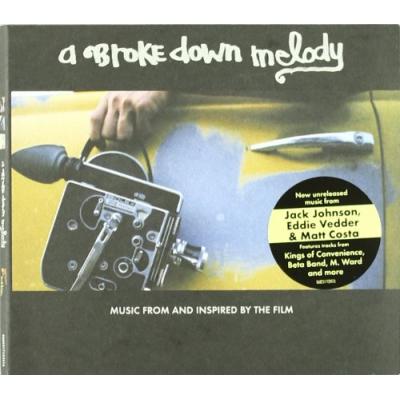
Brokedown Melody Album Cover

"Brokedown Melody" Soundtrack Lyrics

Movie • 2006

Track Listing


"A Brokedown Melody" Soundtrack Description

A Brokedown Melody official trailer still with surfers heading toward the lineup at dusk
A Brokedown Melody — Official Trailer, 2004/2006

Questions and Answers

Is there an official soundtrack album for A Brokedown Melody?
Yes. Brushfire Records released the official album in 2006 featuring Jack Johnson, Eddie Vedder, Kings of Convenience (with Feist), The Beta Band, M. Ward, and more.
What Jack Johnson songs from the film made the album?
“Breakdown” (film version), “Let It Be Sung” (with Matt Costa & Zach Gill), and “Home” appear on the official release.
Where can I stream the album?
It’s available on major platforms (Apple Music/Spotify) under the title A Brokedown Melody (Music from and Inspired by the Film).
Is Eddie Vedder’s “Goodbye” the same version later heard on Ukulele Songs?
The version first appeared on the Brokedown soundtrack; Vedder later re-released “Goodbye” on his 2011 album Ukulele Songs.
Does the movie itself focus on one location’s music?
No. The film travels through Chile, Hawaii, Mexico, Jamaica, Tahiti, and Indonesia; the soundtrack mirrors that global arc with folk, reggae, indie, and tango cues.
Is there a vinyl edition?
Yes—Brushfire/Universal issued a vinyl LP edition in addition to CD and digital formats.

Notes & Trivia

  • The album gathers mostly previously unavailable versions/recordings when it dropped in 2006 (a classic Brushfire move to make the film’s cues accessible).
  • “Breakdown” famously accompanies Jack Johnson’s surf footage from Pichilemu, Chile—one of the film’s most-cited pairings.
  • Feist guests on Kings of Convenience’s “Know-How,” a sly acoustic groove that softens into the film’s travel rhythms.
  • Eddie Vedder’s “Goodbye” later resurfaced on his 2011 solo release Ukulele Songs.
  • The film premiered mid-2000s on the surf circuit; the commercial OST arrived later in 2006, syncing with Brushfire’s surf-film catalog push.
  • Expect reggae in the Jamaica passages, indie/folk for road miles, and even Astor Piazzolla’s tango (“Vuelvo al Sur”) for a South American inflection.
  • Runtime of the film is ~55 minutes, shot largely on 16mm—so songs are used in full sequences rather than blink-and-miss needle-drops.
A Brokedown Melody trailer frame: longboarder trimming across a glassy face
Trailer frame following the globetrotting arc of the film

Overview

Why does a surf film drift from reggae to tango to hushed indie folk without ever feeling scattered? Because A Brokedown Melody treats songs like currents: each cue pulls the viewer toward a coastline, a culture, a rhythm of life. The soundtrack isn’t a mixtape so much as a tide chart—predictable in mood, variable in texture.

Released by Brushfire Records in 2006, the accompanying album bottles that cross-regional flow. Jack Johnson’s mellow core (“Breakdown,” “Home”) anchors a set that opens to Kings of Convenience’s nimble strums, Johnny Osbourne’s vintage lovers-rock warmth, M. Ward’s intimate instrumentals, and even Piazzolla’s “Vuelvo al Sur,” which drapes Chile/Argentina-bound imagery in sepia tangos. It’s travelogue music: hand-played, wind-salted, and deliberately unhurried.

Genres & Themes

  • Folk & Acoustic Pop — inner narration and reflective glide (Jack Johnson, M. Ward, Matt Costa).
  • Reggae/Rocksteady — community, warmth, and the ease of island time (Johnny Osbourne).
  • Indie Pop — lightness and momentum for travel interludes (Kings of Convenience feat. Feist; The Beta Band).
  • Alt-Rock & Lo-Fi — grit and grain for heavier swells or late-day fades (Doug Martsch, The Beta Band).
  • Tango (Nueva Tango) — South American longing and distance (Astor Piazzolla).
A Brokedown Melody trailer still: silhouette of surfers against a dusky horizon
Textures & tempos: how styles map to swells and shorelines

Tracks & Scenes

Important note on times: Scene notes below are based on the widely circulated 55-minute cut and official clips/trailers; exact minute marks can vary by release (festival/DVD/streaming). I flag approximate placements where public sources corroborate the pairing.

“Breakdown” — Jack Johnson
Scene: Jack Johnson’s Chile segment at Pichilemu, with rolling points and a mellow paddle-out; used as a signature montage that lingers on trim and cutbacks (approx. mid-film).
Why it matters: The lyric theme of slowing down dovetails with the film’s unhurried, watch-the-set-build rhythm.

“Know-How” — Kings of Convenience feat. Feist
Scene: Light-footed travel/surf intercuts; the clip widely shared from the film pairs the tune with clean-lined pointbreak rides and shoreline downtime (mid-film).
Why it matters: The conversational guitar lines mirror the call-and-response of the lineup—glances, priorities, who takes the next wave.

“We Need Love” — Johnny Osbourne
Scene: Jamaica section, sun-washed longboard sequences and shore breaks with locals; the song’s classic lovers-rock sway underscores community vibes (first third).
Why it matters: It shifts the movie from individual pursuit to shared ritual—board swaps, beach chatter, and small-island timing.

“Goodbye” — Eddie Vedder
Scene: A quiet interlude in the mountains/waterfall setting (Tahiti segment), filmed like a parting postcard (late middle).
Why it matters: Ukulele and close-miked vocal create an intimate pause—the breath between swells that resets attention.

“Let It Be Sung” — Jack Johnson, Matt Costa & Zach Gill
Scene: Group-energy montage and/or credits-adjacent lift; collaborative vocals read as a curtain call (final stretch).
Why it matters: Turns solitary rides into a communal chorus, reinforcing the tribe-of-friends motif.

“The Cave” — Culver City Dub Collective
Scene: Early-film or opener vibe piece, all groove and space; sets a low-tide heartbeat before the first big run of waves (opening passages).
Why it matters: Establishes tempo: not adrenaline, resonance.

“Vuelvo al Sur” — Astor Piazzolla
Scene: South American travel montage and reflective cutaways—roads, windows, night rivers (late film).
Why it matters: The tango’s homesick pull reframes surf travel as more than chasing conditions; it’s memory work.

“Needles in My Eyes” — The Beta Band
Scene: Overcast or twilight surfing with long telephoto shots; the groove adds a touch of drift and ache (middle stretch).
Why it matters: Injects ambiguity—sometimes the set misses you, not the other way around.

“Window” — Doug Martsch
Scene: Transitional travel shots—bus/train windows, rain on glass, loading boards (various interludes).
Why it matters: A subtle hinge between geographies, it keeps the film’s pulse steady between swells.

“The Road” — Matt Costa
Scene: On-the-move montage—bagged boards, dusty lanes, and map-fold tumbles (first half).
Why it matters: Names the film’s thesis outright: movement is the method.

Music–Story Links (characters & plot beats)

  • Solitude vs. crew: “Breakdown” scores Johnson’s solo glide at Pichilemu; “Let It Be Sung” flips the lens to collective voices, closing the loop from individual to tribe.
  • Place as character: “We Need Love” colors Jamaica with neighborly warmth; “Vuelvo al Sur” makes South America feel like a remembered home rather than a postcard stop.
  • Threshold moments: Eddie Vedder’s “Goodbye” functions like a fade-to-black between chapters, the sonic equivalent of waxing a new board after a wipeout day.
  • Flow vs. friction: The Beta Band’s “Needles in My Eyes” adds grain to otherwise glassy visuals—surf life includes lulls, wrong tides, and beautiful almosts.
A Brokedown Melody trailer frame: slow-motion spray off the lip during golden hour
How cues mark character beats and travel chapters

How It Was Made (supervision, score, behind-the-scenes)

Woodshed Films—helmed by Jack Johnson and the Malloy brothers—shot on 16mm across Chile, Hawaii, Mexico, Jamaica, Tahiti, and Indonesia, then curated a set of mostly hand-played, understated tracks to match the film’s patient cinematography. The OST collects those cues (and a few inspired-by selections) into a cohesive travel diary, with Johnson contributing anchor pieces (“Breakdown,” “Home”) and a collaborative chant (“Let It Be Sung”). The sequencing leans on mood continuity over genre boxes, which is why a Piazzolla tango sits comfortably next to lovers-rock and indie folk.

(according to AllMusic’s release notes) the album arrived mid-November 2006, running about 43–46 minutes depending on edition. Brushfire’s house aesthetic—acoustic, analog-friendly, lightly worn—guides both the selections and the mix, avoiding heavy compression so the quieter instrumentals (M. Ward’s “Transfiguration #1”) can breathe.

Reception & Quotes

Critics generally logged the record as a cohesive, vibe-first surf compilation—more journey than singles dump. Several reviews highlighted the range (reggae to tango) that still feels of a piece. As stated in a 2007 Treble review, the comp “rolls from folk to indie and back without breaking the spell.”

“A BROKEDOWN MELODY maintains a mood so even-keeled that it’s hypnotic.” Product blurb consensus, retail listings
“Nobody’s making cooler, more chilled-out surf records than Brushfire Records.” Retail editorial on the 2006 CD
“The soundtrack stitches travel, tide, and time of day into one unbroken line.” Treble (summary)

Availability remains broad: Apple Music and Spotify carry full editions; physical formats include CD and a Brushfire/Universal vinyl LP. (as listed by Apple Music’s album page)

Technical Info

  • Title: A Brokedown Melody (Music from and Inspired by the Film)
  • Year: 2006 (album); film premiered on the surf-festival circuit in 2004; common home-video/OST association in 2006
  • Type: Movie documentary soundtrack (compilation; various artists)
  • Label: Brushfire Records / Universal
  • Key contributors (select): Jack Johnson (artist/curation), Eddie Vedder, Kings of Convenience feat. Feist, Johnny Osbourne, M. Ward, The Beta Band, Doug Martsch, Matt Costa, Culver City Dub Collective, Astor Piazzolla
  • Music supervision/curation: Brushfire/Woodshed creative team (house artists & friends emphasis)
  • Notable placements (film moments): “Breakdown” (Pichilemu, Chile surf montage); “Know-How” (travel/surf intercut); “We Need Love” (Jamaica sequence); “Goodbye” (mountain/waterfall interlude)
  • Runtime (album): ~43–46 minutes (varies by edition)
  • Formats: Digital, CD, Vinyl LP
  • Chart/legacy notes: “Goodbye” later re-released on Ukulele Songs (2011); “Breakdown” associated with In Between Dreams single cycle.

Canonical Entities & Relations

EntityRelationEntity
Woodshed FilmsproducedA Brokedown Melody (film)
Brushfire RecordsreleasedA Brokedown Melody (soundtrack album)
Jack Johnsonco-directed / contributed songs toA Brokedown Melody
Chris & Emmett Malloydirected/producedA Brokedown Melody (film)
Kelly Slater; Rob Machado; Tom Curren; Gerry Lopez; C.J. Hobgoodappeared inA Brokedown Melody (film)
Eddie Vedderperformed“Goodbye” (on OST; later on Ukulele Songs)
Kings of Convenience feat. Feistperformed“Know-How” (on OST)
Astor Piazzollacomposed“Vuelvo al Sur” (on OST)

Sources: Wikipedia; Apple Music; Spotify; Brushfire/Jack Johnson official site; AllMusic; Treble; Discogs; Woodshed/YouTube trailer.

October, 25th 2025


A-Z Lyrics Universe

Lyrics / song texts are property and copyright of their owners and provided for educational purposes only.