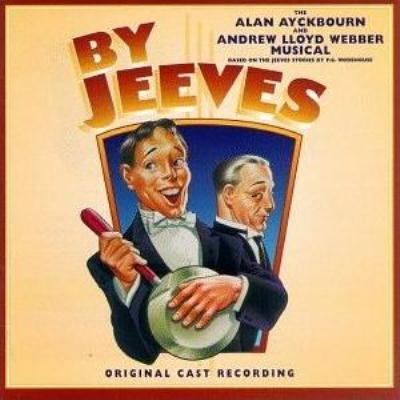
"By Jeeves" Soundtrack Lyrics
Musical • 2001
Track Listing
"By Jeeves" Soundtrack Description
Questions and Answers
- Is there an official 2001 recording tied to the musical?
- Yes—the By Jeeves (American Premier[e] Recording) was released October 16, 2001 to coincide with the Broadway run, featuring the U.S. company led by John Scherer and Martin Jarvis (according to Playbill).
- What exactly happened in 2001—stage or screen?
- Both. A film capture of the musical (directed by Alan Ayckbourn & Nick Morris) aired in March 2001 in Canada, and the production then opened on Broadway that October (as documented on Wikipedia and Playbill).
- Where can I stream the album today?
- It’s available on Apple Music and Spotify under By Jeeves (American Premier[e] Recording) by Andrew Lloyd Webber & By Jeeves Original Broadway Cast.
- Who wrote the score and lyrics?
- Music by Andrew Lloyd Webber; book and lyrics by Alan Ayckbourn, freely adapted from P. G. Wodehouse’s Bertie & Jeeves stories.
- Are the Broadway song order and the album identical?
- Not quite. The Broadway program reflected small changes (e.g., “A False Start,” “Never Fear”) not mirrored exactly on the CD (as stated in the 2001 Playbill report).
- Does a London cast recording exist too?
- Yes—an Original London Cast album (1996) documents the earlier revision; the 2001 American recording is shorter and reflects the later U.S. version (according to AllMusic/cast-album databases).
Notes & Trivia
- The American cast album streeted Oct 16, 2001, ahead of the Oct 28 Broadway opening; it was recorded around the pre-Broadway Pittsburgh run (according to Playbill).
- ℗ credits on digital storefronts list LW Entertainment / The Really Useful Group for the 2001 American album; Decca Broadway handled the CD release.
- The 2001 film was shot in studio in Toronto after the Pittsburgh staging and aired on Canadian TV before video release (as stated on Wikipedia).
- F. Wade Russo served as musical director/pianist on the film capture; David Cullen is credited for arrangements on the stage version.
- Only four numbers from the 1975 version survived lyrically intact into By Jeeves: “Banjo Boy,” “Half a Moment,” “Travel Hopefully,” and “When Love Arrives.”
Overview
Why does a drawing-room farce play like a music-hall cabaret? Because By Jeeves frames the plot as Bertie’s impromptu “recital” when his banjo goes missing—Jeeves swaps strings for storytelling. The album bottles that conceit: short, witty numbers, a nimble pit band, and an emcee vibe that keeps the Wodehouse mayhem civilized.
Andrew Lloyd Webber leans into pastiche—foxtrots, patter, light swing—while Alan Ayckbourn’s lyrics flicker with clubby understatement. On record, the charm is the point: songs as social lubrication, not spectacle. It’s the least bombastic Lloyd Webber score, and proudly so (as noted across cast-album writeups and Playbill’s coverage).
Genres & Themes
- Music-hall & light swing → airy wit: jaunty rhythms keep the caper breezy rather than breathless.
- Patter & wordplay → class comedy: Bertie’s verbal tap-dance papers over panic; Jeeves’ replies land like well-placed cymbal hits.
- Romantic ballad → sincere undercurrent: “Half a Moment” and “When Love Arrives” soften the satire with genuine feeling.
Tracks & Scenes
“Wooster Will Entertain You” — Bertie (John Scherer)
Where it appears: Album opener; in the film/stage frame, Bertie addresses the audience at the church hall after his banjo “mysteriously” vanishes. Diegetic within the frame
Why it matters: Sets the cabaret-within-a-play structure and Bertie’s blithe tone (Playbill notes this track on the 2001 CD).
“Travel Hopefully” — Bertie, Jeeves & Bingo
Where it appears: Early caper momentum: Jeeves ushers Bertie’s tale along, with Bingo Little chiming in as romantic complications sprout. Performance within the story
Why it matters: Cheery locomotion: it turns dithering into forward motion.
“That Was Nearly Us” — Honoria & Bertie
Where it appears: A near-miss romance recalled in story mode; Honoria’s athletic gusto collides with Bertie’s evasions. In-narrative duet
Why it matters: Classic Wodehouse dodge-song—polite, prickly, funny.
“Love’s Maze” — Stiffy, Bertie & Company
Where it appears: Scheme-on-scheme montage: engagements, misunderstandings, and Jeeves’ chess moves. Ensemble feature
Why it matters: A kaleidoscopic patter-waltz that maps the plot’s knotty circuits (lyrics reference the funhouse feel).
“The Hallo Song” — Bertie, Cyrus Budge & Gussie
Where it appears: A comic set-piece of mistaken identities and loud greetings as Bertie’s tale grows more baroque. Comic trio
Why it matters: A vintage Lloyd Webber earworm folded into Ayckbourn’s farce engine.
“What Have You Got to Say, Jeeves?” — Bertie & Jeeves
Where it appears: Turning point: Bertie appeals to Jeeves for a master-scheme to untangle the mess. Duet
Why it matters: The archetypal valet-as-dramaturg moment, set to a lightly insistent groove.
“Half a Moment” — Harold & Stiffy
Where it appears: A sincere love duet tucked inside the froth. Ballad
Why it matters: Gives the album its heart; a favorite across both London (1996) and American (2001) releases.
“It’s a Pig!” — Honoria, Madeline, Bertie, Bassett & Gussie
Where it appears: The social whirl hits farce overdrive—status, pride, and livestock metaphors collide. Ensemble
Why it matters: One of the most purely comic ensemble turns; cast albums spotlight it for good reason.
“By Jeeves” — Bertie, Bingo & Gussie
Where it appears: Late show-number as the title character’s steady hand becomes the evening’s theme. Ensemble
Why it matters: A toast to competence; Jeeves resolves what Bertie narrates.
Note: Song titles and presence are drawn from the 2001 American recording; Broadway’s program and the 1996 London album show small sequence/title variations (as stated in Playbill and cast-album listings).
Music–Story Links (characters & plot beats)
- Framed entertainment: Opener-to-closer structure (“Wooster Will Entertain You” → “By Jeeves”) keeps us inside Bertie’s onstage improvisation.
- Jeeves as tempo: Whenever Bertie stalls, a Jeeves-led number (“Travel Hopefully,” the Bertie–Jeeves duet) nudges the narrative onward.
- Ballads = sincerity: “Half a Moment” and “When Love Arrives” park the farce long enough for real feeling—then the patter resumes.
How It Was Made (supervision, score, behind-the-scenes)
The musical is a wholesale 1990s rewrite of 1975’s Jeeves, with new numbers and slimmed-down orchestration. The 2001 American cast album was recorded around the Pittsburgh pre-Broadway run and released Oct 16, 2001—two weeks before the Broadway opening (according to Playbill). The filmed version—co-produced by the CBC, Really Useful Films and Tapestry Pictures—was shot in Toronto and aired on Canadian TV in March 2001, then issued on video (as stated on Wikipedia).
Credits of note for the 2001 iteration: John Scherer (Bertie), Martin Jarvis (Jeeves), Donna Lynne Champlin (Honoria), James Kall (Gussie), among others; arrangements by David Cullen; film musical direction/piano by F. Wade Russo. Streamable releases list ℗ to LW/Really Useful (Apple Music/Spotify entries corroborate). (according to Playbill and storefront listings)
Reception & Quotes
Reactions range from affectionate to tart. Some enjoyed the gentle throwback; others found it featherweight. A few capsule takes:
“A tea-party of a show… a musical entertainment.” — Playbill contemporaneous coverage
“Shabby-to-rotten… but even that felt comfortingly normal.” — Vulture (2020 stream revisit)
Still, the American cast album remains a tidy way to tour Wodehouse-land in 47 minutes. (as stated in AllMusic and platform listings)
Technical Info
- Title: By Jeeves (American Premier[e] Recording)
- Year: 2001
- Type: Musical (filmed stage musical + Broadway cast album)
- Music: Andrew Lloyd Webber
- Book & Lyrics: Alan Ayckbourn
- Principal 2001 performers (album/film): John Scherer (Bertie), Martin Jarvis (Jeeves), Donna Lynne Champlin (Honoria), James Kall (Gussie), Don Stephenson (Bingo), Emily Loesser (Stiffy), Ian Knauer (Harold), Becky Watson (Madeline)
- Label / Rights: Decca Broadway (CD release); ℗ LW Entertainment / The Really Useful Group (digital storefronts)
- Album date & length: Oct 16, 2001; ~47 minutes / 14 tracks
- Selected notable numbers: “Wooster Will Entertain You,” “Travel Hopefully,” “That Was Nearly Us,” “Love’s Maze,” “The Hallo Song,” “What Have You Got to Say, Jeeves?”, “Half a Moment,” “It’s a Pig!,” “By Jeeves,” “When Love Arrives.”
- 2001 film capture: Shot in Toronto post-Pittsburgh; aired March 2001 (Canada); directed by Alan Ayckbourn & Nick Morris
- Availability: Album on Apple Music/Spotify; film clips and curated scenes available on the official By Jeeves YouTube presence.
Canonical Entities & Relations
| Entity | Relation | Entity |
|---|---|---|
| Andrew Lloyd Webber | composed music for | By Jeeves |
| Alan Ayckbourn | wrote book & lyrics for | By Jeeves |
| John Scherer | starred as | Bertie Wooster (album/film) |
| Martin Jarvis | starred as | Jeeves (album/film/Broadway) |
| Decca Broadway | released | U.S. cast CD (2001) |
| LW Entertainment / The Really Useful Group | ℗ rights-holder for | digital album (2001) |
| Alan Ayckbourn & Nick Morris | directed | By Jeeves 2001 film |
| F. Wade Russo | music directed & played piano for | 2001 film |
Sources: Playbill (album release & song notes); Wikipedia (show/film overview); Apple Music & Spotify (album availability/metadata); Discogs & Amazon (track/credit confirmations); CastAlbums.org (song catalog); Variety (production coverage); Vulture (2020 re-broadcast review).
October, 26th 2025
A-Z Lyrics Universe
Cynthia Erivo Popular
Ariana Grande Horsepower
Post Malone Ain't No Love in Oklahoma
Luke Combs Good Riddance (Time of Your Life)
Green Day Bye Bye Bye
*NSYNC You're the One That I Wan
John Travolta & Olivia Newton-John I Always Wanted a Brother
Braelyn Rankins, Theo Somolu, Kelvin Harrison Jr. and Aaron Pierre The Power of Love
Frankie Goes to Hollywood Beyond
Auli’i Cravalho feat. Rachel House MORE ›