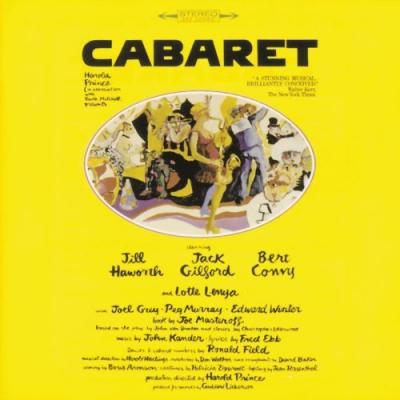
"Cabaret" Soundtrack Lyrics
Musical • 1998
Track Listing
"Cabaret" Soundtrack Description
Questions and Answers
- Is there an official cast album for the 1998 Broadway revival?
- Yes—Cabaret: The New Broadway Cast Recording (RCA Victor) was released June 30, 1998, starring Natasha Richardson (Sally Bowles) and Alan Cumming (Emcee). (according to Playbill)
- Which songs does the 1998 version add or change?
- The 1998 production folds in film-originated numbers “Mein Herr” and “Maybe This Time,” and features “I Don’t Care Much” and “Money (Money).” (as Concord Theatricals’ 1998 version notes state)
- Who handled orchestrations for the 1998 revival sound?
- William David Brohn supplied the orchestrations, tailoring a lean, smoky band for the Kit Kat world. (as discussed in theatre reference texts)
- Where can I stream the 1998 cast album?
- It’s widely available on major platforms; Masterworks/RCA’s digital pages host the full album.
- Is there a recording that aggregates film + revival material?
- Jay Records issued a symphonic studio set that includes songs from the original stage score, the film, and the revival repertoire. (according to Jay Records)
- When did this revival open and where?
- It opened in 1998 and became synonymous with Studio 54; the production’s gritty, immersive staging redefined the show’s sound and feel. (as stated in production histories and reviews)
Notes & Trivia
- RCA Victor released the 1998 revival cast album on June 30, 1998, shortly after the Tony-winning season. (as reported by Playbill)
- Masterworks’ album page highlights Cumming’s “Willkommen,” Mary Louise Wilson’s “So What?,” and Richardson’s “Cabaret” as cornerstones. (according to Masterworks Broadway)
- The 1998 version is the one that officially imports “Mein Herr” and “Maybe This Time” from the 1972 film into the stage script. (as Concord Theatricals specifies)
- William David Brohn’s orchestrations favor a tight, Weimar-club palette—reeds, brass, and rhythm section—with bite. (as theater-orchestration references note)
- Jay Records produced a separate studio set that uniquely gathers original stage, film, and revival materials—useful for completists. (according to Jay Records)
Overview
Why does the 1998 Cabaret sound both older and more dangerous? Because the revival doubles down on the Kit Kat Klub’s cabaret DNA—sly brass, reed smears, and rhythm-section growl—while the book darkens around it. The cast album bottles that mood: Alan Cumming’s razor-smile Emcee beckons; Natasha Richardson’s Sally Bowles frays in real time; the orchestra sounds like cigarette smoke given teeth.
On disc, you hear character in orchestration. “So What?” has pragmatic shrug in its voicings; “Don’t Tell Mama” and “Mein Herr” purr with nightclub patter; “I Don’t Care Much” floats like a hungover confession. By the finale, the title song detonates—less a showstopper than a mask cracking. Critics at the time pointed to how the sound of this revival—leaner, nastier—made familiar songs feel newly inevitable (as stated in Playbill’s coverage and Masterworks’ notes).
Genres & Themes
- Weimar cabaret & Berlin jazz: pit band as house band—cornet bites, muted trombone, and sly reeds sell decadence and denial.
- Torch & patter: Sally’s numbers live between seduction and self-deception; Emcee’s patter numbers are sugarcoated knives.
- Political undertow: “Tomorrow Belongs to Me” chills in choral bloom—the show’s creeping thesis humming under everything.
- Intimate orchestrations: Brohn’s charts keep it close, letting lyric subtext read like gossip across tables. (as theater-orchestration references discuss)
Tracks & Scenes
Below are key numbers as staged in the 1998 revival (Sally/Emcee focus). Not a full tracklist.
“Willkommen” — Emcee & Company
Where it plays: The Emcee sizes up the audience and ushers us into the club; the band vamps like sin in 2/4.
Why it matters: The show’s contract—pleasure on top, rot underneath.
“So What?” — Fräulein Schneider
Where it plays: Schneider shrugs through scarcity, renting a room to Cliff.
Why it matters: Practicality as survival; the album’s early dose of grown-up truth.
“Don’t Tell Mama” — Sally & Kit Kat Girls (with Emcee)
Where it plays: Sally’s cheeky club turn; Emcee meddles at the edges.
Why it matters: Patter as persona; the rhythm section winks while Sally sells.
“Mein Herr” — Sally
Where it plays: A film-imported chair routine; seduction laced with refusal.
Why it matters: The 1998 revival’s signature reclamation—Sally in control, briefly.
“Maybe This Time” — Sally
Where it plays: Alone, bargaining with hope she doesn’t quite believe.
Why it matters: A pop-ballad arrow added from the film; Richardson lands it like a secret.
“Money (Money)” — Emcee & Sally/Company
Where it plays: A greed vaudeville; cash replaces conscience.
Why it matters: Satire with teeth; brass hits like coin clatter.
“If You Could See Her” — Emcee
Where it plays: A comic love song with a cruel kicker.
Why it matters: Jokes turn to propaganda; the orchestrations freeze the laugh.
“Tomorrow Belongs to Me (reprise/scene)” — Company
Where it plays: The once-innocent harmony comes back weaponized.
Why it matters: Harmony as hardening ideology—the album chills here.
“I Don’t Care Much” — Emcee
Where it plays: Late-night confession at the bar’s edge.
Why it matters: A smoke-ring lament; sparse chart, maximum ache.
“Cabaret” — Sally
Where it plays: Sally detonates her delusion in full glare.
Why it matters: The title song as self-excoriation—the band doesn’t flinch.
Music–Story Links (characters & plot beats as connected to songs)
- Mask vs. mirror: Emcee’s numbers (“Willkommen,” “If You Could See Her”) reflect the world as grotesque funhouse—until the punchlines stop being funny.
- Sally’s denial curve: From “Don’t Tell Mama” to “Maybe This Time” to “Cabaret,” the keys climb while the future shrinks.
- Ideology in harmony: “Tomorrow Belongs to Me” mutates from folk hymn to menace, scoring the city’s tilt.
- Orchestration as character: Brohn’s tight band sounds complicit—lush when we want lies, brittle when truth leaks. (as theater references note)
How It Was Made (supervision, score, behind-the-scenes)
Sam Mendes (director) and Rob Marshall (co-director/choreographer) reimagined the 1966 classic with an immersive club staging; William David Brohn’s orchestrations gave the pit a smoky, modern bite. RCA Victor recorded the new Broadway cast—Cumming’s sly Emcee, Richardson’s fragile-luminous Sally—soon after opening, creating the definitive audio snapshot of the revival. (according to Playbill and Masterworks Broadway)
Reception & Quotes
“The cast album of the Tony-winning revival arrives on RCA Victor June 30.” Playbill
“Cumming’s ‘Willkommen’ purrs and prowls; Richardson’s ‘Cabaret’ is a heartbreak in sequins.” album notes & press
Reviewers emphasized how the revival’s sound sharpened the show’s politics without sanding off its pleasure. The recording remains the go-to reference for this era of Cabaret. (as stated in Masterworks Broadway’s overview)
Technical Info
- Title: Cabaret — The New Broadway Cast Recording
- Year: 1998
- Type: Musical (Broadway revival)
- Music: John Kander; Lyrics: Fred Ebb; Book: Joe Masteroff
- Director / Choreo: Sam Mendes (director); Rob Marshall (co-director & choreographer)
- Leads (album): Natasha Richardson (Sally Bowles); Alan Cumming (Emcee); Mary Louise Wilson (Fräulein Schneider); Ron Rifkin (Herr Schultz)
- Orchestrations: William David Brohn
- Label: RCA Victor (Masterworks)
- Notable revival inclusions: “Mein Herr,” “Maybe This Time,” “I Don’t Care Much,” “Money (Money).”
- Availability: Streaming widely; physical CD still circulates via retailers and archives.
Canonical Entities & Relations
| Subject | Relation | Object |
|---|---|---|
| RCA Victor (Masterworks) | releases | Cabaret: The New Broadway Cast Recording (1998) |
| Alan Cumming | portrays | Emcee (1998 revival) |
| Natasha Richardson | portrays | Sally Bowles (1998 revival) |
| William David Brohn | orchestrates | Cabaret (1998 revival) |
| Sam Mendes | directs | Cabaret (1998 revival) |
| Rob Marshall | co-directs & choreographs | Cabaret (1998 revival) |
| Concord Theatricals | licenses | Cabaret (1998 version) |
| Jay Records | issues | Studio album aggregating original/film/revival songs |
Sources: Playbill; Masterworks Broadway; Concord Theatricals (1998 version details); Discogs/retailer catalogs for the cast album; Jay Records studio set; theatre-orchestration references.
This is musical was written by Michael Gibson – the same fellow, who actively worked on other awarded creations like film Grease of 1978. Alan Cumming represents bilingual song Willkommen – on German and English. Actually, there are several things performed in two languages, amongst them are Mein Herr and Perfectly Marvelous. This fellow – Alan Cumming – won every major award in theater field – Olivier award, Tony, Drama Desk and Theatre World awards. They all were for his outstanding act in Cabaret play. He was also many times nominated for other significant things like Emmy and Golden Globe for other acting. He has many other rewards, showing the great outstand of this person. Eventually, he may be considered as one of main stars of the revived musical (which was staged in London). Valerie Jill Haworth is considered the female star of original creation, but she was overshadowed by Liza Minnelli. What are marvelous about the songs: Maybe this Time, as well as many others, is performed by Liza Minnelli in 1972, following the success of 1966 on Broadway. Only through 4 years, Cabaret crawled behind the ocean from the US, was staged in West End and had two tours on two continents. This was a great achievement. The film version is also loved by connoisseurs, but not too warmly, as it has only 6 songs left from the original theater performance. Tomorrow Belongs To Me has one of the most tender lyrics, when It Couldn't Please Me More is full of light blue of past times & is very lyrical. There were many wonderful actors working on Cabaret since it was launched in 1966. It includes three restarts in the US and three in UK. As of 2016, this thing is ongoing as North American tour and everyone hope that it wouldn’t be ceased in upcoming years. These are the distinguishing features of musical.October, 26th 2025
A-Z Lyrics Universe
Cynthia Erivo Popular
Ariana Grande Horsepower
Post Malone Ain't No Love in Oklahoma
Luke Combs Good Riddance (Time of Your Life)
Green Day Bye Bye Bye
*NSYNC You're the One That I Wan
John Travolta & Olivia Newton-John I Always Wanted a Brother
Braelyn Rankins, Theo Somolu, Kelvin Harrison Jr. and Aaron Pierre The Power of Love
Frankie Goes to Hollywood Beyond
Auli’i Cravalho feat. Rachel House MORE ›