"Camelot" Soundtrack Lyrics
Musical • 1998
Track Listing
Julie Andrews
Julie Andrews
Robert Goulet
Richard Burton
Richard Burton
Robert Goulet
Julie Andrews
Mary Sue Berry
Richard Burton
Richard Burton
Ensemble
Julie Andrews
Roddy McDowall
Richard Burton
"Camelot" Soundtrack Description
Questions and Answers
- What exactly is the “1998” Camelot album?
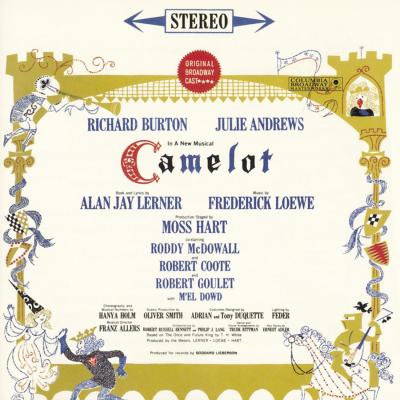
- The 1998 disc is a Columbia/Legacy remaster of the 1960 Original Broadway Cast Recording (Richard Burton, Julie Andrews, Robert Goulet) with refreshed audio and archival notes. (according to Playbill’s reissue coverage)
- When did the 1998 edition hit stores?
- AllMusic lists June 29, 1998 for the Sony/Columbia CD reissue; it’s the widely circulated remaster from that year.
- Who produced and conducted the original cast recording?
- Legendary Columbia producer Goddard Lieberson produced; Franz Allers conducted the orchestra.
- What’s different about the 1998 release vs. older CDs?
- New remastering and expanded booklet materials (playbill clippings, photos, essays) that frame the show’s history for modern listeners. (as stated in the Columbia/Legacy notes summarized by Playbill)
- Is the 1998 remaster streaming today?
- Yes—the remastered program is the standard streaming version on platforms under “Camelot (Original Broadway Cast Recording).”
- Who orchestrated the show heard on this album?
- Robert Russell Bennett and Philip J. Lang provided the classic orchestrations; Trude Rittmann handled dance/choral arrangements.
Notes & Trivia
- 1998’s remaster is part of Sony/Columbia’s Broadway Masterworks initiative, which restored classic cast albums with upgraded sound and booklets. (as reported by Playbill)
- The original 1960 session was cut December 11, 1960 at CBS 30th Street Studio—New York’s storied “church” where Columbia recorded everything from Miles to Bernstein.
- Richard Burton narrates Arthur’s arc with talk-sung gravitas; Robert Goulet’s breakout “If Ever I Would Leave You” became his lifelong signature. (as Masterworks Broadway’s profile reminds)
- The OBC album helped cement the “Camelot” aura around the Kennedy era—often cited in cultural histories. (as stated in Masterworks Broadway’s notes)
- The 1998 CD’s program is the template of what you’ll hear on modern streaming editions. (according to AllMusic and platform listings)
Overview
Why does this soundtrack feel like a legend humming to itself? Because Camelot is all architecture and ache: Lerner & Loewe’s courtly melodies set inside Bennett/Lang’s gleaming orchestrations, sung by a cast whose names became shorthand—Burton’s rue, Andrews’s quicksilver poise, Goulet’s velvet brass. The 1998 remaster doesn’t reinterpret it; it removes dust so the original colors glow.
As an album, it tells a clean story. “Camelot” and “C’est Moi” sketch ideals; “The Lusty Month of May” and “Then You May Take Me to the Fair” introduce temptation and sport; “How to Handle a Woman” pauses the pageantry for intimacy; “If Ever I Would Leave You” detonates romance; and the closing sequences grind those ideals against reality. Critics long ago called it a landmark; the remaster just makes the case easier to hear. (as noted in AllMusic’s overview and Masterworks’ essays)
Genres & Themes
- Golden-age symphonic Broadway: full-bodied reeds and brass, harp glint, and strings that bloom into ballads.
- Pastoral pomp vs. human scale: court ceremonials crash into private confessions; the orchestrations toggle between the two.
- Lyric wit: Lerner’s rhyme play sparkles in patter and sours, on purpose, in the endgame numbers.
- Vocal character-writing: Burton’s spoken-sung candor, Andrews’s crystalline line, Goulet’s baritone sheen map directly onto the love triangle.
Tracks & Scenes
Not a full tracklist—just the anchor numbers as they function in the stage narrative (heard here in the 1998 remaster of the 1960 OBC).
“Camelot” — King Arthur
Where it plays: Arthur sells Guenevere on his vision of a just kingdom.
Why it matters: The thesis song—policy disguised as romance.
“The Simple Joys of Maidenhood” — Guenevere
Where it plays: Early, as Guenevere daydreams about chivalric attention.
Why it matters: Bubbly irony; she’s about to get more attention than she bargained for.
“C’est Moi” — Lancelot
Where it plays: Lancelot’s entrance, brag included.
Why it matters: Comic bravado that sets up a very real moral challenge to Arthur.
“The Lusty Month of May” — Guenevere & Ensemble
Where it plays: Spring festival; flirtation becomes public sport.
Why it matters: The court loosens—so do loyalties.
“How to Handle a Woman” — Arthur
Where it plays: Arthur wonders how to love without smothering.
Why it matters: Grown-up tenderness in a story that could have been all pageant.
“If Ever I Would Leave You” — Lancelot
Where it plays: Lancelot declares an impossible devotion.
Why it matters: Goulet’s calling card; the triangle tips from rumor to inevitability.
“What Do the Simple Folk Do?” — Arthur & Guenevere
Where it plays: The couple tries play-acting at ordinary happiness.
Why it matters: Adorable on the surface, desperate underneath.
“I Loved You Once in Silence” — Guenevere
Where it plays: A confession at the brink.
Why it matters: The melody’s hush carries the cost of all their choices.
“Guenevere” / Finale
Where it plays: Reckoning and a fragile torch passed to Tom of Warwick.
Why it matters: The ideal survives in story if not in law; the album’s ache lingers.
Music–Story Links (characters & plot beats as connected to songs)
- Ideal vs. impulse: The bright “Camelot” fanfare keeps colliding with sensual, modal turns in “Lusty Month” and the Lancelot/Guenevere material.
- Arthur’s humanity: “How to Handle a Woman” strips the crown; the arrangement thins so we hear the man worrying about love and power.
- Love triangle geometry: Goulet’s baritone weight in “If Ever I Would Leave You” is the musical mass that bends every orbit.
- Memory as mission: The finale’s reprise aims the dream at a child; the music literally hands the motif to the future.
How It Was Made (supervision, score, behind-the-scenes)
Columbia’s Goddard Lieberson captured the original company in a single December 11, 1960 session at the famed 30th Street Studio, with Franz Allers conducting and orchestrations by Robert Russell Bennett and Philip J. Lang. The 1998 Columbia/Legacy remaster resurfaced the tapes with cleaner transfers and a handsome booklet (playbill pages, period photos, and a contextual essay). (as stated in Playbill’s reissue note and library/label records)
Reception & Quotes
“A Broadway landmark…the performances and writing remain glorious.” AllMusic
“The remasters in the Masterworks series make the case for the classics all over again.” Playbill
Even for listeners raised on later revivals, the remastered OBC remains the reference point—Burton’s spoken warmth, Andrews’s gleam, and Goulet’s star-making balladry. (as Masterworks Broadway’s profile underscores)
Technical Info
- Title: Camelot — Original Broadway Cast Recording (1998 Columbia/Legacy remaster)
- Year: 1998 (original album 1960)
- Type: Musical
- Music: Frederick Loewe; Lyrics/Book: Alan Jay Lerner
- Original Producer: Goddard Lieberson; Conductor: Franz Allers
- Orchestrations: Robert Russell Bennett; Philip J. Lang; Dance/Choral: Trude Rittmann
- 1998 Label: Columbia/Legacy (Sony); part of Broadway Masterworks remasters
- Selected notable numbers: “Camelot,” “The Simple Joys of Maidenhood,” “C’est Moi,” “The Lusty Month of May,” “How to Handle a Woman,” “If Ever I Would Leave You,” “What Do the Simple Folk Do?,” “I Loved You Once in Silence,” “Guenevere.”
- Recording: December 11, 1960 — CBS 30th Street Studio, NYC
- Availability: 1998 CD reissue and current streaming editions (as listed by AllMusic and major platforms)
Canonical Entities & Relations
| Subject | Relation | Object |
|---|---|---|
| Frederick Loewe | composes | Camelot (score) |
| Alan Jay Lerner | writes lyrics & book for | Camelot |
| Goddard Lieberson | produces | Original Broadway Cast Recording (1960) |
| Franz Allers | conducts | Original Broadway Cast Recording |
| Robert Russell Bennett; Philip J. Lang | orchestrate | Camelot |
| Trude Rittmann | arranges | Dance/choral music |
| Columbia/Legacy (Sony) | remasters & reissues | 1998 CD edition |
| Masterworks Broadway | hosts | OBC album profile & assets |
Sources: Playbill (Columbia Broadway Masterworks reissue note); AllMusic (1998 release listing); Masterworks Broadway (OBC profile); Library/archives catalog entries (recording date/credits); IBDB & OVERTURE credits pages.
October, 26th 2025
A-Z Lyrics Universe
Cynthia Erivo Popular
Ariana Grande Horsepower
Post Malone Ain't No Love in Oklahoma
Luke Combs Good Riddance (Time of Your Life)
Green Day Bye Bye Bye
*NSYNC You're the One That I Wan
John Travolta & Olivia Newton-John I Always Wanted a Brother
Braelyn Rankins, Theo Somolu, Kelvin Harrison Jr. and Aaron Pierre The Power of Love
Frankie Goes to Hollywood Beyond
Auli’i Cravalho feat. Rachel House MORE ›