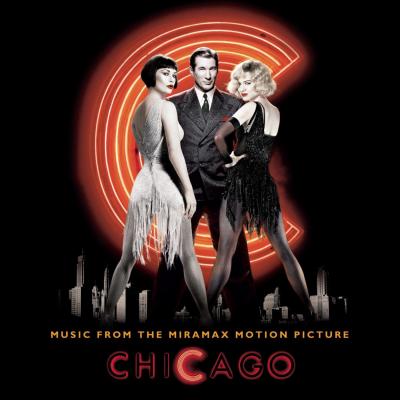
"Chicago" Soundtrack Lyrics
Musical • 2003
Track Listing
Catherine Zeta-Jones / Renee Zellweger / Taye Diggs
Renee Zellweger / Reilly, John C. / Colm Feore
Catherine Zeta-Jones / Susan Misner / Deidre Goodwin
Queen Latifah / Taye Diggs
Richard Gere / Renee Zellweger
Christine Baranski / Cleve Asbury / Shaun Amyot
Renee Zellweger
Catherine Zeta-Jones / Taye Diggs
John C. Reilly
Richard Gere
Catherine Zeta-Jones / Queen Latifah
Renee Zellweger / Taye Diggs
Renee Zellweger / Catherine Zeta-Jones / Taye Diggs
Catherine Zeta-Jones / Renee Zellweger
Danny Elfmann
Danny Elfman
Queen Latifah / Lil' Kim / Macy Gray
Anastacia
Full Script
Gwen Verdon as Roxie Hart
"Chicago: Music from the Miramax Motion Picture" Soundtrack Description

Questions & Answers
- Is there an official soundtrack album?
- Yes. Chicago: Music from the Miramax Motion Picture was issued by Epic/Sony Music in late 2002 (territorial CD issues rolled into early 2003).
- Who wrote the songs—and who composed the film score?
- The songs are by John Kander (music) and Fred Ebb (lyrics). The film’s original score is by Danny Elfman.
- Is there new material written just for the movie?
- Yes—Kander & Ebb wrote “I Move On” specifically for the film, and it plays over the end credits.
- Who supervised/directed the music performances?
- Music direction/supervision is credited to Paul Bogaev, with Maureen Crowe also credited for musical supervision on the film adaptation.
- Does the album include the big showstoppers?
- It includes the headline numbers—“All That Jazz,” “Cell Block Tango,” “We Both Reached for the Gun,” “Mister Cellophane,” “Razzle Dazzle,” and the finale “Nowadays/Hot Honey Rag”—plus two pop-inspired bonus tracks tied to the release.
- What’s with the year 2003?
- The film expanded wide and dominated awards season through early 2003; several regions received CD street dates in January 2003 even though the album originally streeted in November 2002.
Overview
How do you make Fosse’s cynicism sing on film without losing the bite? Chicago solves it by treating every number like a fantasy vaudeville set—spotlights, feathers, and fourth-wall winks—then letting John Kander and Fred Ebb’s tunes do the smiling while Danny Elfman’s underscoring sharpens the edges underneath.
The soundtrack preserves that show-within-a-show design: roaring ensemble cuts (“All That Jazz,” “Cell Block Tango”), character soliloquies (“Mister Cellophane”), and media-circus set pieces (“We Both Reached for the Gun,” “Razzle Dazzle”). It’s staged sleaze with precision polish. One more flourish: “I Move On,” a Kander & Ebb original for the film that doubles as a curtain call over the credits—new, but thematically seamless.
Additional Info
- Label: Epic Records/Sony Music Soundtrax; initial street date November 2002, with several regions following in January 2003.
- Recording: 2002 sessions centered at Metalworks Studios, Ontario, with large ensemble vocals and on-set prerecords.
- Awards: Won the 2004 Grammy Award for Best Compilation Soundtrack Album; “I Move On” received an Oscar nomination.
- Pop tie-ins: Two bonus tracks were packaged for the film campaign alongside the cast performances.
- Score: Danny Elfman contributed original score cues to bridge and accent the narrative between numbers.
Notes & Trivia
- Playbill reported the soundtrack’s Epic/Sony release plan ahead of the film’s opening.
- Discogs’ packaging/credit entries document soundtrack production by Randy Spendlove and Ric Wake.
- Filmtracks highlights Elfman’s score involvement and Paul Bogaev’s role as songs conductor.
- “Class” (Velma & Mama) was filmed but cut; the number appears on home-video editions as a deleted scene.
- CastAlbums records an early-2003 European CD street date—useful for collectors reconciling date discrepancies.
Genres & Themes
Jazz-age vaudeville — brassy horns, struts, and rimshots sell the showbiz sheen while the plot skewers celebrity justice.
Character cabaret — each solo doubles as testimony: Roxie’s star-is-born fantasy, Amos’s self-erasure, Billy’s carnival-barker sales pitch.
Courtroom-as-theater — numbers weaponize spectacle; choreography and chorus lines become legal strategy.

Tracks & Scenes
“Overture / And All That Jazz” — Catherine Zeta-Jones
Where it plays: Opening club sequence as Velma commands the stage; intercut with Roxie’s night out and offstage crime (diegetic performance framing).
Why it matters: Announces the film’s grammar—numbers as stage fantasies that comment on the plot.
“Cell Block Tango” — Velma & the Merry Murderesses
Where it plays: In Cook County Jail’s “Murderers’ Row,” each inmate recounts her crime in stylized vignettes (“Pop! Six! Squish!...”).
Why it matters: A rhythmic character mosaic that sets the story’s unapologetic moral temperature.
“When You’re Good to Mama” — Queen Latifah
Where it plays: Mama Morton’s quid-pro-quo sermon, staged like a sultry club act (diegetic-styled).
Why it matters: Explains the economy of favors that powers the prison—and the plot.
“All I Care About” — Richard Gere
Where it plays: Billy Flynn makes his feather-fan entrance with chorus girls and satin—pure showman optics.
Why it matters: Reframes the defense attorney as ringmaster; justice is a revue, not a system.
“We Both Reached for the Gun” — Richard Gere, Renée Zellweger & Company
Where it plays: Press conference reimagined as a ventriloquist act; Roxie becomes Billy’s puppet, reporters bounce like marionettes.
Why it matters: The film’s sharpest media satire—Fosse mechanics plus newsroom choreography.
“Roxie” — Renée Zellweger
Where it plays: Roxie’s mirrorball fantasy of instant fame, complete with tuxedoed dancers spelling her name in bulbs.
Why it matters: A star-is-born confession—narcissism rendered as charm.
“Mister Cellophane” — John C. Reilly
Where it plays: Amos pleads his invisibility in a sad-sack vaudeville turn under a lonely spotlight.
Why it matters: The film’s human ache—an antidote to all that jazz.
“Razzle Dazzle” — Richard Gere & Company
Where it plays: Trial becomes carnival; Billy sells illusion as evidence, with chorus-girl jurors and ballyhoo flourishes.
Why it matters: The thesis song—spectacle as legal strategy.
“Nowadays / Hot Honey Rag” — Renée Zellweger & Catherine Zeta-Jones
Where it plays: Finale—Roxie and Velma reunite for a razzle-dazzle double act (non-diegetic fantasy staged as triumph curtain call).
Why it matters: Cynical, glittering equilibrium: fame over justice, applause over truth.
“I Move On” — Renée Zellweger & Catherine Zeta-Jones
Where it plays: Original end-credits song written for the film by Kander & Ebb.
Why it matters: A new capstone that still speaks fluent Chicago—ambition, reinvention, brass.
Deleted but notable: “Class” — Catherine Zeta-Jones & Queen Latifah was shot and later issued as a DVD/Blu-ray bonus; the studio cut it from the theatrical run but it appears on many soundtrack editions.
Music–Story Links (characters & plot beats)
- Crime → Cabaret: “All That Jazz” crosscuts the murder with a nightclub act, teaching us to read reality as theater from frame one.
- Favors-as-currency: “When You’re Good to Mama” literalizes the bribery economy that gets Roxie her lawyer and her headlines.
- Media manipulation: “We Both Reached for the Gun” turns the press into props—Billy’s puppetry = narrative control.
- Invisible men: “Mister Cellophane” halts the glitter to show who gets erased in the circus.
- Justice as show: “Razzle Dazzle” makes the verdict a lighting cue; truth bows to choreography.
How It Was Made
Rob Marshall shoots the numbers as fantasy interludes while keeping narrative scenes crisp and unsung. Paul Bogaev served as music director/conductor and oversaw vocal arrangements and prerecords; Maureen Crowe is also credited with musical supervision. Randy Spendlove and Ric Wake produced the soundtrack album, aligning film mixes with album sequencing. Danny Elfman provided the lean, noir-tinged score threads to bridge numbers without dulling the brass.
Reception & Quotes
“A rousing and energetic adaptation… big, brassy fun.” Roger Ebert
“Sassy, sizzling—and smart about turning courtroom drama into revue.” Variety
“Elfman’s underscoring and Bogaev’s supervision make the transitions sing.” Filmtracks
Availability: widely streamable and on physical formats; charted strongly through 2003 and later won the 2004 Grammy for Best Compilation Soundtrack.
Technical Info
- Title: Chicago: Music from the Miramax Motion Picture
- Year: 2003 (film’s wide run & awards year; album originally released Nov 2002 with some regional CDs Jan 2003)
- Type: Musical (film soundtrack)
- Songs by: John Kander & Fred Ebb
- Score: Danny Elfman
- Music Direction/Supervision: Paul Bogaev (music director/conductor); Maureen Crowe (musical supervision)
- Soundtrack Producers: Randy Spendlove, Ric Wake
- Label: Epic Records / Sony Music Soundtrax
- Notable placements: “All That Jazz,” “Cell Block Tango,” “We Both Reached for the Gun,” “Mister Cellophane,” “Razzle Dazzle,” “Nowadays/Hot Honey Rag,” “I Move On” (original song for film)
- Studios/Recording: principal work at Metalworks Studios (Mississauga, ON)
- Awards: Grammy (Best Compilation Soundtrack, 2004); “I Move On” nominated for the Academy Award
Canonical Entities & Relations
| Subject | Relation | Object |
|---|---|---|
| Chicago (2002 film) | songs by | John Kander; Fred Ebb |
| Chicago (2002 film) | score by | Danny Elfman |
| Chicago: Music from the Miramax Motion Picture | record label | Epic Records / Sony Music Soundtrax |
| Chicago: Music from the Miramax Motion Picture | album producers | Randy Spendlove; Ric Wake |
| Chicago (2002 film) | music director & conductor | Paul Bogaev |
| Chicago (2002 film) | musical supervision | Maureen Crowe |
| Chicago (2002 film) | features song | “I Move On” (original song for film) |
Sources: Playbill; Discogs; Filmtracks; IMDb; Wikipedia.
October, 28th 2025
A-Z Lyrics Universe
Cynthia Erivo Popular
Ariana Grande Horsepower
Post Malone Ain't No Love in Oklahoma
Luke Combs Good Riddance (Time of Your Life)
Green Day Bye Bye Bye
*NSYNC You're the One That I Wan
John Travolta & Olivia Newton-John I Always Wanted a Brother
Braelyn Rankins, Theo Somolu, Kelvin Harrison Jr. and Aaron Pierre The Power of Love
Frankie Goes to Hollywood Beyond
Auli’i Cravalho feat. Rachel House MORE ›