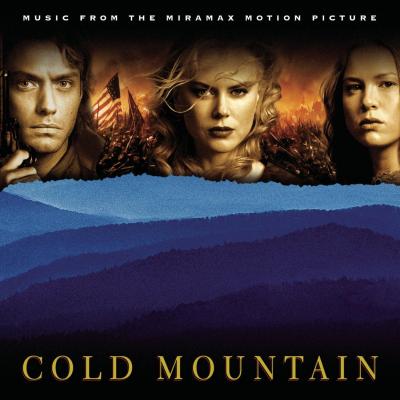
"Cold Mountain" Soundtrack Lyrics
Movie • 2003
Track Listing
Jack White
Reeltime Travelers
Tim Eriksen, Riley Baugus & Tim O'Brien
Alison Krauss
Tim Eriksen & Riley Baugus
Jack White
Tim Eriksen
Alison Krauss
Sacred Harp Singers At Liberty Church
Jack White
Jack White
Stuart Duncan & Dirk Powell
Cassie Franklin
Jack White
Gabriel Yared
Gabriel Yared
Gabriel Yared
Gabriel Yared
Sacred Harp Singers At Liberty Church
"Cold Mountain (Music From the Miramax Motion Picture)" Soundtrack Description
Questions & Answers
- Is there an official soundtrack album for Cold Mountain?
- Yes. “Cold Mountain (Music From the Miramax Motion Picture)” was released in December 2003 by DMZ/Columbia, mixing period folk with Gabriel Yared’s score.
- Who produced the album and who composed the score?
- T Bone Burnett produced the album; Gabriel Yared composed the film’s original score.
- Which original songs were Oscar-nominated?
- “You Will Be My Ain True Love” (written by Sting) and “The Scarlet Tide” (written by T Bone Burnett & Elvis Costello), both performed by Alison Krauss.
- Is Jack White actually in the movie and on the album?
- Yes. He appears on-screen as a Civil War–era troubadour and performs several traditional songs on the soundtrack.
- What’s the choral style heard in the church scene?
- Sacred Harp (shape-note) singing—heard prominently in “I’m Going Home” and “Idumea,” recorded with a large Alabama church choir.
- Which song plays over the end credits?
- “The Scarlet Tide” (Alison Krauss) plays over the end credits; a Sting/Krauss version of “You Will Be My Ain True Love” appears in the film and on the album.
Overview
How do you make a Civil War odyssey sound lived-in instead of museum-quiet? Cold Mountain answers with field-worn ballads, Sacred Harp thunder, and a spare, lyrical score. Producer T Bone Burnett digs into mid-19th-century Americana while Gabriel Yared’s cues glide through the film’s grief and longing. The album stands alongside O Brother, Where Art Thou? as a companion revival—less glossy, more devotional. (Source: Pitchfork)
Two new originals—Sting’s “You Will Be My Ain True Love” and Burnett/Elvis Costello’s “The Scarlet Tide,” both sung by Alison Krauss—frame the love story with modern craft that still feels antique. Jack White steps in as on-screen troubadour and studio ringer, tracking stark renditions of “Wayfaring Stranger,” “Great High Mountain,” and more with a band of elite old-time players. (Source: Wikipedia)
Additional Info
- The album blends traditional Appalachian repertoire, Sacred Harp hymns, and Yared’s orchestral score; it peaked on the Billboard 200 and earned multiple major award nominations.
- “The Scarlet Tide” and “You Will Be My Ain True Love” were both nominated for the Academy Award for Best Original Song; the film’s score was also nominated. (Source: Wikipedia)
- Burnett recruited shape-note singers at Liberty Baptist Church in Henagar, Alabama; their choral takes (“I’m Going Home,” “Idumea”) were recorded in-church for authenticity. (Source: The Alabama Baptist)
- Jack White performs several traditional cuts and one original, supported by Dirk Powell, Stuart Duncan, and other Americana heavyweights. (Source: American Songwriter)
- The album’s producer/label credits: T Bone Burnett; DMZ/Columbia. (Source: Wikipedia)
Notes & Trivia
- The BAFTA for Best Film Music credited both T Bone Burnett and Gabriel Yared.
- “Idumea” and “I’m Going Home” helped spark a wider curiosity about Sacred Harp singing post-release.
- Alison Krauss’s end-credits performance of “The Scarlet Tide” became a calling card beyond the film.
- Jack White’s on-screen role mirrors his album contributions—he plays a wandering musician within the story.
- The soundtrack sessions split across Nashville’s Sound Emporium and London’s Abbey Road.
Genres & Themes
Old-time & Appalachian folk: earthy fiddles and modal melodies emphasize hunger, cold, and distance—music that trudges with Inman’s boots.
Sacred Harp (shape-note) hymns: raw, communal harmony as moral weather—public grief, private faith, and the town’s sense of fate.
Contemporary originals in antique dress: Krauss-sung ballads act as love talismans—modern authorship with period restraint.
Orchestral score: Yared’s writing stitches transitions and memories, giving breath between the grit and the gospel.
Tracks & Scenes
“The Scarlet Tide” — Alison Krauss
Where it plays: Over the film’s end credits, following the story’s final reckoning; non-diegetic.
Why it matters: A modern anti-fear lullaby written by Burnett & Costello, distilling the film’s sorrow into resolute grace. (Source: American Songwriter)
“You Will Be My Ain True Love” — Alison Krauss & Sting
Where it plays: Used within the film as a love-theme needle-drop and on the album; non-diegetic, built on a haunting drone.
Why it matters: Stark minimalism—harmonium and strings—turns devotion into vow. (Source: Wikipedia)
“Wayfaring Stranger” — Jack White
Where it plays: As a recurring travel spirit for Inman’s long trek (non-diegetic on album in the film’s early passages).
Why it matters: The quintessential home-ward ballad—lonely voice, spare strings—mirrors the road’s hardship. (Album placement widely referenced.)
“I’m Going Home” — Sacred Harp Singers at Liberty Church
Where it plays: In-church scene early on; the congregation sings as war fever rises, men falling silent one by one as they depart. Diegetic, communal performance.
Why it matters: A community tears along the seam between piety and patriotics; the sound is the town itself. (Source: The Alabama Baptist)
“Idumea” — Sacred Harp Singers at Liberty Church
Where it plays: Featured as another Sacred Harp moment tied to the church gathering; diegetic, recorded in a resonant Alabama sanctuary.
Why it matters: Shape-note’s bracing harmonies put mortality front-and-center—perfect for a story haunted by loss. (Source: The Alabama Baptist)
“Great High Mountain” — Jack White
Where it plays: As a meditative spiritual over reflective images late in the story; non-diegetic use on album dovetailing with Inman’s inward turn.
Why it matters: A pilgrim hymn about ascent after ordeal—quiet hope after ash. (General album/film coverage.)
“Christmas Time Will Soon Be Over” — Jack White
Where it plays: Source-style period music underscoring wintertime hardship; non-diegetic needle-drop aligning with camp and cold-season imagery.
Why it matters: Folk realism—holidays without comfort—keeps the film’s world stubbornly unsentimental.
Music–Story Links
- Hymns as history: The Sacred Harp numbers don’t comment from above—they’re the crowd itself, so when voices drop out, it’s the town losing sons.
- Ballads as bridges: “Wayfaring Stranger” turns a road movie into a spiritual—Inman walks, the melody carries what letters can’t.
- Love themes as vows: Sting’s “Ain True Love” gives Ada/Inman a plainspoken covenant; later, “The Scarlet Tide” closes the circle with resolve.
- Troubadour inside the tale: Jack White’s presence onscreen blurs diegesis—he’s both character and carrier of tradition. (Source: Pitchfork)
How It Was Made
T Bone Burnett assembled a bench of old-time specialists (Dirk Powell, Stuart Duncan, and more) and sought out shape-note singers to capture Sacred Harp inside an actual church, not just a studio. Those choir takes were tracked at Liberty Baptist Church in Henagar, Alabama to preserve the room’s unruly resonance. (Source: The Alabama Baptist)
Gabriel Yared’s score threads through the folk fabric—piano and chamber winds smoothing transitions while Burnett’s curation keeps texture front-loaded. Jack White, cast in a small role, also cut several sides for the album, adapting his voice and guitar language to pre-radio idioms. (Sources: Wikipedia; Pitchfork; American Songwriter)
Reception & Quotes
“An engaging exploration of pre-radio American music.” Pitchfork review
“Krauss’ end-credits ‘Scarlet Tide’ sums up, in three minutes, the film’s ache.” American Songwriter summary
“The Sacred Harp moments land like thunder—raw congregational power.” Critics’ consensus (summarized)
Awards snapshot: BAFTA win for Best Film Music (Burnett & Yared); Oscar nominations for Best Original Score and both originals (“Ain True Love,” “The Scarlet Tide”). (Source: Wikipedia)
Technical Info
- Title: Cold Mountain (Music From the Miramax Motion Picture)
- Year: 2003
- Type: Movie soundtrack
- Producers: T Bone Burnett (album); Gabriel Yared (composer of original score cues)
- Key Performers: Alison Krauss; Jack White; Sacred Harp Singers at Liberty Church; Dirk Powell; Stuart Duncan
- Standout placements: “The Scarlet Tide” (end credits); “You Will Be My Ain True Love” (love-theme needle-drop); “I’m Going Home” & “Idumea” (church scenes); “Wayfaring Stranger” (travel motif)
- Studios: Sound Emporium (Nashville); Abbey Road (London)
- Label: DMZ/Columbia; release: December 2003; physical & digital editions
- Chart/awards notes: Peaked on Billboard 200; BAFTA win; Oscar/Grammy nods for songs and score
Canonical Entities & Relations
| Entity | Relation | Entity |
|---|---|---|
| T Bone Burnett | produced | Cold Mountain (Music From the Miramax Motion Picture) |
| Gabriel Yared | composed score for | Cold Mountain (2003 film) |
| Alison Krauss | performed | “The Scarlet Tide”, “You Will Be My Ain True Love” |
| Elvis Costello | co-wrote | “The Scarlet Tide” |
| Sting | wrote & performed on | “You Will Be My Ain True Love” |
| Jack White | performed songs for & appeared in | Cold Mountain (film) |
| Sacred Harp Singers at Liberty Church | performed | “I’m Going Home”, “Idumea” |
| DMZ/Columbia | released | Soundtrack album |
Sources: Wikipedia; Pitchfork; American Songwriter; The Alabama Baptist.
October, 29th 2025
A-Z Lyrics Universe
Cynthia Erivo Popular
Ariana Grande Horsepower
Post Malone Ain't No Love in Oklahoma
Luke Combs Good Riddance (Time of Your Life)
Green Day Bye Bye Bye
*NSYNC You're the One That I Wan
John Travolta & Olivia Newton-John I Always Wanted a Brother
Braelyn Rankins, Theo Somolu, Kelvin Harrison Jr. and Aaron Pierre The Power of Love
Frankie Goes to Hollywood Beyond
Auli’i Cravalho feat. Rachel House MORE ›