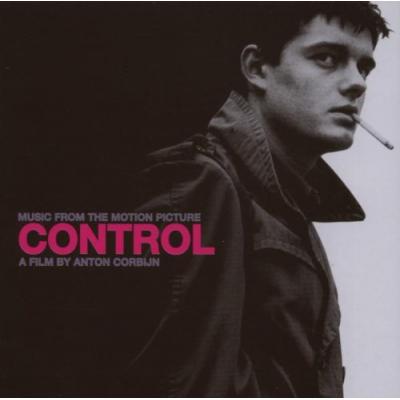
"Control" Soundtrack Lyrics
Movie • 2007
Track Listing
New Order
The Velvet Underground
The Killers
The Buzzcocks
Joy Division
Supersister
Iggy Pop
Joy Division
Sex Pistols
New Order
David Bowie
John Cooper Clarke
Roxy Music
Joy Division
Kraftwerk
Joy Division
David Bowie
New Order
"Control (Music from the Motion Picture)" Soundtrack Description
Questions & Answers
- Is there an official soundtrack album?
- Yes. Control (Music from the Motion Picture) was released in 2007, widely circulated on Rhino/Warner-affiliated imprints and streaming services.
- Who provided the score/incidental music?
- New Order (the post-Joy Division group of Bernard Sumner, Peter Hook and Stephen Morris) contributed original incidental music cues for the film.
- Are the Joy Division performances in the film the original recordings?
- No—the actors perform the live Joy Division numbers on screen; licensed studio recordings from other artists (Bowie, Buzzcocks, Roxy Music, Kraftwerk) are the originals.
- What plays over the end credits?
- The Killers’ cover of Joy Division’s “Shadowplay” closes the film.
- Who handled music supervision?
- Ian Neil is credited as the film’s music supervisor.
- Where can I hear the album?
- Major platforms host Control (Original Motion Picture Soundtrack) (2007) as a 17-track compilation.
Overview
How do you capture a band that hated myth-making? Anton Corbijn’s Control scores the answer with austere period cuts, raw in-film performances, and discreet new cues by New Order. Instead of drowning Ian Curtis’s story in nostalgia, the soundtrack frames it—punk’s spark on one side, post-punk’s chill on the other.
The compilation pulls era-defining tracks (Velvet Underground, Buzzcocks, Iggy Pop, Bowie, Roxy Music, Kraftwerk) alongside Joy Division essentials, then lets the cast perform key Joy Division scenes live. It’s an honest, narrow-band mix: no gloss, just the records Curtis heard and the sound his band was becoming. IMDb, Discogs and Spotify all line up on the release, while Wikipedia’s film entry and a long-running Joy Division archive clarify what’s diegetic versus licensed.
Additional Info
- Album identity: Issued in 2007 as Control (Music from the Motion Picture); retail copies commonly list Rhino/Warner credits.
- New Order’s role: Bernard Sumner, Peter Hook and Stephen Morris supply original incidental cues as New Order.
- Cast-as-band: All live Joy Division performances in the film are by the actors, not vintage recordings.
- Signature closer: The Killers’ “Shadowplay” cover runs over the end credits.
- Licensing palette: Original recordings by David Bowie, Roxy Music, Kraftwerk, Iggy Pop, Buzzcocks, Velvet Underground appear as source/needle-drops.
- Availability: Streaming compilation typically shows 17 tracks; physical editions vary by territory.
Notes & Trivia
- Corbijn had photographed Joy Division and later directed New Order’s “Atmosphere” video—his history subtly shapes the soundtrack’s restraint.
- The album sequencing mixes originals with one high-profile cover (“Shadowplay” by The Killers) to bridge eras.
- Two New Order instrumentals (“Exit,” “Hypnosis”) function as connective tissue between period songs.
- Stand-up poet John Cooper Clarke’s “Evidently Chickentown” appears—perfectly abrasive for late-night mood.
- Physical editions differ slightly in packaging/art and region codes; Discogs documents multiple pressings.
Genres & Themes
Proto-/post-punk spine = inevitability. Velvet Underground to Buzzcocks to Joy Division: the track curation maps how Ian’s tastes funnel into his band’s language.
Glam & art-rock hues = aspiration vs. alienation. Bowie and Roxy Music signal the outward-facing glamour Ian admired but couldn’t inhabit.
Krautrock pulse = motion without release. Kraftwerk’s motorik steadiness mirrors the film’s trudging fates—tour, work, repeat.
Tracks & Scenes
“Transmission” — Joy Division (performed by the cast)
Where it plays: TV studio sequence (diegetic) as the band seizes their moment on Tony Wilson’s local program.
Why it matters: The mantra “dance, dance, dance” lands like a dare; the live-for-camera energy cements Joy Division’s arrival.
“Love Will Tear Us Apart” — Joy Division (performed by the cast)
Where it plays: Late-performance setting (diegetic), echoing cracks in Ian and Deborah’s marriage.
Why it matters: The lyric’s private ache turns public; the film lets performance bleed into biography.
“Dead Souls” — Joy Division
Where it plays: Used non-diegetically to bridge touring montage and mounting pressure.
Why it matters: Its churn and chant feel like the inside of Ian’s head—circling, escalating.
“Shadowplay” — The Killers
Where it plays: End credits (non-diegetic).
Why it matters: A contemporary salute that sends viewers out with the same stark riff, reframed by a 2007 arena-rock tilt.
“What Goes On” — The Velvet Underground
Where it plays: Early source moment (non-diegetic/needle-drop) sketching Ian’s tastes in the pre-band days.
Why it matters: A stylistic breadcrumb—the drone and chug that Joy Division would purify.
“Boredom (Live at the Roxy)” — Buzzcocks
Where it plays: Club scene energy bed (diegetic/venue speakers) in the punk-scene montage.
Why it matters: Punk’s permission slip: noise, nerve, and the will to start a band.
“Sister Midnight” — Iggy Pop
Where it plays: Night interiors/source moment (diegetic) underlining restlessness and split selves.
Why it matters: Sleaze and shadow—themes the film doesn’t prettify.
“Drive-In Saturday” — David Bowie
Where it plays: Domestic/interlude sequence (non-diegetic), scoring a fleeting calm.
Why it matters: Glam as ghost—beauty Ian can admire but can’t keep.
“2HB” — Roxy Music
Where it plays: Lounge-ish source cue (diegetic) contrasting the band’s raw sets.
Why it matters: Sophistication as foil; Joy Division’s austerity reads sharper against it.
“Autobahn” — Kraftwerk
Where it plays: Travel montage (non-diegetic) tracking the grind of small tours.
Why it matters: Motorik hypnosis becomes narrative glue—forward motion without emotional escape.
“Evidently Chickentown” — John Cooper Clarke
Where it plays: Late-night Mancunian texture (diegetic/venue PA) with poetic bite.
Why it matters: Northern grit, unvarnished—the film’s sense of place in one relentless rant.
“Atmosphere” — Joy Division
Where it plays: A reflective passage (non-diegetic) near the close.
Why it matters: Elegy without melodrama—the cue most closely aligned with Corbijn’s visual restraint.
Music–Story Links
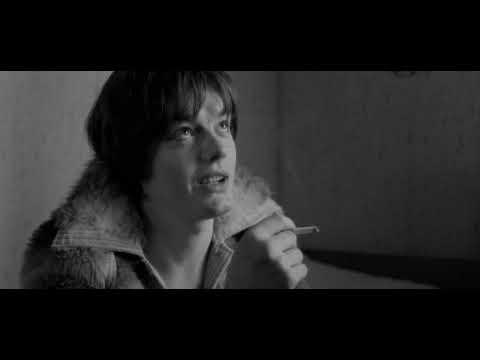
When the band surges, the film lets the cast play—diegetic performances that keep us in the room with Ian. When life crowds in, period records take over: Buzzcocks’ scrappy yelp for the scene’s spark, Bowie/Roxy for unreachable glamour, Kraftwerk for the tour treadmill. New Order’s bridges hold the structure together, the sound of a future already forming in grief.
How It Was Made
Incidental music: New Order wrote original cues for the film, while the core Joy Division material was performed live on set by the cast—Anton Corbijn’s way of avoiding archival feel.
Supervision: Music supervisor Ian Neil steered clearances and curation, assembling a period-true set that reflected Curtis’s documented listening.
Reception & Quotes
Critics praised the soundtrack’s integrity: no jukebox bloat, just songs that Ian loved, performed or heard as he lived them. The compilation and the film both read as carefully argued time capsules.
“The Velvet Underground, Roxy Music, David Bowie and Iggy Pop all aurally influence Ian Curtis …” Vanity Fair
“Actors perform the Joy Division numbers; licensed ’70s tracks land as the world around them.” IMDb / Wikipedia
“Official album on Rhino/Warner routes; streaming editions typically run 17 tracks.” Spotify / Discogs
Technical Info
- Title: Control (Music from the Motion Picture)
- Year: 2007
- Type: Movie (biographical drama)
- Incidental music: New Order
- Music Supervision: Ian Neil
- Selected notable placements: “Transmission” (TV studio performance); “Love Will Tear Us Apart” (live set); “Shadowplay” (end credits, The Killers); “What Goes On” (period source); “Autobahn” (travel montage); “Evidently Chickentown” (late-night texture)
- Label/album status: Rhino/Warner-affiliated release; regional pressings documented
- Availability: Streaming compilation (approx. 17 tracks) and 2007 CD editions; territories vary slightly
Canonical Entities & Relations
| Entity | Relation | Entity |
|---|---|---|
| Control (2007, Movie) | features | Control (Music from the Motion Picture) (MusicAlbum) |
| New Order | composed/performed | Incidental music (“Exit,” “Hypnosis”) |
| Joy Division | songs by | “Transmission,” “Love Will Tear Us Apart,” “Atmosphere,” “Dead Souls” |
| The Killers | performed | “Shadowplay” (cover) — end credits |
| Ian Neil | served as | Music Supervisor |
| Rhino / Warner | released | 2007 soundtrack CD |
| Anton Corbijn | directed | Control (Movie) |
Sources: Wikipedia; IMDb; Discogs; Spotify; Vanity Fair; Joy Division Central (fan archive with citation notes).
October, 29th 2025
A-Z Lyrics Universe
Cynthia Erivo Popular
Ariana Grande Horsepower
Post Malone Ain't No Love in Oklahoma
Luke Combs Good Riddance (Time of Your Life)
Green Day Bye Bye Bye
*NSYNC You're the One That I Wan
John Travolta & Olivia Newton-John I Always Wanted a Brother
Braelyn Rankins, Theo Somolu, Kelvin Harrison Jr. and Aaron Pierre The Power of Love
Frankie Goes to Hollywood Beyond
Auli’i Cravalho feat. Rachel House MORE ›