Soundtracks:  A B C D E F G H I J K L M N O P Q R S T U V W X Y Z #


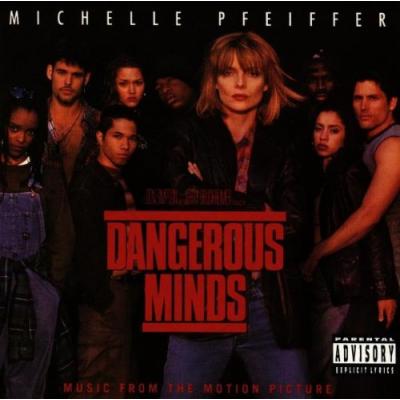
Dangerous Minds Album Cover

"Dangerous Minds" Soundtrack Lyrics

Movie • 1995

Track Listing


"Dangerous Minds: Music from the Motion Picture" Soundtrack Description

Dangerous Minds 1995 official trailer still with Michelle Pfeiffer, used to illustrate the soundtrack’s presence in promotion
Dangerous Minds — Theatrical Trailer, 1995

Overview

What happens when a classroom drama becomes a pop-rap phenomenon? Dangerous Minds answered that in 1995: its soundtrack turned a gritty teacher–student story into a chart-topping cultural moment. The album leans hard into West Coast hip-hop and mid-’90s R&B, with Coolio & L.V.’s “Gangsta’s Paradise” as the gravitational center—instantly recognizable and inseparable from Michelle Pfeiffer’s on-screen stare-downs.

Beyond the hit single, the album works like a mixtape of mood: bass-forward street realism rubbing shoulders with smoother New Jack and hip-hop soul. Inside the film, Wendy & Lisa’s score stitches scenes together while needle-drops sketch character and place. It’s a soundtrack that doesn’t just sell the movie; it reframes it—no accident that Billboard and the RIAA would soon be part of its story.

Questions & Answers

Is there an official soundtrack album?
Yes — Dangerous Minds: Music from the Motion Picture (1995), released on MCA Soundtracks/UMG.
Who composed the score heard between the songs?
Wendy Melvoin & Lisa Coleman (better known as Wendy & Lisa) composed the original score.
Which song became the breakout hit from the film?
Coolio featuring L.V.’s “Gangsta’s Paradise,” built on Stevie Wonder’s “Pastime Paradise.”
Does “Gangsta’s Paradise” play in the film itself or only in marketing?
It plays in the movie (including over the titles) and anchored the film’s marketing and music video.
Who handled music supervision?
Kathy Nelson served as the film’s music supervisor.
Did the album chart well?
Yes. It hit No. 1 on the Billboard 200 in 1995 and later earned multi-platinum certification.
Where can I stream the album today?
It’s available on major platforms (e.g., Apple Music and Spotify) under its original title.

Notes & Trivia

  • “Gangsta’s Paradise” intentionally contains no profanity to clear the Stevie Wonder interpolation—an unusual constraint for a 1995 rap single.
  • The soundtrack topped the U.S. album chart weeks after release; it wasn’t just a single-driven success.
  • Wendy & Lisa came aboard after producers sought a cohesive score voice to bridge the film’s needle-drops.
  • Michelle Pfeiffer appears in the “Gangsta’s Paradise” video, visually tying the hit to the movie’s classroom setting.
  • The album became a mid-’90s touchstone for hip-hop/R&B soundtracks alongside titles like Above the Rim and Waiting to Exhale.

Genres & Themes

West Coast hip-hop & G-funk — Fat bass, minor-key keys, and choir-like hooks mirror the film’s hard choices and moral weight. The Coolio/L.V./Doug Rasheed production sets a somber pulse rather than party energy, reflecting students’ lived stakes.

Hip-hop soul & R&B — Sleek mid-tempo cuts soften edges for scenes of rapport and respite; that polish underlines LouAnne’s attempts to meet students where they are. In short: indie grit for reality, R&B balm for possibility.

Dangerous Minds trailer frame highlighting classroom tension and music’s somber tone
Dangerous Minds — Trailer music cues framing the classroom stakes (1995)

Tracks & Scenes

Below are notable, verifiable placements; timing notes refer to the U.S. theatrical cut.

“Gangsta’s Paradise” — Coolio feat. L.V.
Where it plays: Over the opening titles and early sequences as LouAnne drives into her new environment; also reprised in the film’s end run/credits context via the film’s marketing and video tie-in. Non-diegetic.
Why it matters: Sets the film’s thesis in four minutes: fear, fatalism, and a plea for guidance. The Stevie Wonder backbone (“Pastime Paradise”) gives it moral gravitas.

“Mr. Tambourine Man” — Bob Dylan
Where it plays (usage in story): LouAnne Johnson uses the lyrics in class to teach metaphor and symbolism; the song itself is referenced within instruction. Diegetic reference (pedagogical, not a full performance on screen).
Why it matters: Bridges the canon and the classroom; LouAnne reframes poetry as relevant to the students’ world.

“This Is the Life” — Wendy & Lisa
Where it plays: Used within the film and featured on the album (non-diegetic soundtrack placement).
Why it matters: Connects the scoring duo’s tonal language to the compilation, smoothing transitions between dramatic beats and radio-ready tracks.

Additional album cuts — R&B and rap tracks by artists like Aaron Hall, Big Mike, Craig Mack, and IMx/Immature appear on the album and in film cues. While not every on-screen moment is foregrounded, the selections amplify setting (hallways, bus rides, neighborhood exteriors) with period-correct groove rather than needle-drop spectacle.

Music–Story Links

When LouAnne first meets the class’s hostility, “Gangsta’s Paradise” frames the broader system they’re up against—its choral bed makes every choice feel judged by a larger choir. Later, her Dylan lesson (“Mr. Tambourine Man”) reframes language as a survival tool; the film’s hip-hop/R&B selections counter stereotypes by giving students a sonic home turf. Wendy & Lisa’s cues do the quiet labor: connective tissue in scenes where behavior changes slowly, not in big Hollywood swings.

Dangerous Minds trailer image emphasizing student–teacher face-offs underscored by somber hip-hop cues
Musical subtext — trailer frames that the full film develops in score and songs

How It Was Made

Score: Wendy Melvoin & Lisa Coleman, alumni of Prince’s Revolution, wrote the original score after producers sought a cohesive musical voice to tie scenes together.

Supervision: Kathy Nelson oversaw licensing and song placement — crucial for clearing a major Stevie Wonder interpolation and aligning label partners.

The single that moved mountains: “Gangsta’s Paradise” (Coolio feat. L.V.), produced by Doug Rasheed, interpolates “Pastime Paradise” (1976). Its Antoine Fuqua–directed video, with Pfeiffer on screen, functioned like a second trailer.

Reception & Quotes

The album didn’t just ride the movie; it charted its own course, hitting No. 1 in the U.S. and driving the public conversation around the film. “Gangsta’s Paradise” won the Grammy for Best Rap Solo Performance and became the year’s defining single.

“A riveting, atmospheric single that turned a classroom drama into a national soundtrack.” Billboard-era coverage (summary)
“Coolio’s bleak, choral-laced hit gave the film a moral spine.” Entertainment press retrospectives
“The video with Pfeiffer felt like homework—assigned, yes—but you kept playing it.” Pop-culture essays

Trusted sources referenced in this section and throughout: Billboard, RIAA, IMDb, Apple Music.

Additional Info

  • The album release date: July 11, 1995 (U.S.).
  • Label branding: MCA Soundtracks/UMG (period materials sometimes show MCA or Geffen under UMG).
  • “Gangsta’s Paradise” video crossed 1B views decades later, underscoring its durable link to the film.
  • Clearance note: Stevie Wonder’s approval required cleaning up language; the result broadened radio reach.
  • The soundtrack’s chart run coincided with a 1995 boom in movie albums, placing it among the year’s biggest.
  • Wendy & Lisa’s later TV scoring streak (Crossing Jordan, Heroes, Nurse Jackie) traces back to this film’s success.
  • Music supervisor Kathy Nelson became one of the most credited supervisors of the ’90s/’00s studio era.
Dangerous Minds trailer still highlighting the film’s moody lighting that the soundtrack mirrors
Trailer imagery — moody lighting that the soundtrack mirrors

Technical Info

  • Title: Dangerous Minds: Music from the Motion Picture
  • Year: 1995
  • Type: Movie soundtrack (compilation + original score)
  • Composers (score): Wendy Melvoin & Lisa Coleman
  • Lead single: “Gangsta’s Paradise” — Coolio feat. L.V. (interpolates Stevie Wonder’s “Pastime Paradise”)
  • Music Supervision: Kathy Nelson
  • Label: MCA Soundtracks (UMG)
  • Release/Context: U.S. release July 11, 1995; fueled marketing via the Coolio video
  • Chart/Availability: U.S. No. 1 album; certified multi-platinum; widely available on Apple Music/Spotify

Canonical Entities & Relations

EntityRelationEntity
Dangerous Minds (film)has soundtrackDangerous Minds: Music from the Motion Picture
Coolio feat. L.V.performs“Gangsta’s Paradise” (recording)
Stevie Wondercomposed source for“Pastime Paradise” → interpolated in “Gangsta’s Paradise”
Wendy Melvoin & Lisa ColemancomposeOriginal score cues for film
Kathy Nelsonmusic supervisedDangerous Minds (film)
MCA SoundtracksreleasedOfficial soundtrack album

Sources: Billboard; RIAA; IMDb; Apple Music; Wikipedia; Discogs; Film Music Society.

October, 30th 2025


A-Z Lyrics Universe

Lyrics / song texts are property and copyright of their owners and provided for educational purposes only.