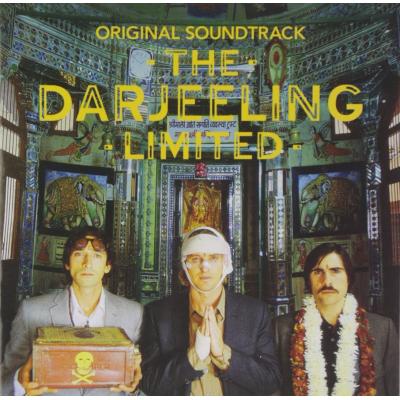
"Darjeeling Limited" Soundtrack Lyrics
Movie • 2007
Track Listing
Peter Sarstedt
Ustad Vilayat Khan
The Kinks
Satyajit Ray
Jyotirindra Moitra
Satyajit Ray
Satyajit Ray
Shankar Jaikishan
Satyajit Ray
Jodphur Sikh Temple Congregation
Jyotirindra Moitra
Satyajit Ray
Alexis Weissenberg
Kisore Kumar
Narlia Village Troubadour
The Kinks
Udaipur Convent School Nuns and Students
Fritz Reiner and The Chicago Symphony Orchestra
The Rolling Stones
Ustad Vilayat Khan
The Kinks
Joe Dassin
"The Darjeeling Limited: Original Soundtrack" Soundtrack Description
Overview
What happens when a mixtape becomes the map? The Darjeeling Limited answers by letting vintage Indian film scores, British rock deep cuts, and a few impeccably chosen pop gems steer three brothers through grief, ego, and (maybe) grace aboard a North Indian train. Instead of commissioning a new score, Wes Anderson curates—raiding Satyajit Ray and Merchant-Ivory soundtracks, then punctuating them with The Kinks, The Rolling Stones, Peter Sarstedt, and Joe Dassin.
The result feels both devotional and mischievous: raga-tinged cues give the film its pulse; rock songs deliver the gut-punches and slow-motion catharses. According to ABKCO Records, the official album collects this palette, including three Kinks tracks and the first Rolling Stones song to appear on a Wes Anderson soundtrack album. And yes, it’s unabashedly a vibe: dusty-warm, bittersweet, and a little wry—the sound of running for a train while carrying way too much baggage (literal and otherwise).
Questions & Answers
- Is there an official soundtrack album?
- Yes. It’s titled The Darjeeling Limited: Original Soundtrack and was released in 2007 by ABKCO Records.
- Who handled the music curation?
- Director Wes Anderson and longtime music supervisor Randall Poster shaped the selections; the film primarily uses pre-existing recordings.
- Which Kinks songs are in the film?
- “This Time Tomorrow,” “Strangers,” and “Powerman,” all from the 1970 album Lola Versus Powerman and the Moneygoround, Part One.
- What’s the French song over the end credits?
- Joe Dassin’s “Les Champs-Élysées” plays in full during the closing credits.
- Does the short film Hotel Chevalier connect musically?
- Yes. Peter Sarstedt’s “Where Do You Go To (My Lovely)?” is central in Hotel Chevalier and threads into the feature’s musical identity.
- Is there original score composed for this movie?
- Not in the usual sense—Anderson pulls heavily from Satyajit Ray’s film music and other Indian cinema cues instead of commissioning a new score.
- Where can I stream the album?
- It’s available on major platforms (e.g., Spotify/Apple Music) under the compilation title noted above.
Notes & Trivia
- It’s the first Wes Anderson soundtrack album to include a Rolling Stones track (“Play With Fire”).
- Three Kinks songs frame the brothers’ arc: the run, the reckoning, and the letting-go.
- Much of the “score” comes from Satyajit Ray’s films—Anderson treats those cues like sacred threads between scenes.
- Peter Sarstedt’s song gained a second life with Hotel Chevalier; Pitchfork later spotlighted how the pairing revived interest in the artist.
- The album omits Beethoven’s Seventh (heard in the film), a frequent point of fan confusion.
Genres & Themes
Classic Indian film music → Spiritual drift & ritual. Ray and Merchant-Ivory cues wrap the train’s compartments in tradition—harmonium, sitar, and orchestral textures that make prayer scenes and processions feel lived-in, not exoticized.
’70s British rock → Momentum & rupture. The Kinks arrive whenever the brothers move or choose—running, confronting, shedding baggage. Brit-rock becomes a metronome for change.
Baroque/classical touches → Melancholy clarity. A piano “Clair de Lune” excerpt surfaces like moonlight after arguments: reflective, a little bruised, quietly grand.
Tracks & Scenes
“This Time Tomorrow” — The Kinks
Where it plays: Opening minutes (~00:02–00:04), as Peter (Adrien Brody) sprints and leaps onto the train—classic Anderson slow-motion; non-diegetic.
Why it matters: Restless guitars + Ray Davies’s itinerant lyrics frame the whole movie as forward motion even when the brothers are stuck.
“Strangers” — The Kinks
Where it plays: Mid-film, in the river-accident aftermath and funeral procession sequence; long, wordless slow-motion walk; non-diegetic.
Why it matters: The refrain (“we are not two, we are one”) becomes a thesis for grief shared and brotherhood relearned.
“Powerman” — The Kinks
Where it plays: Late film (final act), as the brothers sprint, drop their monogrammed luggage, and catch the next train—non-diegetic.
Why it matters: The literal shedding of baggage to those crunchy guitars is the character beat made physical: choose each other, not the stuff.
“Play With Fire” — The Rolling Stones
Where it plays: Late sequence aboard the train—Anderson’s lateral, compartment-to-compartment tableau of the supporting cast; non-diegetic.
Why it matters: A sinuous, ominous glide that reframes the ensemble and underlines how fragile these reconciliations really are.
“Where Do You Go To (My Lovely)?” — Peter Sarstedt
Where it plays: Heard in the film’s orbit and central to the prologue short Hotel Chevalier; non-diegetic needle-drop during Jack’s Paris interlude.
Why it matters: Nostalgia with a sting—romance complicated by class and memory. It also stitches the short to the feature’s emotional fabric.
“Les Champs-Élysées” — Joe Dassin
Where it plays: End credits (full song); non-diegetic.
Why it matters: A jaunty sing-along that recasts the journey’s bruises as buoyant possibility—one last smile before the lights come up.
Title & theme cues — Satyajit Ray, Ustad Vilayat Khan, Shankar-Jaikishan, et al.
Where they play: Throughout: temple prayers, quiet cabin beats, travel montages; often diegetic-adjacent (ritual/performance) or non-diegetic underscoring.
Why they matter: They honor the cinematic lineages Anderson is referencing. According to The Criterion Collection, Anderson explicitly drew on Ray and Merchant-Ivory to give the film a shared cultural grammar.
Music–Story Links
Anderson uses songs as emotional jump cuts. The opening “This Time Tomorrow” literally propels Peter aboard; the later “Powerman” repeats the motif but demands a sacrifice (drop the bags). “Strangers” reframes the Whitmans’ narcissism after the river tragedy—their grief is not unique, and the walk to the funeral makes them small in the best way. Meanwhile “Play With Fire” slides through compartments like a cautionary whisper: you can fake rituals, but you can’t fake growth.
How It Was Made
Music supervision here meant archaeology. Randall Poster has described traveling to India and working with rights holders to access Satyajit Ray and Merchant-Ivory recordings. The compilation nature of the score explains why the film feels like it’s remembering as much as it’s unfolding—Anderson and Poster treat these older cues as living artifacts rather than background wallpaper.
Per ABKCO Records, the album collects 22 tracks, from Indian cinema themes to rock cornerstones, with Anderson and Poster credited as compilation producers. (IMDb lists Poster as music supervisor; The Criterion Collection’s release features a discussion with James Ivory specifically about these source cues.)
Reception & Quotes
“A loving homage to the film music of Satyajit Ray and Merchant-Ivory.” Criterion/Slant coverage
“Three Kinks tracks, each landing on an unforgettable slow-motion beat.” ScreenRant discussion
“Sarstedt’s song found a new audience via Anderson’s prologue and feature pairing.” Pitchfork feature
Fans and critics often call out the “Strangers” funeral walk and the luggage-drop “Powerman” run as quintessential Anderson syncs. Availability note: the album is widely streaming; physical editions have been repressed intermittently.
Additional Info
- Label notes credit Wes Anderson and Randall Poster as compilation producers.
- Not every song heard in the film appears on the album (e.g., a Beethoven cue).
- The Stones’ sync marks a rare inclusion on an Anderson soundtrack album due to past licensing hurdles.
- Some Indian cues originate from Charulata, Jalsaghar, Teen Kanya, Shakespeare Wallah, and others.
- “Les Champs-Élysées” closes the film in full—a fact often used in music-quiz nights.
- Anderson’s prologue short Hotel Chevalier premiered with the feature, musically anchored by Sarstedt.
- Collectors note Sterling Sound mastering on certain editions.
- The Spotify and Apple track orders match the ABKCO sequence, not scene order.
Technical Info
- Title: The Darjeeling Limited: Original Soundtrack
- Year: 2007
- Type: Movie soundtrack (compilation of pre-existing recordings)
- Key curators: Wes Anderson (compilation producer); Randall Poster (music supervisor/compilation producer)
- Label: ABKCO Records (initial release September 25, 2007)
- Notable placements: “This Time Tomorrow” (opening run), “Strangers” (funeral walk), “Powerman” (luggage drop/train leap), “Play With Fire” (compartment tableau), “Les Champs-Élysées” (end credits)
- Availability: CD, digital, and streaming; vinyl/physical pressings appear periodically.
Canonical Entities & Relations
| Entity | Relation | Entity |
|---|---|---|
| Wes Anderson | Compilation producer of | The Darjeeling Limited: Original Soundtrack |
| Randall Poster | Music supervisor / compilation producer of | The Darjeeling Limited soundtrack |
| ABKCO Records | Record label for | The Darjeeling Limited: Original Soundtrack |
| The Kinks | Performs | “This Time Tomorrow” / “Strangers” / “Powerman” |
| The Rolling Stones | Performs | “Play With Fire” |
| Joe Dassin | Performs | “Les Champs-Élysées” |
| Satyajit Ray | Composes source cues used in | The Darjeeling Limited |
| Ustad Vilayat Khan / Shankar-Jaikishan | Composes source cues used in | the film/album |
Sources: ABKCO Records; Wikipedia; IMDb; The Criterion Collection; Pitchfork; ScreenRant; Discogs; MusicBrainz; Spotify.
October, 30th 2025
A-Z Lyrics Universe
Cynthia Erivo Popular
Ariana Grande Horsepower
Post Malone Ain't No Love in Oklahoma
Luke Combs Good Riddance (Time of Your Life)
Green Day Bye Bye Bye
*NSYNC You're the One That I Wan
John Travolta & Olivia Newton-John I Always Wanted a Brother
Braelyn Rankins, Theo Somolu, Kelvin Harrison Jr. and Aaron Pierre The Power of Love
Frankie Goes to Hollywood Beyond
Auli’i Cravalho feat. Rachel House MORE ›