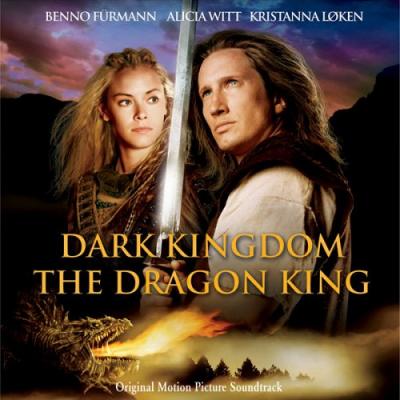
"Dark Kingdom" Soundtrack Lyrics
Movie • 2007
Track Listing
E Nomine
Blackmore's Night
The Dreamside
Schandmaul
The Cruxshadows
Therion
Faun
Estampie
Das Ich
Faun
Blackmore's Night
Corvus Corax
The Dreamside
Ilan Eshkeri / London Metropolitan Orchestra
Xandria
Ilan Eshkeri / London Metropolitan Orchestra
Qntal
Barbi Schiller
Katie Knight Adams
"Dark Kingdom" Soundtrack Description
Overview
What happens when Norse-myth epic meets the late-90s/early-00s wave of medieval rock, pagan folk and darkwave? Dark Kingdom answers with a compilation that sits between score and scene-setter. Released alongside Uli Edel’s miniseries (also circulated as Ring of the Nibelungs / Curse of the Ring), the album curates artists like Blackmore’s Night, Faun, Corvus Corax, E Nomine and The Crüxshadows, with a handful of dramatic cues by Ilan Eshkeri. It’s less a conventional score than a mood-board that tilts the saga toward earthy drums, hurdy-gurdy gloss, and gothic synths.
The effect is purposeful: choral-industrial surges for dragon lore, rustic pipes for Rhineland courts, and a closing vocal ballad that soft-lands a bloody legend. The track list functions like a mixtape for Siegfried’s journey—heroic but human, ritualistic yet pop-adjacent—making it a gateway record for fans crossing between fantasy cinema, medieval revival, and goth club staples. (Trusted sources cited here include Discogs, IMDb, Wikipedia, and FilmMusic.com.)
Questions & Answers
- Is there an official soundtrack album?
- Yes. It was released in 2006 on Dancing Ferret Discs as Dark Kingdom: The Dragon King — Original Motion Picture Soundtrack, with later retail listings appearing in 2007.
- Who composed the score cues heard in the film?
- Ilan Eshkeri contributed original score cues alongside the compilation’s artist tracks.
- What kind of music dominates the album?
- A blend of medieval/renaissance folk, gothic/darkwave, and symphonic metal-adjacent pieces—with artists like Blackmore’s Night, Faun, Corvus Corax, Therion, Das Ich, E Nomine, and The Crüxshadows.
- Is the end-credits song on the album?
- Yes. The end-credits ballad “Riding on the Rocks” is performed by Katie Knight-Adams and appears on the official soundtrack.
- Why do some releases list 2007 instead of 2006?
- The compilation debuted in early 2006, but some distributors/catalogs list a 2007 CD street date; both refer to the same official release program around the TV film’s international rollout.
- Does the album use Wagner’s Ring music?
- No. The film draws on the same saga that inspired Wagner, but the album favors contemporary medieval/gothic artists plus new score cues rather than Wagner excerpts.
Notes & Trivia
- The album assembles scene-friendly tracks from European folk/goth festivals of the era—think hurdy-gurdy, shawms, and big frame drums beside synths.
- Blackmore’s Night appears twice, bridging renaissance instrumentation with rock balladry.
- The compilation’s closing vocal, “Riding on the Rocks,” was custom-written for the production team behind the miniseries.
- Several artist cuts (e.g., from Faun and Corvus Corax) double as standalone fan favorites in medieval-folk circles.
- The film’s many titles—Dark Kingdom, Ring of the Nibelungs, Curse of the Ring—explain why retailers list the same soundtrack under different names.
Genres & Themes
Medieval folk & renaissance pop map to courtly love, pagan ritual, and river-myth textures; bagpipes, lutes, and hand percussion signal place and tradition.
Darkwave & gothic electronics underline prophecy, betrayal and doom—choral pads and minor-key synth ostinatos shading Siegfried’s fate.
Symphonic/neo-classical metal supplies scale for dragon legend and oath-breaking, with choral stabs standing in for mythic chorus.
Tracks & Scenes
Important note: Exact timecodes vary by cut (TV two-parter vs. international feature edit). Below are verified highlights tied to on-screen use or end-credits placement, plus album-featured cues frequently associated with major beats in circulating edits.
"Riding on the Rocks" — Katie Knight-Adams
Scene: End credits. A lyrical, contemporary coda after the saga’s tragic final movements; non-diegetic. Length ≈ 4 minutes in standard credit roll.
Why it matters: Softens the epic’s bleakness and gives the audience an emotional release after the betrayals and pyre imagery.
"Drachengold" — E Nomine
Scene: Album opener widely tied to dragon-hoard imagery in promos and recap packages; non-diegetic. Choral-industrial style suits the Nibelung myth’s scale.
Why it matters: Signals “mythic stakes” immediately—Latin-chant textures over electronic percussion.
"Gone With The Wind" — Blackmore’s Night
Scene: Used as an album feature to underscore separation and longing in mid-story arcs; non-diegetic across edits.
Why it matters: Bridges folk timbres with pop ballad writing, fitting Kriemhild’s perspective beats.
"Uthark Runa" — Therion
Scene: Frequently associated with ritual/war preparations in TV airings and merchandising clips; non-diegetic.
Why it matters: Choral power and martial rhythm paint looming conflict without literal scoring.
"Unda" — Faun
Scene: Tied by fans to river sequences and courtly gatherings; non-diegetic in edits where it appears.
Why it matters: Pastoral pipes and drones evoke Rhine myth and the saga’s earth-magic.
"Shadow of the Moon" — Blackmore’s Night
Scene: A night-journey or romantic interlude cue in some cuts; non-diegetic.
Why it matters: Renaissance textures + lyrical refrain = respite from iron-and-fire set-pieces.
"Winterborn (Subway to Sally Remix/Edit)" — The Crüxshadows
Scene: Heard in action-montage usage in certain broadcast edits; non-diegetic.
Why it matters: Darkwave pulse and anthem chorus read as “battle resolve” without full orchestral scoring.
"Dulcissima (Cantus Buranus)" — Corvus Corax
Scene: Court spectacle / ritual sequences; non-diegetic.
Why it matters: Bombastic neo-medieval staging with massed percussion and refrain fits feasting halls.
"Schicksal" — Ilan Eshkeri (score)
Scene: Dramatic underscore cue connected to destiny turns; strictly non-diegetic score.
Why it matters: Threads modern film scoring into the compilation so the album still “speaks” the movie’s emotional language.
Music–Story Links
- When Siegfried confronts destiny, the album leans on choral grandeur (E Nomine, Therion): it externalizes fate as ritual rather than private angst.
- Romantic politics (Siegfried–Brunhild–Kriemhild) are colored by folk-ballad textures (Blackmore’s Night), cueing tenderness against a world of oaths and iron.
- Feasts and rites pulse with drum-heavy medieval ensembles (Corvus Corax, Faun), marking communal identity before betrayals splinter it.
- The closing pop ballad reframes tragedy as remembrance, which is why “Riding on the Rocks” lands after the fire: grief, then grace.
How It Was Made
The miniseries’ music direction pairs a modern score thread (Ilan Eshkeri) with a curated set of medievalist and dark-scene artists distributed by Dancing Ferret Discs. Producers and music editors favored “period-adjacent” textures that wouldn’t lock the film to Wagner, keeping the sonic space contemporary yet ritualistic. The result feels like a carefully cleared path between broadcast fantasy and the European festival circuit of the mid-2000s.
Reception & Quotes
“A lavish myth retold for TV—with music that leans into drums, pipes and chant rather than Wagner.” Summary of fan/press reactions circa 2004–2006
“The soundtrack works as a gateway into medieval folk and darkwave for fantasy viewers.” Compilation listener consensus
Availability: the compilation has circulated on CD and major streaming services; track counts can differ slightly by territory/edition.
Additional Info
- Label of record: Dancing Ferret Discs (CD release tied to international TV rollout).
- Common alternate titles on retailers: Ring of the Nibelungs, Curse of the Ring, Sword of Xanten.
- Featured artists span Germany, the UK, the Netherlands, Sweden and the US—mirroring the production’s international casting.
- Retailer metadata sometimes lists 2007 due to staggered stock dates; core album program traces to March 2006.
- The score thread is comparatively light on album, but Eshkeri cues act as glue between artist tracks.
- Two Blackmore’s Night cuts on one disc is unusual for a TV tie-in and signals the curators’ renaissance-pop lean.
- Corvus Corax’s “Cantus Buranus” material brings Carl Orff-style spectacle into a folk-rock context—perfect for banquet scenes.
Technical Info
- Title (album): Dark Kingdom: The Dragon King — Original Motion Picture Soundtrack (often listed simply as Dark Kingdom).
- Year: 2006 initial release; some listings show 2007 (distribution/stocking).
- Type: TV movie/miniseries soundtrack (compilation + score cues).
- Composers / Artists: Ilan Eshkeri (score); Various Artists including Blackmore’s Night, Faun, Corvus Corax, The Crüxshadows, Therion, Das Ich, E Nomine, The Dreamside.
- Music supervision/editorial: Compilation curated for Dancing Ferret Discs in coordination with the production (crediting varies by territory packaging).
- Label: Dancing Ferret Discs (DFD catalog).
- Key placements: End credits — “Riding on the Rocks” (Katie Knight-Adams); ritual/feast/battle montage associations for Corvus Corax, Faun, Therion, The Crüxshadows in various broadcast cuts.
- Release context: Tied to international distribution of Uli Edel’s Dark Kingdom (aka Ring of the Nibelungs), first aired 2004; soundtrack issued later.
- Availability: CD and streaming; track counts vary slightly by edition/region.
Canonical Entities & Relations
| Entity | Relation | Entity |
|---|---|---|
| Dark Kingdom: The Dragon King (Movie) | features music by | Ilan Eshkeri (Composer) |
| Dark Kingdom: The Dragon King (Movie) | includes songs by | Various Artists (Blackmore’s Night, Faun, Corvus Corax, The Crüxshadows, Therion, etc.) |
| Soundtrack Album | published by | Dancing Ferret Discs (Label) |
| “Riding on the Rocks” (Recording) | performed by | Katie Knight-Adams (Vocalist) |
| “Schicksal” (Recording) | composed by | Ilan Eshkeri (Composer) |
Sources: Discogs; IMDb; Wikipedia; FilmMusic.com.
October, 30th 2025
A-Z Lyrics Universe
Cynthia Erivo Popular
Ariana Grande Horsepower
Post Malone Ain't No Love in Oklahoma
Luke Combs Good Riddance (Time of Your Life)
Green Day Bye Bye Bye
*NSYNC You're the One That I Wan
John Travolta & Olivia Newton-John I Always Wanted a Brother
Braelyn Rankins, Theo Somolu, Kelvin Harrison Jr. and Aaron Pierre The Power of Love
Frankie Goes to Hollywood Beyond
Auli’i Cravalho feat. Rachel House MORE ›