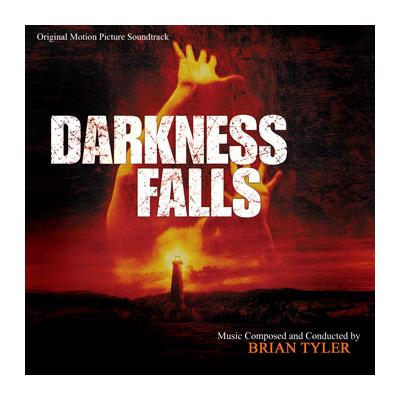
"Darkness Falls" Soundtrack Lyrics
Movie • 2003
Track Listing
Closure
Brian Tichy
Vixtrola
"Darkness Falls (Original Motion Picture Soundtrack)" Soundtrack Description
Overview
What does “stay in the light” sound like? In Darkness Falls (2003), Brian Tyler answers with a sprinting, nervy score—short cues, hard attacks, and a survival rhythm that rarely lets up. The album, released the same year, is a compact blitz of strings, low brass hits, and percussion flurries that mirror the film’s don’t-blink pacing.
Underneath the orchestral adrenaline, sparse source songs puncture the blackout: a post-industrial end-credits needle-drop and a few rock cues that pop up in apartments and bars. The blend keeps the movie’s rulebook—light equals life—front and center while giving the audience brief, gritty snapshots of everyday sound before the Tooth Fairy snuffs them out. AllMusic catalogs the album as a Brian Tyler release; Varèse Sarabande issued the CD in March 2003; and IMDb documents the handful of featured source tracks.
Questions & Answers
- Is there an official soundtrack album?
- Yes. Darkness Falls (Original Motion Picture Soundtrack) is a Brian Tyler score album released in 2003 on Varèse Sarabande; it’s also available on major streaming platforms.
- Who composed the score?
- Brian Tyler composed and conducted the original score.
- What song plays over the end credits?
- “Gunboat” — Vixtrola plays when the credits begin.
- What rock track is heard when Kyle is swapping flashlights in his apartment?
- “Look Out Below” — Closure is heard diegetically during that apartment sequence.
- Are the source songs on the Varèse score CD?
- No—the CD focuses on Tyler’s score. The movie’s rock cues (Vixtrola, Closure, etc.) are licensed source tracks not included on the score album.
- Where can I stream the score?
- Streaming services carry the 2003 Brian Tyler album; availability can vary by region.
Notes & Trivia
- The album consists entirely of Brian Tyler’s score cues; the film’s rock songs are not part of the official CD.
- End credits use a female-fronted industrial/alt-rock track—Vixtrola’s “Gunboat”—a tonal jolt after 80+ minutes of orchestral chase.
- Several cue titles (“Stay in the Light,” “Lose a Tooth”) double as plot rules or in-scene beats—handy breadcrumbs when following the film.
- The CD first shipped in early March 2003 and later went out of print; digital platforms reintroduced it for streaming years later.
- Composer Brian Tyler was on a 2003 heater—this score arrived the same season he did Children of Dune and, soon after, The Hunted.
Genres & Themes
Hybrid orchestral horror: tightly wound strings, low brass surges, and percussion patterns that feel like a metronome for running. It’s kinetic rather than purely atmospheric.
Source-music jolts: gritty rock cues—heard on radios, in rooms, over credits—briefly reset the ear, then the score drags us back into the dark. The contrast underlines the film’s rule: light equals safety.
Tracks & Scenes
“Gunboat” — Vixtrola
Where it plays: End credits (non-diegetic). The lights come back on—then this post-industrial track ushers you out.
Why it matters: A stylish exit that feels modern and caustic, telegraphing survival with scars.
“Look Out Below” — Closure
Where it plays: Kyle’s apartment while he cycles through flashlights; heard as background source audio (diegetic).
Why it matters: A grounded, contemporary texture that makes the “gear-up” prep feel like real life intruding on a nightmare.
“Hand of Emptiness” — Brian Tichy
Where it plays: Briefly as source music in the film (likely radio/room ambience).
Why it matters: Another abrasive, guitar-forward splash that contrasts with Tyler’s orchestral language.
“Rock Nation” — Scott Nickoley & Jamie Dunlap
Where it plays: Bar/room ambience as a diegetic needle-drop.
Why it matters: Library-style rock cue that sells small-town nightlife before the lights—and safety—go again.
“Stay in the Light” — Brian Tyler
Where it plays: Score cue underscoring the film’s mantra during chase beats with flashlights; non-diegetic.
Why it matters: It’s the musical embodiment of the rulebook: urgent figures + percussive clockwork = run now.
“Lose a Tooth” — Brian Tyler
Where it plays: Score cue tied to the legend’s trigger moments; non-diegetic.
Why it matters: A sharp, staccato piece that punctuates the movie’s mythology with a grim little wink.
Scene placements for the licensed songs are documented by IMDb and community-verified notes at SoundtrackINFO; score cue functions are inferred from on-screen usage and cue titles. The official score CD/stream confirms track names and order via Varèse Sarabande and AllMusic.
Music–Story Links
Every time light becomes a plot device, Tyler’s writing tightens—the rhythm section behaves like a pulse ox for the scene. When characters hold still, the harmony thins; when they bolt, ostinatos snap into place.
The source songs puncture the dread with everyday noise—radios, room sound, a closing-credits shock of cool. That contrast keeps the monster supernatural and the humans painfully normal.
How It Was Made
Brian Tyler composed and conducted; orchestrations and recording credits reflect his early-2000s action-horror toolkit—fast turnarounds, short cues, lots of kinetic writing. The score album arrived from Varèse Sarabande with a sub-50-minute runtime that mirrors the movie’s breathless pace.
On the film side, the handful of source cues were licensed for specific diegetic moments (apartment prep; bar ambience) and the credits crawl. That editorial restraint preserves tone—needle-drops never overwhelm the central musical identity.
Reception & Quotes
“Tyler keeps the music in constant motion—short cues that punch hard and get out.” MovieMusic UK
“A brisk, aggressively orchestrated horror score that mirrors the film’s pace.” AllMusic capsule notes
The film’s critical notices were mixed, but the score earned steady appreciation among horror fans who wanted tense, high-energy writing without wall-to-wall dissonance.
Additional Info
- Album focus: score only. Licensed songs do not appear on the Varèse CD.
- Key licensed tracks in-film: Vixtrola “Gunboat” (end credits); Closure “Look Out Below” (apartment scene); plus brief rock cues by Brian Tichy and Nickoley/Dunlap.
- Streaming: the complete Brian Tyler score is available on major services.
- Cue design: many tracks run 40–150 seconds—built for fast editorial intercuts.
- Collectability: original CD pressings have gone out of print; catalog references persist via label discographies.
Technical Info
- Title: Darkness Falls (Original Motion Picture Soundtrack)
- Year / Type: 2003 / movie
- Composer & Conductor: Brian Tyler
- Label: Varèse Sarabande (VSD-6449)
- Album length: ~48 minutes (26 cues on streaming editions)
- Release timeline: CD shipped early March 2003; digital/streaming availability added later
- Notable in-film songs (licensed): Vixtrola “Gunboat”; Closure “Look Out Below”; Brian Tichy “Hand of Emptiness”; Nickoley/Dunlap “Rock Nation”
- Film release context: Theatrical U.S. release January 24, 2003
Canonical Entities & Relations
| Subject | Relation | Object |
|---|---|---|
| Brian Tyler | composed score for | Darkness Falls (2003 film) |
| Varèse Sarabande | released | Darkness Falls (Original Motion Picture Soundtrack) |
| Vixtrola | performed | “Gunboat” (end credits) |
| Closure | performed | “Look Out Below” (apartment scene) |
| Brian Tichy | performed | “Hand of Emptiness” (source in film) |
| Scott Nickoley & Jamie Dunlap | wrote/performed | “Rock Nation” (source in film) |
Sources: AllMusic; Varèse Sarabande; IMDb; SoundtrackINFO; Discogs; MovieMusic.com; Spotify.
October, 30th 2025
A-Z Lyrics Universe
Cynthia Erivo Popular
Ariana Grande Horsepower
Post Malone Ain't No Love in Oklahoma
Luke Combs Good Riddance (Time of Your Life)
Green Day Bye Bye Bye
*NSYNC You're the One That I Wan
John Travolta & Olivia Newton-John I Always Wanted a Brother
Braelyn Rankins, Theo Somolu, Kelvin Harrison Jr. and Aaron Pierre The Power of Love
Frankie Goes to Hollywood Beyond
Auli’i Cravalho feat. Rachel House MORE ›