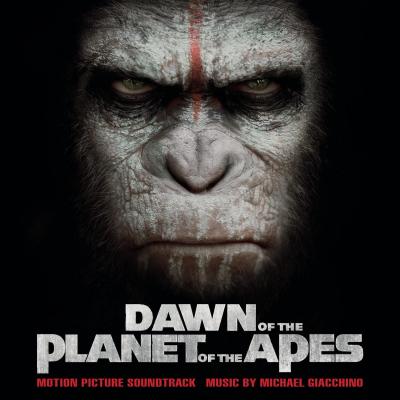
"Dawn of the Planet of the Apes" Soundtrack Lyrics
Movie • 2014
Track Listing
The Band
"Dawn of the Planet of the Apes" Soundtrack Description
Overview
How do you score a civilization that’s learning to speak? Michael Giacchino’s Dawn of the Planet of the Apes (Original Motion Picture Soundtrack) answers with ritual percussion, austere choir, and a melody that tentatively blooms into hope before collapsing back into conflict. Rather than wall-to-wall “action brass,” the album alternates pulse-heavy suspense with processional, almost sacred writing for Caesar’s community—music that listens as much as it leads. (Trusted sources: the album’s Sony Classical release and full program are documented by Apple Music and Discogs.)
Director Matt Reeves uses the score like weather: omnipresent, shaping mood and movement. Jerry Goldsmith’s 1968 DNA lingers in the modern textures, but Giacchino’s voice—think Lost’s pensive piano fused to battery-of-drums thunder—is the film’s center of gravity. The result is a score-first soundtrack: no pop source cues vying for attention, just a long, sculpted arc that tracks trust, fear, and the tipping point into war. (Trusted sources referenced in this article include Wikipedia and Film Music Reporter.)
Questions & Answers
- Is there an official soundtrack album?
- Yes. Dawn of the Planet of the Apes (Original Motion Picture Soundtrack) was released in July 2014 on Sony Classical/Fox Music as a score album by Michael Giacchino.
- Who composed the music?
- Michael Giacchino composed the score; it’s performed by a large Hollywood Studio Symphony ensemble with choir, recorded at the Newman Scoring Stage.
- Does the album include songs or only score?
- Only score. It’s a purely orchestral/choral album built around recurring thematic material and heavy percussion.
- What’s the end-credits cue called?
- “Planet of the End Credits,” an almost nine-minute suite that restates the score’s principal ideas.
- Are there nods to earlier Apes scores?
- Yes—Giacchino’s writing alludes to Jerry Goldsmith’s original 1968 sound-world while staying firmly in his own idiom.
- Is there a single “main theme”?
- There are several motifs; the most lyrical emerges in “The Great Ape Processional,” later swelling in “Primates for Life.”
Notes & Trivia
- Giacchino’s notorious track-title puns are in full force—“Gorilla Warfare,” “The Apes of Wrath,” “How Bonobo Can You Go.”
- The end-title suite, “Planet of the End Credits,” compresses the score’s core ideas into one big farewell.
- Reviewers frequently compared the harmonic language to his Lost writing, with percussion nods to classic Apes sonics.
- Score-first soundtrack: the film uses no pop needle-drops, keeping the soundworld unified.
Genres & Themes
Primal percussion—taikos, low toms, and ensemble battery—telegraph communal will and impending conflict; drums equal law.
Choral austerity supplies mythic scale for Caesar’s moral choices, often hanging over static harmonies like a warning flare.
String-led lament gives the apes’ family theme its humanizing warmth, first tentative, then bolder as the community briefly stabilizes.
Tracks & Scenes
"The Great Ape Processional" — Michael Giacchino
Scene: Early in the film, a communal sequence in the ape settlement—ceremony, family, and order; non-diegetic score.
Why it matters: Introduces the score’s most lyrical motif, framing Caesar’s people as a culture, not a mob.
"Past Their Primates" — Michael Giacchino
Scene: Quiet interludes among Caesar’s family after first contact with humans; non-diegetic.
Why it matters: Transforms the processional melody into intimate strings—empathy over spectacle.
"Close Encounters of the Furred Kind" — Michael Giacchino
Scene: Tense standoff moments as humans enter ape territory; non-diegetic suspense writing that blossoms into an “ape” action idea.
Why it matters: Establishes the score’s primary action rhythm—drums that feel like a heartbeat shared by two species.
"The Lost City of Chimpanzee" — Michael Giacchino
Scene: Exploration sequences around the overgrown city and dam; non-diegetic with distant choral color.
Why it matters: Eerie choral clusters tilt the sound toward myth and ruin.
"Monkey to the City" — Michael Giacchino
Scene: Movement from the forest toward San Francisco; travel montage energy.
Why it matters: Momentum cue—rhythmic ostinatos that push characters into the human world’s remains.
"Monkey See, Monkey Coup" — Michael Giacchino
Scene: The insurrection kicks off; non-diegetic battle writing with pounding ensemble drums.
Why it matters: One of the score’s fiercest action cues—pure kinetic threat.
"Gorilla Warfare" — Michael Giacchino
Scene: Prolonged combat through the city and at the tower; non-diegetic.
Why it matters: Extended set-piece writing that layers choir over percussion for apocalyptic weight.
"The Apes of Wrath" — Michael Giacchino
Scene: Violent clashes as loyalties split; non-diegetic.
Why it matters: Brutal accents and low-brass clusters render rage without dialogue.
"Primates for Life" — Michael Giacchino
Scene: Aftermath and hard-won clarity as dawn breaks—non-diegetic.
Why it matters: Emotional culmination of the apes’ family theme; tenderness after thunder.
"Planet of the End Credits" — Michael Giacchino
Scene: End credits suite.
Why it matters: A nine-minute curtain call weaving the score’s themes into a satisfying epilogue.
Music–Story Links
- Processional → polity: when drums move in lockstep, the film frames the apes as a society with rules—Caesar’s ideal.
- Choir = conscience: vocal writing often enters at moral forks (mercy vs. vengeance), echoing Caesar’s burden.
- Ostinatos mark escalation: once the human–ape détente falters, relentless patterns signal inevitability—conflict as machinery.
- End-credits suite reframes the narrative as cycle, not closure—motifs recur, unresolved, like history repeating.
How It Was Made
Recorded at the Newman Scoring Stage with an 80-plus piece orchestra and sizable choir, the sessions emphasized live percussion layers and low-end presence. Matt Reeves and Giacchino discussed honoring the franchise’s avant textures (think Goldsmith’s 1968 sound experiments) while writing a modern, character-first score. Music supervision was handled on the studio side, with Patrick Houlihan credited; the album itself was issued by Sony Classical/Fox Music with Giacchino producing.
Reception & Quotes
“The atmosphere is carefully constructed… the core material is very strong.” Movie Wave (James Southall)
“Highlights involve ‘Great Ape Processional’ and ‘Primates for Life,’ aided by rhythmic and choral effects.” Filmtracks review
Contemporary coverage framed the album as a strong in-film experience that can feel long as a standalone listen—common for score-only releases.
Additional Info
- Label/issue: Sony Classical with Fox Music; digital and CD editions launched the week of July 7–8, 2014.
- End-credits stinger: no extra scene, but an audio tag follows the credits in theatrical presentations.
- Giacchino’s pun tradition became a minor news item during the trilogy’s press—fans swap favorites (“The Apes of Wrath” is up there).
- Session players include a large Hollywood Studio Symphony roster; Tim Simonec is credited as conductor/orchestrator.
- Themes: a dignified family/processional idea, a jagged war rhythm, and bleak choral colorings for moral fracture.
- Album runtime sits around 77–78 minutes; some reviewers wished for a tighter, shorter program.
Technical Info
- Title (album): Dawn of the Planet of the Apes (Original Motion Picture Soundtrack)
- Year: 2014
- Type: Movie (score album)
- Composer: Michael Giacchino
- Label: Sony Classical / Fox Music
- Key cues on album: “The Great Ape Processional,” “Monkey See, Monkey Coup,” “Gorilla Warfare,” “Primates for Life,” “Planet of the End Credits.”
- Recording: Newman Scoring Stage, Twentieth Century Fox Studios; orchestra & choir.
- Availability: Widely streaming and on CD; official playlists mirror the 19-track program.
Canonical Entities & Relations
| Entity | Relation | Entity |
|---|---|---|
| Dawn of the Planet of the Apes (Movie) | directed by | Matt Reeves |
| Dawn of the Planet of the Apes (Movie) | music by (score) | Michael Giacchino |
| Soundtrack Album | released by | Sony Classical / Fox Music |
| “The Great Ape Processional” (Recording) | theme develops in | “Primates for Life” (Recording) |
| “Planet of the End Credits” (Recording) | is end-credits suite of | Dawn of the Planet of the Apes (Movie) |
| Patrick Houlihan | credited as | Music Supervisor |
Sources: Apple Music; Discogs; Wikipedia; Film Music Reporter; Movie Wave; Filmtracks.
Almost entirely instrumental. Honestly, what else to expect from such a film, gloomy and full of naturalism? There is nothing to sing. There should be only instrumental accompaniment really, because everything is very serious and have few words. Sometimes even frightening. You have to be in constant expectation of some kind of trick while looking at the characters. After all, they are apes. Jason Clarke acted in the film. He participates in many roles now, after convincingly played in The Great Gatsby (this was a spring for his career, not the beginning). Apart from him, the film has a big star – Gary Oldman, who plays now only infirm persons. Unlike his work even 20 years ago. It is a clear regression for somebody. Some critics have already noted that Gary plays with much less spirit and fewer believe him. But we are not critics, simply music lovers. So we note that the film has a great story, fully thought-out characters and incredible computer graphics. And so it gathered an impressive USD 700 million as the box office. Although the creators risked with a huge amount of 170 million as production expenses. But didn’t lose. The Weight is a song of "The Band" band. Interesting name for the musical gathering. Certainly nobody confuse them with such a name ;) Many compositions are very brutal and majestic. For example, as The Apes of Wrath. Or Past Their Primates. The hand of Michael Giacchino is felt really – this man makes compositions with many instruments. Sometimes he comes to the capacity of 150 people. Fantastic monumentality of his sounds is impressive in every motion picture.October, 30th 2025
'Dawn of the Planet of the Apes': read more on IMDb, WikipediaA-Z Lyrics Universe
Cynthia Erivo Popular
Ariana Grande Horsepower
Post Malone Ain't No Love in Oklahoma
Luke Combs Good Riddance (Time of Your Life)
Green Day Bye Bye Bye
*NSYNC You're the One That I Wan
John Travolta & Olivia Newton-John I Always Wanted a Brother
Braelyn Rankins, Theo Somolu, Kelvin Harrison Jr. and Aaron Pierre The Power of Love
Frankie Goes to Hollywood Beyond
Auli’i Cravalho feat. Rachel House MORE ›