Soundtracks:  A B C D E F G H I J K L M N O P Q R S T U V W X Y Z #


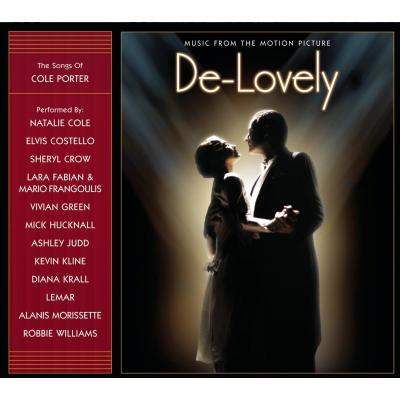
De-Lovely Album Cover

"De-Lovely" Soundtrack Lyrics

Movie • 2004

Track Listing


"De-Lovely" Soundtrack Description

De-Lovely (2004) official trailer frame with Kevin Kline as Cole Porter and Ashley Judd as Linda, setting the film’s songbook-biopic tone
De-Lovely — official trailer still, 2004.

Overview

How do you dramatize a life that already feels like a playlist? De-Lovely (2004) turns Cole Porter’s love story into a staged memory, then threads it with freshly recorded versions of his standards—performed on screen by pop and jazz stars. The soundtrack is both period and postmodern: it keeps the wit of Porter’s lyrics intact while letting 2000s voices (Alanis Morissette, Sheryl Crow, Elvis Costello, Diana Krall, Robbie Williams, Natalie Cole and more) carry them.

The companion album, released in mid-June 2004, collects these performances alongside cast vocals by Kevin Kline and Ashley Judd. A separate original score by Stephen Endelman provides interstitial emotion—quiet strings, piano, and tasteful underscoring around the set-piece numbers. Retail editions differ slightly by region (one U.S. pressing omits a Kline solo), but the throughline is clear: it’s a celebratory “new cast recording” of Porter’s greatest hits shaped to the film’s scenes.

De-Lovely trailer frame emphasizing cabaret-style performances that the soundtrack reprises on album
Cabaret flashbacks meet modern voices—stagecraft as memory.

Questions & Answers

Is there an official soundtrack album?
Yes. De-Lovely: Music from the Motion Picture was issued in June 2004 on Columbia/RCA (Sony/BMG), with 18–19 tracks depending on territory.
Who composed the score?
Stephen Endelman composed the original score (distinct from the Cole Porter songs).
Who supervised the music?
Becky Bentham served as music supervisor (Hot House Music Ltd.), coordinating the film’s song performances and clearances.
Which artists appear performing in the film?
Notable cameos include Alanis Morissette (“Let’s Do It”), Elvis Costello (“Let’s Misbehave”), Sheryl Crow (“Begin the Beguine”), Diana Krall (“Just One of Those Things”), Natalie Cole (“Ev’ry Time We Say Goodbye”), Robbie Williams (“It’s De-Lovely”), Lemar (“What Is This Thing Called Love?”), plus cast vocals by Kevin Kline and Ashley Judd.
Is “You’re the Top” on the album—and who sings in the credits?
Yes; the album ends with Cole Porter himself performing “You’re the Top.” The film’s closing also nods to Porter’s own voice.
Are there regional differences between releases?
Yes. For example, some U.S. editions omit Kevin Kline’s “Easy to Love,” while European tracklists retain it.

Notes & Trivia

  • Trusted source note: Apple Music and Discogs list the album as a 2004 Columbia/RCA release under the Sony/BMG umbrella.
  • Several numbers were staged and recorded to feel like live club/cabaret performances on set—then mixed for album clarity.
  • Robbie Williams appears as the wedding singer performing “It’s De-Lovely.”
  • Endelman’s score earned a Grammy nomination tied to the film.
  • The album’s closer is Porter himself on “You’re the Top”—a smart curtain call.

Genres & Themes

American Songbook / Jazz-pop — satin harmonies and tight rhythm sections wrap Porter’s wordplay; modern vocal colors (Alanis’s alt-pop edge, Krall’s cool swing) refract classic charts rather than mimic them.

Cabaret & big-band arrangements — brassy punctuations and reeds keep theatrical energy; they double as an audio time machine between Paris salons, Broadway stages, and Hollywood parties.

Film score chamber textures — Endelman’s piano/strings act as connective tissue, easing transitions between memory vignettes and production numbers.

Trailer frame hinting at the cabaret staging and orchestra hits that characterize the soundtrack’s arrangements
Songbook shimmer with a cinematic spine.

Tracks & Scenes

“It’s De-Lovely” — Robbie Williams
Where it plays: At Cole and Linda’s wedding reception, staged as a slick dance-band number; Williams appears on screen as the bandleader/singer.
Why it matters: A gleaming “overture” to the marriage—Porter’s pun-happy optimism delivered with pop charm.

“Let’s Do It (Let’s Fall in Love)” — Alanis Morissette
Where it plays: A party sequence performance; the camera weaves through guests as Alanis delivers flirty, sly verses.
Why it matters: Modern timbre meets 1920s innuendo; it tilts the film’s nostalgia toward witty seduction.

“Let’s Misbehave” — Elvis Costello
Where it plays: White-tux club turn—Costello fronts the band as the scene pivots from elegant to impish.
Why it matters: A playful permission slip, musically underlining Porter/Linda’s pact to navigate love on their own terms.

“Begin the Beguine” — Sheryl Crow
Where it plays: A lush recital-style interlude, spotlighting the melody as Cole reflects on past triumphs.
Why it matters: Swooning swing that sells the film’s memory-revue device.

“Just One of Those Things” — Diana Krall
Where it plays: Late-night club scene; Krall’s quartet frames shifting glances between Cole and Linda.
Why it matters: Smoky detachment that gently acknowledges love’s fragility.

“Ev’ry Time We Say Goodbye” — Natalie Cole
Where it plays: A farewell-tinged montage as illness and distance gather.
Why it matters: The lyric lands like subtext for a complicated marriage—tender and bruised.

“What Is This Thing Called Love?” — Lemar
Where it plays: A stylish cameo set against Venice vistas; the number plays like a postcard from Cole’s European years.
Why it matters: Soul inflection refreshes a standard without sanding off its sophistication.

“In the Still of the Night” — Kevin Kline & Ashley Judd
Where it plays: Intimate duet underscoring Cole and Linda’s bond, performed in-character.
Why it matters: Lets the leads “own” a Porter classic inside their story rather than ceding it entirely to cameos.

“You’re the Top” — Cole Porter
Where it plays: Album closer and film coda nod; Porter’s own voice rolls over the end, briefly collapsing biopic and archive.
Why it matters: A final wink from the real composer—history stepping into the spotlight.

Music–Story Links

Numbers are placed like emotional scene changes. “It’s De-Lovely” celebrates a union before the film tests it; “Let’s Misbehave” articulates the couple’s flexible rules; Krall’s “Just One of Those Things” relaxes into bittersweet acceptance; and Natalie Cole’s “Ev’ry Time We Say Goodbye” softens the late-act partings. The cameos aren’t stunt casting—each timbre comments on Cole and Linda’s pact, fame’s mask, and the cost of keeping love onstage.

Trailer moment of stage lights and a tuxedoed bandleader, echoing how songs function as scene changes in the film
Each song = a scene change, not just a cover.

How It Was Made

Director Irwin Winkler favored on-set vocal performances and a “live” feel for many sequences, with studio polish added later. Stephen Endelman produced and arranged alongside noted engineers, and Becky Bentham wrangled a who’s-who of guest vocalists. The album dropped in tandem with the film’s release window on Columbia/RCA, under the Sony/BMG umbrella.

Trusted source mention: industry coverage detailed the cameo production numbers and Winkler’s preference for live sound; press and retailer listings align on label/date and the notable guest roster.

Reception & Quotes

Reviews were mixed on the biopic framing but consistently praised the songs and star turns; the album charted on Billboard’s Top Soundtracks while stoking a brief Porter revival in 2004.

“Ambitious… the chance to listen to these songs in a fresh context is the chief pleasure.” Variety
“A sublime collection of songs linked by scripted banter… not delightful, not delicious, just disappointing.” The Guardian (capsule take)

Additional Info

  • Regional note: some U.S. CDs omit “Easy to Love” (Kevin Kline); European editions include it.
  • Guest turns double as diegetic performances—club singers and bandleaders inside the story world.
  • The album sequencing broadly follows the film’s revue structure rather than strict chronology.
  • Endelman collaborated directly with several guests to tailor keys/arrangements to their voices.
  • Robbie Williams’ wedding-band cameo is one of the film’s most replayed clips online.

Technical Info

  • Title: De-Lovely — Music from the Motion Picture
  • Year: 2004
  • Type: Movie (musical biopic; song performances + original score)
  • Songs by: Cole Porter (new performances recorded for the film)
  • Score composer: Stephen Endelman
  • Music supervision: Becky Bentham (Hot House Music Ltd.)
  • Label: Columbia / RCA (Sony/BMG)
  • Availability: Digital/streaming and CD; some tracklist differences by territory
  • Selected notable placements: “It’s De-Lovely” (wedding; Robbie Williams), “Let’s Do It” (party; Alanis Morissette), “Let’s Misbehave” (club; Elvis Costello), “Begin the Beguine” (Sheryl Crow), “Just One of Those Things” (Diana Krall), “Ev’ry Time We Say Goodbye” (Natalie Cole), “What Is This Thing Called Love?” (Lemar), “In the Still of the Night” (Kline/Judd)

Canonical Entities & Relations

SubjectRelationObject
Irwin WinklerdirectedDe-Lovely (2004)
Jay CockswroteScreenplay for De-Lovely
Stephen EndelmancomposedOriginal score for De-Lovely
Becky Benthamserved asMusic Supervisor
Columbia / RCA (Sony/BMG)releasedDe-Lovely: Music from the Motion Picture
Robbie Williamsperformed“It’s De-Lovely” (wedding scene)
Alanis Morissetteperformed“Let’s Do It (Let’s Fall in Love)”
Elvis Costelloperformed“Let’s Misbehave”
Diana Krallperformed“Just One of Those Things”
Natalie Coleperformed“Ev’ry Time We Say Goodbye”

Sources: Discogs; Apple Music; Wikipedia; IMDb; Variety; Mix Magazine; SoundtrackCollector; Phase9.

October, 30th 2025


A-Z Lyrics Universe

Lyrics / song texts are property and copyright of their owners and provided for educational purposes only.