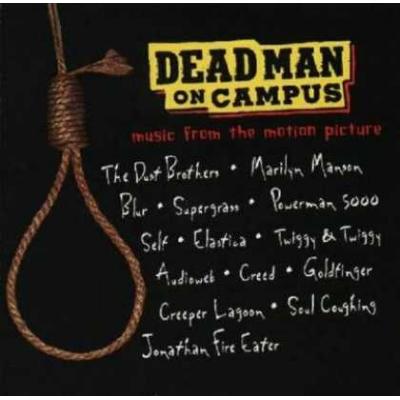
"Dead Man On Campus" Soundtrack Lyrics
Movie • 1998
Track Listing
Marilyn Manson
Blur
Elastica
Supergrass
Self
The Dust Brothers
Soul Coughing
Powerman 5000
Creed
Audioweb
Goldfinger
Jonathan Fire*Eater
Creeper Lagoon
Twiggy & Twiggy
"Dead Man On Campus" Soundtrack Description
Overview
What does late-’90s college chaos sound like? In Dead Man On Campus (1998), it’s britpop, big-beat, post-grunge and a notorious Bowie cover blasting out of dorm stereos. The commercially released album, Dead Man On Campus: Music From the Motion Picture, arrived August 4, 1998 on DreamWorks Records and leans hard on then-hot alt/indie names (Blur, Elastica, Supergrass) alongside U.S. college-radio staples (Soul Coughing, Creed, Goldfinger). Trusted sources: AllMusic and Discogs document the release date, label and core details; IMDb lists cue clearances, and Art of the Title confirms the opening-credits song.
On screen, the songs function like punchlines and propulsion—needle-drops as character shorthand—while Mark Mothersbaugh’s score handles the connective comic tension. The album isn’t a wall-to-wall reproduction of everything heard in the film, but it bottles the prankish, sleep-deprived mood that MTV Films was trading in at the time.
Questions & Answers
- Is there an official soundtrack album?
- Yes. Dead Man On Campus: Music From the Motion Picture was released August 4, 1998 by DreamWorks Records as a various-artists compilation.
- Who composed the original score?
- Mark Mothersbaugh composed the score for the film.
- What song plays over the opening credits?
- Marilyn Manson’s cover of David Bowie’s “Golden Years” is used for the opening credits/title sequence.
- Who handled music supervision/production?
- The Dust Brothers (John King & Michael Simpson) are credited as executive music producers, with Amy Finnerty listed as music supervisor.
- Does the album include every song heard in the movie?
- No. It captures the marquee cues but, like many ’90s tie-ins, not every on-screen needle-drop.
- What label put the album out?
- DreamWorks Records released the album in the U.S.
Notes & Trivia
- The title sequence (by Imaginary Forces) was built around a wicked S.A.T.-style “Suicide Aptitude Test,” set to Manson’s “Golden Years.”
- DreamWorks Records issued the album; several featured artists (e.g., Self, Powerman 5000, Jonathan Fire*Eater) were on the label at the time.
- Goldfinger’s “Walking in the Dark” has become a minor soundtrack-credits easter egg for the band’s fans.
- Score-to-songs balance is very ’98 MTV Films: big recognizable cuts up front, energetic score in the seams.
Genres & Themes
Britpop & UK alt (Blur, Elastica, Supergrass) = arrogant swagger and wry cool—the “we’re totally fine” mask before the GPA freefall.
U.S. college-radio heavies (Soul Coughing, Creed, Goldfinger) = slacker propulsion, bar-band catharsis, and skate-punk adrenaline.
Remix culture (Dust Brothers, Propellerheads) = caffeinated montage energy; distorted beats for bad decisions.
Tracks & Scenes
"Golden Years" — Marilyn Manson
Scene: Opening credits/title sequence, over the stylized suicide-test graphics; non-diegetic.
Why it matters: A brazen Bowie cover telegraphs the film’s dark-comic tone and MTV-era aesthetics.
"Cowboy Song" — Blur
Scene: Heard on the soundtrack/album; associated with dorm-life texture in early reels (album cut appears even when scene placement is light in some edits).
Why it matters: Britpop bite introduces the film’s smirking mood.
"Human" — Elastica
Scene: Early campus sequences and dorm transitions; non-diegetic needle-drop.
Why it matters: Lean, spiky minimalism fits the mid-’90s college palate and the protagonists’ shrugging bravado.
"We Still Need More (Than Anyone Can Give)" — Supergrass
Scene: Party-night montage—friends on the make, responsibilities ignored; non-diegetic.
Why it matters: A winking thesis for the film’s premise: more thrills, fewer consequences.
"Super Bon Bon (Propellerheads Remix)" — Soul Coughing
Scene: Momentum cue for chaos runs between dorms and parties; non-diegetic.
Why it matters: That rubbery bassline + big-beat frame turns screwball into velocity.
"Organizized" — Powerman 5000
Scene: Amped-up misadventure/“let’s recruit a new roommate” shenanigans; non-diegetic.
Why it matters: Industrial-tinged stomp that matches the film’s cartoon menace.
"Bound & Tied" — Creed
Scene: Late-film comeuppance energy; non-diegetic.
Why it matters: Post-grunge weight for the story’s darker swerve.
"Walking in the Dark" — Goldfinger
Scene: Night exteriors and between-scenes connective tissue; non-diegetic.
Why it matters: A burst of skate-punk momentum that keeps the caper airborne.
"Realize (Chemical Brothers Remix)" — The Dust Brothers
Scene: Collage-style city/night transitions; non-diegetic.
Why it matters: Signature Dust Brothers crunch—perfect for MTV-era cutting.
Music–Story Links
- Manson’s “Golden Years” reframes a taboo premise as satire from the very first frame—dark humor set to a glam mirror.
- UK alt cuts signal faux sophistication; when plans unravel, the cues pivot to heavier U.S. alt (Creed, Powerman 5000) to sell consequence.
- Remixes (Dust Brothers/Propellerheads) turn academic panic into montage momentum—that’s the film’s comic engine.
How It Was Made
The album was assembled under the aegis of DreamWorks Records, which—per release credits—leaned on its own roster for several cuts while licensing marquee UK tracks. In the film, Mark Mothersbaugh provides the score, while The Dust Brothers are credited as executive music producers with Amy Finnerty as music supervisor. The title sequence was produced by Imaginary Forces and explicitly built around “Golden Years.” (Trusted sources: AllMusic, Discogs, IMDb, and Art of the Title/Imaginary Forces project pages.)
Reception & Quotes
“A mixtape of campus hedonism—Britpop, remixes and alt-rock swagger packed into 55 minutes.” Album-guide consensus (AllMusic/retail summaries)
“The opening credits sell the tone instantly—wicked design to Manson’s ‘Golden Years.’” Title-design coverage
Critical reaction to the film was mixed to negative, but the soundtrack’s snapshot of 1998 college-alt culture has aged into a tidy time capsule.
Additional Info
- Album runtime sits around 55 minutes; selections differ slightly by territory pressings.
- Some songs are album-only edits; film snippets may be shorter.
- Because the film had multiple trailers/TV spots, viewers sometimes remember cues from marketing rather than from the final cut.
- The soundtrack’s mix of DreamWorks-signed acts and UK licenses is typical of the label’s late-’90s strategy.
- Score album: none issued separately; Mothersbaugh’s cues live only in the film.
Technical Info
- Title (album): Dead Man On Campus: Music From the Motion Picture
- Year: 1998 (album released August 4, 1998)
- Type: Movie (various-artists soundtrack + original score in film)
- Composer (score): Mark Mothersbaugh
- Label: DreamWorks Records (catalog DRMD-50032, U.S.)
- Selected notable placements: “Golden Years” (opening titles); “Super Bon Bon (Propellerheads Remix)” (party/chaos montage); “Organizized” (recruit-a-roommate mayhem); “Walking in the Dark” (night transitions)
- Availability: Out-of-print CD; tracks widely available via artist catalogs/streaming.
Canonical Entities & Relations
| Entity | Relation | Entity |
|---|---|---|
| Dead Man On Campus (Movie) | score by | Mark Mothersbaugh |
| Dead Man On Campus (Movie) | executive music producers | The Dust Brothers (John King & Michael Simpson) |
| Dead Man On Campus (Movie) | music supervisor | Amy Finnerty |
| Soundtrack Album | released by | DreamWorks Records |
| “Golden Years” (Recording) | performed by | Marilyn Manson (written by David Bowie) |
| “Walking in the Dark” (Recording) | performed by | Goldfinger |
Sources: AllMusic; Discogs; IMDb; Art of the Title / Imaginary Forces.
October, 30th 2025
A-Z Lyrics Universe
Cynthia Erivo Popular
Ariana Grande Horsepower
Post Malone Ain't No Love in Oklahoma
Luke Combs Good Riddance (Time of Your Life)
Green Day Bye Bye Bye
*NSYNC You're the One That I Wan
John Travolta & Olivia Newton-John I Always Wanted a Brother
Braelyn Rankins, Theo Somolu, Kelvin Harrison Jr. and Aaron Pierre The Power of Love
Frankie Goes to Hollywood Beyond
Auli’i Cravalho feat. Rachel House MORE ›