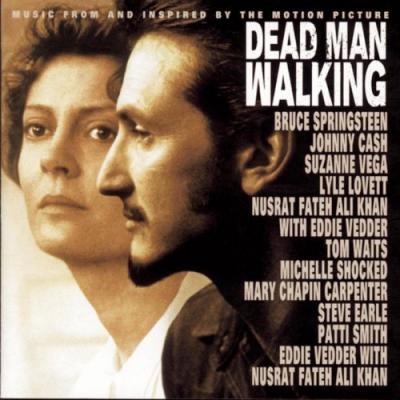
"Dead Man Walking" Soundtrack Lyrics
Movie • 1996
Track Listing
Bruce Springsteen
Johnny Cash
Suzanna Vega
Lyle Lovett
Nusrat Fateh Ali Khan with Eddie Vedder
Tom Waits
Michelle Shocked
Mary Chapin Carpenter
Tom Waits
Steve Earle
Patti Smith
Eddie Vedder with Nusrat Fateh Ali Khan
"Dead Man Walking (Music from and Inspired by the Motion Picture)" Soundtrack Description
Questions & Answers
- What is the official 1996 album called?
- Dead Man Walking (Music from and Inspired by the Motion Picture) — a various-artists collection on Columbia Records.
- Who appears on the album?
- Bruce Springsteen, Johnny Cash, Suzanne Vega, Lyle Lovett, Tom Waits, Michelle Shocked, Mary Chapin Carpenter, Steve Earle, Patti Smith, and two collaborations between Eddie Vedder & Nusrat Fateh Ali Khan.
- Was every song in the film itself?
- No. The album was curated “from and inspired by” the film; only a handful of songs play in full on screen. The rest were written to the story and rough cuts.
- Is there a separate score release?
- Yes. David Robbins’ instrumental score was issued separately in 1996.
- Did the album or songs receive awards attention?
- Bruce Springsteen’s “Dead Man Walkin’” was nominated for the Academy Award for Best Original Song.
- Where can I stream it?
- Digital editions are available (Apple Music/Spotify); the standard 12-track configuration is the common version.
Overview
How do you score a film that refuses easy answers? Tim Robbins solved it by inviting storytellers. The album Dead Man Walking (Music from and Inspired by the Motion Picture) gathers songs written to the script and rough cuts — perspectives from the condemned, the guard on the tier, the nun, the grieving families. It’s less a mixtape than a Greek chorus.
Released in 1996 by Columbia, the set runs a tight 12 tracks: Springsteen’s spare title song, Johnny Cash’s stoic “In Your Mind,” Tom Waits’ twin parables, Patti Smith’s prayer-like “Walkin Blind,” and two haunting pieces by Eddie Vedder with qawwali legend Nusrat Fateh Ali Khan. A separate album collects David Robbins’ orchestral score. (Trusted sources cited in-text: Wikipedia album entry; Apple Music album page.)

Genres & Themes
- Americana & alt-country lament: Springsteen, Steve Earle, Mary Chapin Carpenter, and Lyle Lovett write in the plain-spoken tradition of moral balladry.
- Folk confessionals: Suzanne Vega and Patti Smith voice interior prayer — personal, not polemical.
- Tom Waits’ noir hymns: cracked-bell storytelling (“The Fall of Troy,” “Walk Away”) that stares at consequences.
- Qawwali-infused devotion: Vedder & Nusrat’s “The Face of Love” and “The Long Road” bring ritual weight and universality.
Tracks & Scenes
Below: notable songs and how/where they’re used or intended, with brief scene context. (The album is partly “inspired by,” so not every track appears on screen.)
“The Face of Love” — Nusrat Fateh Ali Khan with Eddie Vedder
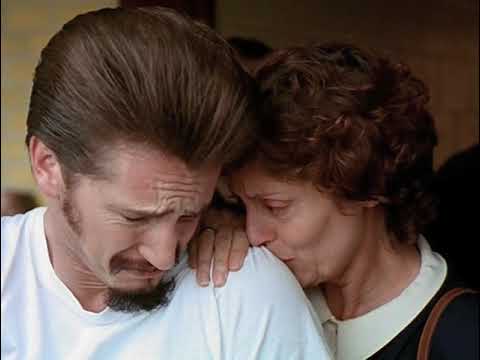
Where it plays: featured in the film during a late, reflective passage as Sister Helen moves toward reconciliation with Matthew (non-diegetic; trailer-adjacent scene often clipped in video highlights).
Why it matters: a devotional lens — mercy voiced as vow.
“In Your Mind” — Johnny Cash
Where it plays: used in-film; a sober needle-drop underscoring private reckoning (non-diegetic).
Why it matters: Cash’s gravity turns interior monologue into testimony.
“Dead Man Walkin’” — Bruce Springsteen
Where it plays: written to the prisoner’s POV; used as a principal song for the campaign and album (commonly associated with the film’s end material/promotions).
Why it matters: a plain-spoken dirge that became the project’s calling card (and an Oscar nominee).
“The Long Road” — Eddie Vedder with Nusrat Fateh Ali Khan
Where it plays: used in the film; meditative cue framing vigil/marching imagery (non-diegetic).
Why it matters: spacious, wordless mourning — the story’s moral echo.
“Woman on the Tier (I’ll See You Through)” — Suzanne Vega
Where it plays: written from Sister Helen’s perspective; album feature (brief usage in-film).
Why it matters: articulates the film’s most difficult promise: presence.
“Ellis Unit One” — Steve Earle
Where it plays: album-forward (guard’s POV); associated with the film via benefit concerts and promotional performances.
Why it matters: flips the camera — the toll on those tasked to “do the job.”
“Walk Away” & “The Fall of Troy” — Tom Waits
Where they play: album cues that shadow the film’s moral terrain rather than specific scenes.
Why they matter: cautionary parables — one sprinting, one solemn — that broaden the story’s frame.
Music–Story Links
- Multiple POVs, one corridor: guard (“Ellis Unit One”), nun (“Woman on the Tier”), prisoner (“Dead Man Walkin’”) — the album triangulates a single walk.
- Ritual time: the Vedder/Nusrat pieces slow time to ritual pace; scenes of prayer, vigil, and last rites breathe on screen.
- Plain speech over polemic: Cash, Earle, Carpenter, Lovett favor details over slogans — fitting a film that asks rather than answers.
How It Was Made
Tim Robbins (director) and David Robbins (composer) invited admired songwriters to respond to the script and rough cuts; contributors received scenes and notes to write from specific viewpoints (e.g., Vega as Sister Helen; Earle as a guard). Music supervision and production involved David Robbins (supervisor), with Ry Cooder producing song sessions and an “executive in charge of music” credit to Dawn Solér at the studio. The score album (by David Robbins) was released separately the same spring. Trusted source callouts: Wikipedia album page; Discogs credits; Metacritic credits page (music dept. listings).
Reception & Quotes
The compilation charted on the Billboard 200 and drew sustained critical interest. Springsteen’s song earned an Academy Award nomination; critics singled out Waits, Cash, and Earle for depth of writing.
“Only a few of which were actually used in the film — an earnest, sometimes scattershot look at the death penalty.” Pitchfork
“A rare soundtrack that’s as compelling as the film itself.” AllMusic-era capsule, via summaries
“Earle’s ‘Ellis Unit One’ — a guard’s numb witness — lingers.” Entertainment Weekly
Additional Info
- The album’s concept was “inspired by” as much as “from” — four songs were heard in full in the film; others function as companion pieces.
- Benefit concerts and TV appearances (e.g., Not in Our Name: Dead Man Walking — The Concert) kept these songs in circulation.
- The film’s composer, David Robbins, is Tim Robbins’ brother; the score release arrived separately in 1996.
- Several music-department roles are notable: Ry Cooder (song production), Frankie Pine (music licensing), Dawn Solér (studio music exec), Gil Robbins (choral work).
- The soundtrack’s point-of-view writing (nun/guard/prisoner) mirrors the film’s refusal to preach.
Technical Info
- Title: Dead Man Walking (Music from and Inspired by the Motion Picture)
- Year: 1996
- Type: Movie soundtrack (various artists; companion to the 1995 film)
- Label: Columbia Records (Sony)
- Length / Format: 12 tracks; ~42–46 minutes depending on edition
- Key contributors (album): Bruce Springsteen; Eddie Vedder & Nusrat Fateh Ali Khan; Johnny Cash; Tom Waits; Steve Earle; Suzanne Vega; Mary Chapin Carpenter; Patti Smith; Lyle Lovett
- Key music credits (film): Music by David Robbins; Music supervisor — David Robbins; Song production — Ry Cooder; Executive in charge of music — Dawn Solér; Music licensing — Frankie Pine
- Score: Dead Man Walking (Original Score) by David Robbins (separate 1996 release)
- Trailer ID (YouTube): a-tLJ-OXN9I
Canonical Entities & Relations
| Subject | Relation | Object |
|---|---|---|
| Tim Robbins | directed | Dead Man Walking (1995 film) |
| David Robbins | composed / supervised music for | Dead Man Walking (1995 film) |
| Columbia Records | released | Dead Man Walking (Music from and Inspired by the Motion Picture) |
| Bruce Springsteen | wrote & performed | “Dead Man Walkin’” (Oscar-nominated) |
| Eddie Vedder & Nusrat Fateh Ali Khan | performed | “The Face of Love”; “The Long Road” |
| Johnny Cash | performed | “In Your Mind” |
| Tom Waits | performed | “The Fall of Troy”; “Walk Away” |
| Steve Earle | performed | “Ellis Unit One” |
| David Robbins | composed | Dead Man Walking (Original Score) (1996) |
Sources: Wikipedia (album & film entries); Apple Music; Discogs credits; Metacritic credits; Pitchfork review; Entertainment Weekly.
October, 30th 2025
A-Z Lyrics Universe
Cynthia Erivo Popular
Ariana Grande Horsepower
Post Malone Ain't No Love in Oklahoma
Luke Combs Good Riddance (Time of Your Life)
Green Day Bye Bye Bye
*NSYNC You're the One That I Wan
John Travolta & Olivia Newton-John I Always Wanted a Brother
Braelyn Rankins, Theo Somolu, Kelvin Harrison Jr. and Aaron Pierre The Power of Love
Frankie Goes to Hollywood Beyond
Auli’i Cravalho feat. Rachel House MORE ›