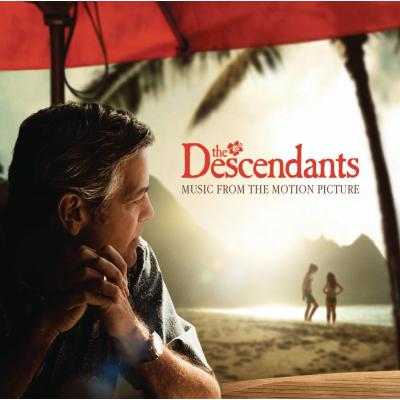
"Descendants, The" Soundtrack Lyrics
Movie • 2011
Track Listing
Gabby Pahinui
Keola Beamer and George Winston
Gabby Pahinui
Dennis Kamakahi
Makaha Sons
Ray Kane
Gabby Pahinui
Jeff Peterson
Gabby Pahinui
Keola Beamer
Gabby Pahinui
Sonny Chillingworth
Gabby Pahinui
Ozzie Kotani
Charles Michael Brotman
Makana
Lena Machado
Sol Hoopii's Novelty Trio
"Descendants, The" Soundtrack Description
Overview
Is it possible for a soundtrack to make paradise feel complicated? The Descendants answers with slack-key guitars, vintage steel, and island voices that feel intimate, patient, and a little bruised. Instead of a traditional orchestral score, the film leans entirely on Hawaiian music—old and new—to frame Matt King’s family crisis against land, history, and responsibility. The result is a mood that’s tender without schmaltz, local without cliché.
Director Alexander Payne and music supervisor Dondi Bastone sifted through mountains of Hawaiian recordings and commissioned subtle new slack-key cues so the film could breathe in its own rhythm. Reporting in the Los Angeles Times and the Honolulu Star-Advertiser underlines how intentionally the team researched the islands’ musical heritage, even consulting an ethnomusicologist to avoid mismatched place songs. The throughline is clear: songs carry place, memory, and choice here—sometimes more honestly than dialogue.
Questions & Answers
- Is there an official soundtrack album?
- Yes. The Descendants (Music from the Motion Picture) was released in November 2011 on Sony Classical and compiles Hawaiian artists featured in the film.
- Is there a traditional “score composer” on this movie?
- No. The film is scored exclusively with Hawaiian music—curated recordings and a handful of newly recorded slack-key pieces by local masters—guided by music editor Richard Ford and music supervisor Dondi Bastone.
- What song plays over the end credits?
- “Ka Makani Kaʻili Aloha” — Gabby Pahinui. It begins during the final scene and flows into the credits.
- What’s the diegetic restaurant performance people remember?
- A trio called KanakAttack performs a yodel-tinged cowboy song at Tahiti Nui in Hanalei—intentionally jarring and diegetic, mirroring Matt’s disorientation.
- Were any tracks recorded specially for the film?
- Yes. Slack-key guitarists Jeff Peterson and Keola Beamer recorded additional cues in Honolulu with Payne and the music team supervising.
- Is the album just “island easy listening”?
- Hardly. Critics (e.g., The Wall Street Journal, AllMusic) praised the selection’s depth—traditional, contemporary, and quietly melancholic rather than touristy.
Notes & Trivia
- The album was nominated for the Grammy for Best Compilation Soundtrack for Visual Media.
- Boston Society of Film Critics cited the movie for Best Use of Music in a Film (nomination).
- The oldest cut here is a 1930 Sol Hoopii & His Novelty Trio steel-guitar recording, anchoring the film in Hawaiian music history.
- Music consultant Jay Junker advised the team on place-specific mele, warning against dropping a Big Island song over an Oʻahu scene.
- Hawaiian hip-hop even sneaks in: Sudden Rush’s work is credited among the film’s music placements.
- Makana’s “Deep in an Ancient Hawaiian Forest” became a fan-favorite cue after the film.
Genres & Themes
Slack-key guitar (kī hō‘alu) sets the emotional grammar: open-tuned guitars and unhurried melodies let grief, grace, and generosity linger between lines. In this story, slack-key equals vulnerability and rootedness.
Classic steel & hapa-haole standards add historical patina—nostalgia without rose-tint—mirroring the King family’s land legacy and the moral math around it. Jawaiian/reggae shadings (and a flash of local hip-hop) surface as island-present tense, hinting at a living culture rather than museum glass.
Tracks & Scenes
Note: The film uses pre-existing songs throughout; placements below focus on identifiable scene functions and diegetic moments documented by interviews and industry notes.
“Ka Makani Kaʻili Aloha” — Gabby Pahinui
Scene: Begins under the film’s closing image and continues into the end credits; non-diegetic. A gentle breeze of guitar and voice cools the final shot, letting the last choices settle.
Why it matters: Offers a wordless benediction—Hawai‘i as a presence, not a postcard.
“Deep in an Ancient Hawaiian Forest” — Makana
Scene: Used non-diegetically in reflective passages late in the story (quiet car rides and private reckonings).
Why it matters: Modern slack-key with a haunted hush; it turns interior monologue into landscape.
“Hawaiian Skies” — Jeff Peterson
Scene: Transitional cue over drives and inter-island movement; non-diegetic.
Why it matters: Light, lyrical filigree that keeps the plot breathing without crowding the dialogue.
“Hiʻilawe” — (Gabby Pahinui &/or Sonny Chillingworth versions)
Scene: Heard in atmosphere cues and connective montage; non-diegetic.
Why it matters: A keystone of modern slack-key; its timeless sway stands in for memory.
“Leahi” — Gabby Pahinui
Scene: Non-diegetic needle-drop to sketch everyday Honolulu texture as Matt juggles hospital visits and business calls.
Why it matters: Anchors the film’s “real Oʻahu” vibe—ordinary errands, extraordinary stakes.
“Wai O Ke Aniani” — Gabby Pahinui
Scene: Non-diegetic bed under family interactions that are warm, awkward, and a bit raw.
Why it matters: Steel-guitar shimmer makes home feel fragile and earned.
“ʻImi Au Ia ʻOe” — Keola Beamer
Scene: Quiet montage cue as relationships recalibrate; non-diegetic.
Why it matters: Beamer’s lyrical grace suggests forgiveness in motion.
“Hapuna Sunset” — Charles Michael Brotman
Scene: A calm, panoramic interlude—Kauaʻi vistas as the family considers the land trust; non-diegetic.
Why it matters: Sun-down tones frame the film’s central ethical question without sermonizing.
“Ka Mele Okuʻu Puʻuwai (1930)” — Sol Hoopii’s Novelty Trio
Scene: Vintage source woven into the film to bridge present choices with historic currents; non-diegetic archival presence.
Why it matters: Reminds us that inheritance is cultural as much as legal.
Diegetic standout — KanakAttack (Tahiti Nui scene)
Scene: In the bustling Hanalei bar/restaurant, a trio yodels a Jimmie Rodgers-style cowboy tune. It’s fully diegetic, heard by the characters in the room.
Why it matters: The deliberately “wrong” flavor underscores Matt’s confusion—humor edged with ache—before the plot turns a corner.
Music–Story Links
- Breeze as benediction: Ending on Pahinui’s “Ka Makani Kaʻili Aloha” lets the film exit with humility; Matt’s choices aren’t solved so much as accepted.
- Place vs. postcard: Steel and slack-key classics counter tourist exotica; they sonically argue for lived-in Hawaiʻi—the exact tension of the King family’s land sale.
- Diegetic whiplash: The Tahiti Nui yodel is comic on its face and isolating underneath; it primes Matt’s next step by making him feel out of sync with his home.
- Transitions as truths: The short guitar interludes—especially Peterson’s—carry subtext between scenes, showing how travel time is thinking time.
How It Was Made
Dondi Bastone (music supervisor) and Richard Ford (music editor/executive music producer) began unusually early, surveying thousands of tracks. Payne’s team sought guidance from University of Hawaiʻi ethnomusicologist Jay Junker, whose notes on place-specific songs informed choices, even when emotion eventually trumped strict geography.
Additional slack-key was recorded in Honolulu with Jeff Peterson and Keola Beamer; Payne and Ford were present in the studio and even asked Peterson to improvise to picture. The album’s producers are Alexander Payne, Amy Driscoll, and Dondi Bastone; the label release was handled by Sony Classical.
Reception & Quotes
Critics singled out the soundtrack’s authenticity and restraint, noting how it deepened character without leaning on sentimentality. A few quick snapshots:
“Scored with Hawaiian music by Hawaiian artists—songs of extraordinary sweetness, joy and soulfulness.” The Wall Street Journal
“Highly listenable… as an introduction to traditional Hawaiian music, it’s almost indispensable.” AllMusic
“Deftly blends traditional and modern Hawaiian music.” Rolling Stone
“Likely to spark a mini-craze for Hawaiian slack-key guitar pop.” Salon
There’s also the industry angle: the soundtrack earned a Grammy nomination, and regional critics highlighted the film’s musical choices as awards-level craft.
Additional Info
- Physical CD releases list Sony Classical catalog numbers; later vinyl pressings surfaced via specialty runs.
- Makana’s “Flood” and “Will I Ever See You Again?” appear in the film’s home-video extras; only “Deep in an Ancient Hawaiian Forest” made the main album.
- Many album cuts were licensed from Dancing Cat, Panini, and other Hawaiʻi labels, reflecting a cross-label pull rather than a single-catalog grab.
- The film’s music department started during picture edit—unusually early—so songs could shape the cut.
- One restaurant performance (KanakAttack) was chosen precisely because it felt slightly “off,” dramatizing Matt’s alienation in a place he calls home.
- End-credit usage of Pahinui’s track became a calling card; fans often cite that gentle exit as the film’s emotional afterglow.
Technical Info
- Title: The Descendants (Music from the Motion Picture)
- Year: 2011
- Type: Movie soundtrack (compilation)
- Music approach: 100% Hawaiian recordings; additional slack-key cues recorded for the film
- Producers: Alexander Payne, Amy Driscoll, Dondi Bastone
- Music Supervisor: Dondi Bastone
- Executive Music Producer / Music Editor: Richard Ford
- Label: Sony Classical (album released mid-November 2011)
- Selected notable placements: “Ka Makani Kaʻili Aloha” (end scene/credits); KanakAttack live at Tahiti Nui (diegetic); core cues by Gabby Pahinui, Keola Beamer, Jeff Peterson, Sonny Chillingworth, Makana
- Awards & charts: Grammy nomination (Best Compilation Soundtrack for Visual Media); regional critics recognition for music use
Canonical Entities & Relations
| Subject | Verb | Object |
|---|---|---|
| The Descendants (film) | was released by | Fox Searchlight Pictures (now Searchlight Pictures) |
| The Descendants (Music from the Motion Picture) | recordLabel | Sony Classical |
| Alexander Payne | directed | The Descendants (film) |
| Dondi Bastone | served as | Music Supervisor |
| Richard Ford | served as | Executive Music Producer & Music Editor |
| Jeff Peterson | recorded | slack-key cues in Honolulu for the film |
| Keola Beamer | contributed | slack-key recordings (incl. “ʻImi Au Ia ʻOe”, “Kalena Kai” with George Winston) |
| Makana | contributed | “Deep in an Ancient Hawaiian Forest” |
| Gabby Pahinui | heard in | multiple placements (e.g., “Ka Makani Kaʻili Aloha”, “Leahi”) |
| Tahiti Nui (Hanalei) | features | KanakAttack’s diegetic performance scene |
Sources: Los Angeles Times; Honolulu Star-Advertiser; AFI Catalog; The Wall Street Journal; AllMusic; Rolling Stone; Salon; IMDb; Apple Music; Discogs; MediaStinger; Searchlight Pictures production notes.
All themes of this soundtrack are in the Hawaiian style (as an example – Ka Makani Ka 'Ili Aloha by Gabby Pahinui. The other you just will not find). The film tells the story of what it means to live in Hawaii. In the course of the film, the protagonist declares several times that the very fact of his residence on the peninsula does not imply automatically the posh life, constant partying and all that ordinary people are usually associate with the geographical name. Shailene Woodley – where she only takes the time, because this is already the fourth film only on the first page of this site with her participation – beautiful and charming, as ever. Her career in Hollywood grows rapidly. After that film, she can boast with collaboration with George Clooney himself! Incidentally, he played one of his best roles of his career, as a critics acclaimed after this video work. The general nature of the soundtrack – a relaxing, easy, simple, imbued the listener with love for the Hawaiian themes (you know, the majority of them – not the tourist ones, but for "domestic consumption" – rather grim and dark). All conditions in the selection’s mood are designed to play the music and do the daily business without thinking about what is played (and in general, all the songs on the local – Hawaiian – language, like Ka Loke by Makaha Sons or He Heia He Heia), but simply to listen to the general theme. But there are some to think of eternity. If you are fan of this style, the soul can be assigned here on this soundtrack of 18 songs with a total length in 1:05:05. Happy listening!November, 04th 2025
Learn more about 'The Descendants', an American comedy-drama film on Internet Movie Database and WikipediaA-Z Lyrics Universe
Cynthia Erivo Popular
Ariana Grande Horsepower
Post Malone Ain't No Love in Oklahoma
Luke Combs Good Riddance (Time of Your Life)
Green Day Bye Bye Bye
*NSYNC You're the One That I Wan
John Travolta & Olivia Newton-John I Always Wanted a Brother
Braelyn Rankins, Theo Somolu, Kelvin Harrison Jr. and Aaron Pierre The Power of Love
Frankie Goes to Hollywood Beyond
Auli’i Cravalho feat. Rachel House MORE ›