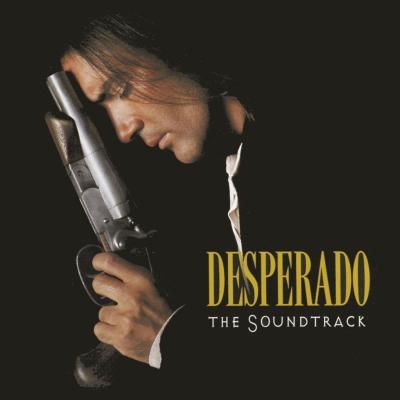
"Desperado" Soundtrack Lyrics
Movie • 1995
Track Listing
Los Lobos
Dire Straits
Wray, Link & His Ra
Latin Playboys
Latin Playboys
Roger & The Gypsies
Los Lobos
Tito & Tarantula
Los Lobos
Los Lobos
Santana, Carlos
Hayek, Salma
Los Lobos
Los Lobos
Tito & Tarantula
Tito & Tarantula
Los Lobos
Los Lobos
"Desperado: The Soundtrack" Soundtrack Description
Overview
Can a revenge western sing? Desperado answers with twanging guitars, percussive gunshots, and a swaggering blend of Chicano rock and border-town blues. The soundtrack doesn’t just decorate the action; it drives it—barroom showdowns pulse to surf-rock riffs, rooftop escapes ride on rubbery basslines, and tender interludes switch to bolero and ranchera hues.
Led by Los Lobos—with vital turns from Tito & Tarantula, Latin Playboys, Dire Straits, Link Wray, Carlos Santana, and even a vocal by Salma Hayek—the album threads diegetic bar-band cues with non-diegetic score pieces named after on-screen mayhem (“Bar Fight,” “Rooftop Action”). The calling card is “Canción del Mariachi,” Antonio Banderas duetting with Los Lobos: a folk anthem reframed as a gunslinger’s serenade. Trusted source: Wikipedia.
Questions & Answers
- Is there an official soundtrack album?
- Yes—Desperado: The Soundtrack (Epic Soundtrax, 1995), an 18-track compilation mixing songs and Los Lobos score cues. Trusted source: Discogs.
- Who composed the score?
- Los Lobos composed and performed the score; their instrumental “Mariachi Suite” later won a Grammy. Trusted source: Wikipedia.
- What song plays over the signature mariachi performance?
- “Canción del Mariachi (Morena de Mi Corazón)”—performed by Antonio Banderas with Los Lobos. Trusted source: IMDb.
- What’s the bar-fight music when the guitar case gets checked?
- “Bar Fight,” a Los Lobos cue commonly identified with that scene. Trusted source: SoundtrackINFO.
- Which track underscores Quentin Tarantino’s bathroom-corridor gag?
- “Chinese Surprize” by Latin Playboys accompanies his walk to the back room. Trusted source: SoundtrackINFO.
- Does Salma Hayek sing on the soundtrack?
- Yes—she performs “Quédate Aquí,” heard in a quieter, intimate moment.
- Is “Six Blade Knife” actually used in the film?
- Yes—Dire Straits’ “Six Blade Knife” features in the opening bar storytelling stretch, setting the cool, dangerous mood.
Notes & Trivia
- “Mariachi Suite” by Los Lobos earned a Grammy for Best Pop Instrumental Performance.
- Tito Larriva (Tito & Tarantula) appears in the film; his band contributes multiple tracks.
- Some track titles (“Bucho’s Gracias/Navajas Attacks,” “Rooftop Action”) are literal scene labels—useful breadcrumbs for rewatchers.
- Karyn Rachtman served as music supervisor—a hallmark of ‘90s needle-drop savvy. Trusted source: Variety.
- Antonio Banderas’ vocal on “Canción del Mariachi” became a pop-culture staple far beyond the film.
Genres & Themes
Chicano rock & ranchera supply the film’s soul—pride, longing, bravado. Those textures make El Mariachi feel like a folkloric figure, not just an action hero.
Surf/garage & roots rock (Link Wray, Dire Straits) add grit and sly cool, perfect for Buscemi’s barroom myth-making and knife-thrower showdowns.
Latin alt and border blues (Latin Playboys, Los Lobos instrumentals) carry the kinetic chases and smoky back-room deals—music that sounds dusty, sun-bleached, and dangerous.
Tracks & Scenes
“Canción del Mariachi (Morena de Mi Corazón)” – Antonio Banderas & Los Lobos
Scene: The film’s emblematic serenade for the gun-slinging troubadour; widely associated with performance moments and the film’s identity (heard prominently with on-screen singing). Diegetic, performed by the lead.
Why it matters: Humanizes the avenger; the melody threads romance into a world of bullets.
“Six Blade Knife” – Dire Straits
Scene: Early bar sequence as Buscemi spins the massacre tale—music oozes menace while the room decides whether to believe him. Non-diegetic needle-drop with a conspiratorial vibe.
Why it matters: Establishes the film’s laconic cool; lets the camera smolder before the gunfire starts.
“Bar Fight” – Los Lobos
Scene: The iconic check-the-guitar-case moment exploding into chaos; elbows, bottles, and ballistic choreography. Score cue synced to hits; largely non-diegetic with percussive stabs that feel physical.
Why it matters: Rhythm maps directly to editing, turning a brawl into musical slapstick.
“Chinese Surprize” – Latin Playboys
Scene: Quentin Tarantino’s character is ushered from the bathroom toward the back room—sleaze and swagger in equal measure, diegetic ambience bleeding into non-diegetic pulse.
Why it matters: A sly tonal pivot: the cue telegraphs that a punchline is coming, then the world tilts.
“Strange Face of Love” – Tito & Tarantula
Scene: Smoldering interludes around the mariachi’s pursuit and Carolina’s wary attraction; used to darken the romantic edges. Non-diegetic song placement.
Why it matters: Larriva’s vocal roughens the love story—affection with a scar.
“Quédate Aquí” – Salma Hayek
Scene: A quiet, intimate beat centering Carolina; diegetic performance that softens the film’s hard lines.
Why it matters: Gives Carolina her own musical voice—rare in mid-’90s actioners.
“Bucho’s Gracias / Navajas Attacks” – Los Lobos (+ interstitial dialogue)
Scene: Knife-thrower Navajas’s arrival and the ambush that follows; tense, stalking rhythms. Non-diegetic with brief diegetic fragments.
Why it matters: Converts a street standoff into a dance of blades and beats.
“Rooftop Action” – Los Lobos
Scene: The bookstore escape surges into a rooftop firefight; momentum-driven underscore.
Why it matters: The cue’s steady gait keeps the geography clear while everything else burns.
“Bella” – Carlos Santana
Scene: Used as a lyrical exhale between shootouts, letting romance linger before the next storm.
Why it matters: Santana’s melodic phrasing adds warmth and classicist grace amid grit.
“Let Love Reign” – Los Lobos
Scene: Late-film release—a bruised, cathartic sway after the main reckoning.
Why it matters: A curtain-call mood: defiant, romantic, a little bittersweet.
Music–Story Links
When Buscemi mythologizes the Mariachi, “Six Blade Knife” makes the room lean in; the song’s patient pulse mirrors the calculated way the story spreads fear. Later, “Bar Fight” turns choreography into percussion—every bottle smash lands like a snare hit, so the waltz of chairs, tables, and bullets reads cleanly.
Carolina’s “Quédate Aquí” reframes her from love interest to co-author of tone; she is not just acted upon—she sings, which changes the temperature of their scenes. And the Los Lobos suite cues (“Rooftop Action,” “Bucho’s Gracias/Navajas Attacks”) mark chapter breaks the way a serialized corrido would: each instrumental a verse advancing the legend. Trusted source: IMDb.
How It Was Made
Composers & band: Los Lobos wrote and performed the score, blending ranchera motifs with garage grit to match Robert Rodriguez’s kinetic cutting and Guillermo Navarro’s sun-blasted images.
Supervision: Karyn Rachtman (music supervisor) coordinated the eclectic needle-drops and album assembly—classic ‘90s soundtrack craft that bridged alt-rock catalogs with Latin roots. Trusted source: Variety.
Contributors: Tito Larriva (Tito & Tarantula) provided songs and appears on screen; Latin Playboys add textural oddities; Carlos Santana’s “Bella” supplies a lyrical respite. The official album also includes Mark Knopfler’s “Six Blade Knife” and Link Wray’s “Jack the Ripper.”
Reception & Quotes
Critics often singled out how the music amplifies Rodriguez’s visual bravura, and fans embraced the album as a stand-alone blast.
“Could scarcely be more dazzling on a purely visual level...” Variety
“A pure adrenaline rush from start to finish.” Daily Press
“Desperado contains almost too much action… but Banderas proves a charismatic lead.” Rotten Tomatoes critics consensus
Availability: The soundtrack has remained in print via Epic/Sony catalog, with digital editions widely available. Trusted source: Apple Music.
Additional Info
- The album intersperses dialogue snippets (“Forgive me, Father…”) between cues—mini scene markers on record.
- Several Los Lobos tracks function as cue-suites; titles double as plot pointers.
- Latin Playboys members overlap with Los Lobos, explaining the seamless texture fit.
- A later Rodriguez-curated compilation, Mexico and Mariachis, revisits the trilogy’s musical DNA.
- Recording/engineering credits include Tom Baker (mastering) and Steve Berlin (mixing).
- The film’s opening bar scene has been explicitly homaged in TV, music choice included.
- “Canción del Mariachi” later popped up in sports programs and live performances—its life extended beyond the film.
Technical Info
- Title: Desperado: The Soundtrack
- Year: 1995
- Type: Movie soundtrack (compilation + score)
- Composers/Score Performers: Los Lobos
- Key Songs: “Canción del Mariachi,” “Six Blade Knife,” “Strange Face of Love,” “Chinese Surprize,” “Bella,” “Bar Fight,” “Rooftop Action.”
- Music Supervision: Karyn Rachtman
- Label: Epic Soundtrax / Sony
- Recognition: “Mariachi Suite” — Grammy (Best Pop Instrumental Performance)
- Release Context: Film released August 1995; album issued the same month.
- Album Availability: CD and digital; broad catalog presence.
Canonical Entities & Relations
| Subject | Relation | Object |
|---|---|---|
| Robert Rodriguez | directed | Desperado (1995) |
| Los Lobos | composed/performed score for | Desperado |
| Antonio Banderas & Los Lobos | performed | “Canción del Mariachi” |
| Karyn Rachtman | music supervised | Desperado |
| Tito & Tarantula | contributed songs to | Desperado: The Soundtrack |
| Epic/Sony | released | Desperado: The Soundtrack |
| Latin Playboys | performed | “Chinese Surprize,” other cues |
| Carlos Santana | performed | “Bella” |
Sources: Wikipedia; IMDb; Discogs; Apple Music; SoundtrackINFO; Variety; SoundtrackCollector.
November, 04th 2025
A-Z Lyrics Universe
Cynthia Erivo Popular
Ariana Grande Horsepower
Post Malone Ain't No Love in Oklahoma
Luke Combs Good Riddance (Time of Your Life)
Green Day Bye Bye Bye
*NSYNC You're the One That I Wan
John Travolta & Olivia Newton-John I Always Wanted a Brother
Braelyn Rankins, Theo Somolu, Kelvin Harrison Jr. and Aaron Pierre The Power of Love
Frankie Goes to Hollywood Beyond
Auli’i Cravalho feat. Rachel House MORE ›