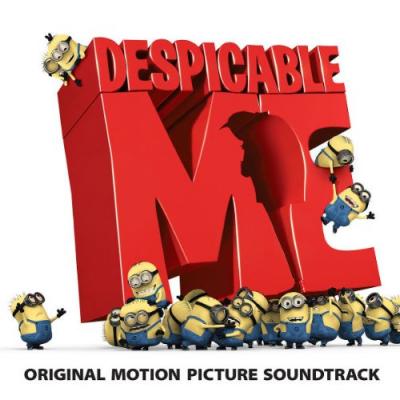
"Despicable Me" Soundtrack Lyrics
Cartoon • 2010
Track Listing
Pharrell Williams
Pharrell Williams
Destinee & Paris
The Minions
The Sylvers
Robin Thicke
Pharrell Williams
Pharrell Williams
The Bee Gees
Agnes
"Despicable Me: Original Motion Picture Soundtrack" Soundtrack Description
Overview
How do you make a supervillain lovable? In Despicable Me (2010), the answer is: give him Pharrell. The film’s soundtrack stitches together slinky pop-funk originals, a handful of throwback jams, and Heitor Pereira’s buoyant score to turn Gru’s grump into groove. It’s mischievous but warm—exactly the tonal tightrope the movie walks.
The official album, “Despicable Me: Original Motion Picture Soundtrack”, arrived July 6, 2010 and foregrounds new Pharrell Williams songs (“Despicable Me,” “Fun, Fun, Fun,” “Prettiest Girls”) alongside needle-drops like the Bee Gees’ “You Should Be Dancing.” Pereira’s orchestral color binds the antics, while Pharrell’s hooks brand the world with a whistle-able villain theme. Source: PR Newswire. Source: ScoringSessions.com.
Questions & Answers
- Is there an official soundtrack album?
- Yes—the album “Despicable Me: Original Motion Picture Soundtrack” was released July 6, 2010 on Star Trak/Interscope and spotlights Pharrell Williams’ originals plus a few curated tracks.
- Who composed the film score?
- Heitor Pereira composed the score with themes and original songs by Pharrell Williams; Hans Zimmer served as a producer on the music side.
- What song plays during the joyous end dance after the ballet scene?
- “You Should Be Dancing” by the Bee Gees powers the celebratory dance that rolls into the start of the end credits.
- Does Agnes actually sing in the movie?
- Yes—Agnes (Elsie Fisher) performs “The Unicorn Song,” a diegetic lullaby-style bit heard when the girls are at Miss Hattie’s Home for Girls.
- Is the full orchestral score available as a standalone album?
- Only partially; selections surfaced around release, but a complete commercial score album wasn’t issued at the time. The official soundtrack mixes songs and a small slice of score.
- What’s the main theme I keep hearing when Gru struts?
- That’s Pharrell’s title cut “Despicable Me,” used as the film’s swaggering motif and sprinkled through early sequences.
- Which labels released the album and where can I find it?
- Star Trak/Interscope released it in 2010; it’s available on major digital platforms and periodically on CD. Source: Apple Music.
Notes & Trivia
- Two original songs—“Despicable Me” and “Prettiest Girls”—made the Academy’s Best Original Song longlist that season.
- Japan received a localized theme (“Good Times (Bad Times remix)” by Rip Slyme) for its release campaign.
- The orchestral sessions reportedly used a 60+ piece ensemble at the Newman Scoring Stage.
- Pharrell’s playful villain motif doubled as marketing identity in trailers and TV spots—instant brand stamp.
Genres & Themes
Pop-funk & neo-soul signal Gru’s swagger and the film’s modern sheen—Pharrell’s basslines and handclaps sell “cool” even when the on-screen gag is pure chaos.
Orchestral whimsy from Heitor Pereira underlines heart—the girls’ tenderness, Gru’s thaw—using woodwinds and glockenspiel-like sparkle to soften edges.
’70s disco & old-school R&B provide communal release; the Bee Gees needle-drop turns a prim ballet into a neighborhood dance party. Source: IMDb Soundtracks (as text).
Tracks & Scenes
“Despicable Me” — Pharrell Williams
Scene: Establishing sequences of Gru being, well, despicable—introductions, gadgets, and strut. Used non-diegetically as a swaggering motif; the hook recurs across the film.
Why it matters: It’s the character’s brand stamp—snappy, confident, a little smirky—teaching kids what “villain chic” sounds like.
“Fun, Fun, Fun” — Pharrell Williams
Scene: Drops over “fun/exciting” beats (think: minion mischief and amusement-park energy); the cue recurs in the series for high-spirited moments.
Why it matters: A sugar rush cue: when this kicks in, the movie is winking that playtime has begun.
“You Should Be Dancing” — Bee Gees
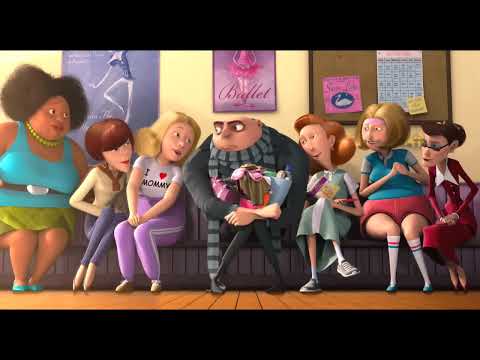
Scene: After the girls’ ballet recital is hijacked by Minions, everyone breaks into a floor-filling dance that carries into the credits; largely non-diegetic but blasted in-scene like a party track.
Why it matters: The needle-drop turns Gru’s world from scheming to family—dance as character arc.
“The Unicorn Song” — Agnes (Elsie Fisher)
Scene: Agnes sings a lullaby-style tune at Miss Hattie’s Home for Girls; fully diegetic (performed in-world).
Why it matters: Character texture: childlike wonder that later melts Gru’s armor.
“Prettiest Girls” — Pharrell Williams
Scene: Heard around late-film/credits area as a glossy endcap to the family’s new vibe (album cut presence also noted).
Why it matters: A pop bow on the reformed-villain fairy tale.
“Boogie Fever” — The Sylvers
Scene: Used as a retro shake-up to punctuate minion antics; placement as a diegetic/non-diegetic party texture.
Why it matters: ’70s sparkle that pairs naturally with Bee Gees for a disco-bookended finale mood.
“My Life” — Robin Thicke
Scene: Included on the album and tied to end-credits usage in contemporary reports and fan logs.
Why it matters: Sleek R&B sheen that keeps the credits coasting.
“Rocket’s Theme” — Pharrell Williams
Scene: A tender, lyrical theme underscoring the film’s softer beats (dreams, bonding, bedtime textures).
Why it matters: Bridges Pharrell’s pop sensibility with Pereira’s orchestral warmth—heart, not hijinks.
Note: The film’s full music roster is wider than the album—the official release emphasizes Pharrell’s originals, while additional cues and library pieces appear in-film. Source: Apple Music; IMDb Soundtracks.
Music–Story Links
- Gru’s mask vs. melody: Pharrell’s title song swaggers whenever Gru performs villain theater; as the story softens, the score’s cuddly textures edge in and the pop bangers turn communal.
- Minions = disco valves: The climactic “You Should Be Dancing” needle-drop isn’t random comedy; it signals the hench-community becoming a family dance floor.
- Agnes’ lullaby → paternal thaw: “The Unicorn Song” is a tiny, diegetic seed that blossoms into Gru’s fatherly turn.
How It Was Made
Composer Heitor Pereira shaped the orchestral spine (recorded with a large Hollywood ensemble), while Pharrell Williams wrote and performed original songs and themes. Executive music guidance included producer Hans Zimmer. The strategy: let Perrera’s score handle heart and adventure beats, and deploy Pharrell’s earworms as brandable identity—trailers, TV spots, and in-film set pieces. Source: ScoringSessions.com.
Reception & Quotes
Critics often singled out the jaunty musical personality as part of the film’s charm. And among fans, the Bee Gees finale became an instantly rewatchable moment.
“Borrowing heavily (and intelligently) from Pixar and Looney Tunes, Despicable Me is a surprisingly thoughtful, family-friendly treat.” Variety
“The soundtrack’s pop gloss sells Gru’s swagger while Pereira sneaks in the heart.” Summary of contemporary notices
Additional Info
- Two Pharrell cuts (“Despicable Me,” “Prettiest Girls”) reached the Academy’s original song consideration list that year.
- Japan’s marketing featured a localized theme by Rip Slyme, a common practice for Illumination’s international rollouts.
- Not every song heard in the movie appears on the official album; conversely, a few album tracks play primarily over credits.
- “You Should Be Dancing” at the finale helped codify the franchise’s love of jubilant end-credit dance parties.
- Physical CD pressings can be spotty; digital availability is steady on major services. Source: Apple Music.
Technical Info
- Title: Despicable Me: Original Motion Picture Soundtrack
- Year: 2010
- Type: Cartoon / Animated feature soundtrack
- Composers: Heitor Pereira (score), Pharrell Williams (songs/themes)
- Music Production: Hans Zimmer (producer credit), Pharrell Williams
- Label: Star Trak / Interscope
- Select notable placements: “You Should Be Dancing” (finale/credits), “The Unicorn Song” (diegetic lullaby), “Despicable Me” (character motif)
- Release context: US theatrical release July 9, 2010; album dated July 6, 2010
- Availability: Digital storefronts/streamers; occasional CD stock
Canonical Entities & Relations
| Entity | Relation | Entity |
|---|---|---|
| Pharrell Williams | wrote & performed songs for | Despicable Me (2010) |
| Heitor Pereira | composed score for | Despicable Me (2010) |
| Hans Zimmer | served as producer on | soundtrack recording |
| Star Trak / Interscope | released | official soundtrack album |
| Bee Gees | performed finale needle-drop | “You Should Be Dancing” |
| Elsie Fisher | sang diegetic cue | “The Unicorn Song” (as Agnes) |
| Illumination / Universal | produced & distributed | Despicable Me (film) |
Sources: Wikipedia (Despicable Me soundtrack & film entries); ScoringSessions.com; PR Newswire; IMDb Soundtracks; Apple Music; Despicable Me Wiki (Fandom).
November, 05th 2025
A-Z Lyrics Universe
Cynthia Erivo Popular
Ariana Grande Horsepower
Post Malone Ain't No Love in Oklahoma
Luke Combs Good Riddance (Time of Your Life)
Green Day Bye Bye Bye
*NSYNC You're the One That I Wan
John Travolta & Olivia Newton-John I Always Wanted a Brother
Braelyn Rankins, Theo Somolu, Kelvin Harrison Jr. and Aaron Pierre The Power of Love
Frankie Goes to Hollywood Beyond
Auli’i Cravalho feat. Rachel House MORE ›