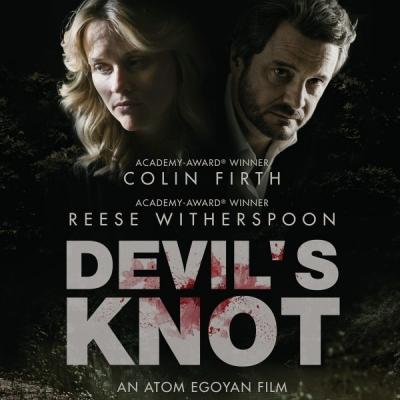
"Devil's Knot" Soundtrack Lyrics
Movie • 2014
Track Listing
Jet Jurgensmeyer
Slayer
Eva Cassidy
Slayer
Skip James
"Devil's Knot (Original Motion Picture Soundtrack)" Soundtrack Description
Overview
How do you score a tragedy everyone already thinks they know? Devil’s Knot (2014, dir. Atom Egoyan) answers with a spare, human-scaled soundtrack that avoids sensationalism. Canadian composer Mychael Danna threads breathy woodwinds, low strings, and hushed textures through scenes of grief, doubt, and small-town pressure, keeping the music close to the characters rather than the headlines.
Instead of shock cues, the album leans on tonality that feels handcrafted and fragile—music that leaves space for testimony, rumor, and prayer. A handful of source songs (period blues, gospel, and late-80s/early-90s metal cues referenced in the case’s “satanic panic”) puncture the quiet, while the score’s cue titles mirror specific beats in the investigation and trial. Trusted sources like Variety, Film Music Reporter, Discogs, and Wikipedia document the score’s authorship, release, and the film’s context.
Questions & Answers
- Is there an official soundtrack album?
- Yes. Varèse Sarabande released Devil’s Knot (Original Motion Picture Soundtrack), featuring Mychael Danna’s score.
- Who composed the score?
- Mychael Danna, a frequent Atom Egoyan collaborator and Academy Award winner for Life of Pi.
- Are there licensed songs in the film beyond the score?
- Yes—period tracks appear, including Eva Cassidy’s “Wade in the Water,” Skip James’s “Devil Got My Woman,” and selections associated with Slayer, alongside a film-performed “That’s All Right.”
- What’s the overall musical tone?
- Muted, elegiac, and investigative—flute and low strings carry a somber, reflective mood rather than sensational courtroom thrills.
- Can I stream or buy the album?
- The Varèse Sarabande album has been issued on CD and digitally via major outlets; availability may vary by region.
- Does the music reference specific scenes?
- Yes. Cue titles like “Pulled from the Water,” “Pro Bono,” and “Reasonable Doubt” align closely with key discoveries and trial phases.
Notes & Trivia
- Danna’s score album arrived after the film’s release, a few years later, as a limited edition.
- The composer–director pairing continues a decades-long Egoyan/Danna collaboration.
- Eva Cassidy’s posthumous rise meant her voice enters the film as a reflective counterpoint rather than a period needle-drop cliché.
- Score cue titles read like a case file, quietly guiding the viewer through evidence and testimony.
- One source song nods toward the Elvis lineage via “That’s All Right,” performed in-film rather than using the 1954 Sun master.
Genres & Themes
Modern chamber score → compassion under scrutiny: soft flute lines and restrained strings humanize parents, lawyers, and suspects, refusing to “solve” the case musically.
Delta blues & gospel → community memory: Skip James and Eva Cassidy function like voices from porches and pews—echoes of grief and endurance.
Metal signifiers → moral panic texture: the presence of Slayer titles underscores the era’s fear of “occult” youth culture, without glamorizing it.
Tracks & Scenes
Important: the film’s licensed songs and Danna’s cues are documented in reputable databases; where on-screen placements aren’t time-coded publicly, descriptions below identify the moment and function (diegetic vs. score) without listing the full album tracklist.
“Wade in the Water” — Eva Cassidy
Scene: Heard early at home, a domestic backdrop before the story’s worst news arrives; used as source music (diegetic) from a radio, grounding the film in everyday life.
Why it matters: a spiritual turned soft jazz-gospel reflects the town’s religious texture and a mother’s routine before rupture.
“Devil Got My Woman” — Skip James
Scene: Used as period source music to color the South’s blues lineage; a needle-drop that deepens the film’s Delta atmosphere.
Why it matters: the haunted timbre of James’s voice matches Egoyan’s elegiac tone—hurt that never quite resolves.
“Altar of Sacrifice” — Slayer
Scene: Referenced as cultural texture around the teens implicated in the case; non-diegetic association and/or incidental source use.
Why it matters: marks how heavy metal ephemera became “evidence” in the public imagination during the 1990s panic.
“Angel of Death” — Slayer
Scene: As above, cited/used in connection with the panic narrative rather than glorified on screen.
Why it matters: underscores the gap between aesthetic shock value and actual proof.
“That’s All Right” — Jet Jurgensmeyer
Scene: A youthful performance/cover used in-film; diegetic performance that contrasts starkly with the case’s darkness.
Why it matters: evokes the region’s Elvis lineage while reminding us these are kids and parents in a music-soaked American South.
“Pulled from the Water” — Mychael Danna (score)
Where it plays: Around the discovery and recovery sequence; non-diegetic score anchors the shock in quiet, solemn writing.
Why it matters: refuses melodrama; lets silence and low strings carry the weight.
“Pro Bono” — Mychael Danna (score)
Where it plays: With Ron Lax’s investigation thread; restrained motifs signal methodical doubt, not grandstanding.
Why it matters: casts the PI’s work as care rather than crusade.
“Reasonable Doubt” — Mychael Danna (score)
Where it plays: Courtroom phases where testimony and uncertainty collide.
Why it matters: a motif that breathes, mirroring the film’s refusal to hammer conclusions.
Music–Story Links
Faith vs. fear: Cassidy’s “Wade in the Water” (a spiritual) sits beside references to Slayer—two sonic worlds illustrating how religious comfort and moral panic coexisted in 1993 West Memphis.
Private grief, public trial: Danna’s intimate woodwind writing clings to faces rather than headlines, echoing the film’s focus on Pam Hobbs (Reese Witherspoon) and Ron Lax (Colin Firth).
Myth vs. evidence: Blues and metal cues trace what the town thinks it knows; the score counters with patient, questioning harmony.
How It Was Made
Egoyan re-teamed with longtime collaborator Mychael Danna. The composer’s approach: minimal, breath-forward instrumentation (notably flute) and a palette designed to avoid courtroom bombast. Music supervision was handled by Laura Katz, whose credits span a wide range of drama and thriller placements.
Reception & Quotes
Critics were mixed on the film but repeatedly singled out the music’s restraint and mood. A couple of crisp snapshots:
“Flute-laced score [that’s] evocatively moody.” The Dissolve
“Music: Mychael Danna; music supervisor: [credit noted in trade review].” Variety
Album availability was confirmed by the trade site Film Music Reporter; discography details appear on Discogs. The film’s core credits and release pattern are consistently documented on Wikipedia.
Additional Info
- The album’s cue names double as a narrative map—useful when rewatching.
- Because the film foregrounds testimony, the score often leaves breathing room; you’ll notice long rests and sustained tones.
- Several releases list the album a few years after the film, common for lower-profile dramas.
- Licensed material is sparing; the emphasis remains on original score.
- Some regional streaming platforms list the film under 2013 (festival year) while U.S. release is 2014.
Technical Info
- Title: Devil’s Knot (Original Motion Picture Soundtrack)
- Year / Type: 2014 movie; score album released subsequently
- Composer: Mychael Danna
- Music Supervision: Laura Katz
- Label: Varèse Sarabande (limited physical; digital availability)
- Select Notable Placements: “Wade in the Water” (Eva Cassidy); “Devil Got My Woman” (Skip James); Slayer titles referenced; “That’s All Right” (Jet Jurgensmeyer, in-film performance)
- Release Context (Film): TIFF world premiere in 2013; U.S. limited theatrical/VOD May 9, 2014
- Running Time (Film): ~114 minutes
Canonical Entities & Relations
| Subject | Relation | Object |
|---|---|---|
| Atom Egoyan | directed | Devil’s Knot (film) |
| Mychael Danna | composed score for | Devil’s Knot (film) |
| Varèse Sarabande | released | Devil’s Knot (Original Motion Picture Soundtrack) |
| Laura Katz | music supervised | Devil’s Knot (film) |
| Eva Cassidy | recording featured | “Wade in the Water” |
| Skip James | recording featured | “Devil Got My Woman” |
| Slayer | songs referenced/featured | “Altar of Sacrifice”; “Angel of Death” |
| Jet Jurgensmeyer | performs | “That’s All Right” (in-film) |
Sources: Variety; Film Music Reporter; Discogs; Wikipedia.
Colin Firth and Reese Witherspoon – both of these great actors got Oscars throughout their careers. In many ways, the films in which they participate get good box offices and recognition of both critics and ordinary viewers, thanks to acting skills of these actors. Now it is two of them in one movie and we can expect from this duo only the most commendable things: a great plot and intrigue to the end and a detective investigation that leads the viewer to an unexpected finale. In the course of the plot, three teenage boys were killed in the forests. Satanists suspected in this and the police already seized them. The lawyer and the investigator, acted by Colin Firth, doubt that they have done it and conducts his own investigation, the purpose of which is not only proof of their innocence in particular, but the restoration of justice in general. Mother of one of the murdered boys, played by, you guessed it right, Reese Witherspoon, initially is in full and unwavering desire that found scums have to suffer the full penalty. But in her not stupid head reasonable doubts arise thanks to the investigator that eventually put her on the diametrically opposite point of view. The plot, however, is not as linear as you might think at first. Its twists are very interesting till the very unexpected ending. Musical accompaniment was extremely little – only five songs. The death metal genre by Slayer band is among these songs, namely, two. This genre is rarely used for the soundtrack. Eva Cassidy showed her song Wade In The Water as qualitative blues, similar to the Devil Got My Woman, but only in the direction, not by the essence. Because these two are completely different. So unlike, as it is eventually can be in frames of a single genre. That's All Right showed a quality rock.November, 04th 2025
'Devil's Knot': learn more on IMDb and WikipediaA-Z Lyrics Universe
Cynthia Erivo Popular
Ariana Grande Horsepower
Post Malone Ain't No Love in Oklahoma
Luke Combs Good Riddance (Time of Your Life)
Green Day Bye Bye Bye
*NSYNC You're the One That I Wan
John Travolta & Olivia Newton-John I Always Wanted a Brother
Braelyn Rankins, Theo Somolu, Kelvin Harrison Jr. and Aaron Pierre The Power of Love
Frankie Goes to Hollywood Beyond
Auli’i Cravalho feat. Rachel House MORE ›