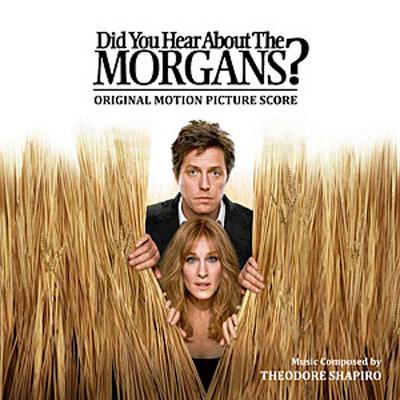
"Did You Hear About The Morgans?" Soundtrack Lyrics
Movie • 2009
Track Listing
Diane Birch
The Vienna Mozart Academy
Canned Heat
George Strait
Bob Dylan
Buddy Holly
Max Steiner
Hank Williams
Clyde Lawrence
Ivy
The Allman Brothers Band
Vic Clay and The Retro Wranglers
George Harrison
Bay City Rollers
Candy Butchers
Lalo Schifrin
Paul McCartney
Gracie Lawrence
Gracie Lawrence
The Allman Brothers Band
Los Lobos
Steve Tyrell
Stevie Wonder
"Did You Hear About the Morgans?" Soundtrack Description
Overview
City-slicker romcom meets Western postcard: the soundtrack pits Manhattan polish against Wyoming twang. Theodore Shapiro’s score stitches the fish-out-of-water gags with light rhythmic cues, then cedes the floor to needle-drops that swing from ’50s/’60s standards (“True Love Ways”) to bar-band boogie (“Going Up the Country”). The result is less about hit-chasing and more about culture-clash texture.
What sets this mix apart is its lived-in Americana: rodeo-ready Southern rock (“Jessica,” “Midnight Rider”), jukebox country (Hank Williams’ “Why Don’t You Love Me”), and a surprise end-credits soul cover (“We Can Work It Out” by Stevie Wonder). A bespoke crooner cut—Steve Tyrell’s “New York Is Where I Live”—bookends the city-mouse arc. Trusted source: Variety.
Questions & Answers
- Is there an official soundtrack album?
- No full multi-artist album was issued. A digital single—Steve Tyrell’s “New York Is Where I Live (from ‘Did You Hear About the Morgans?’)”—was released in December 2009. Trusted source: Madison Gate Records.
- Who composed the original score?
- Theodore Shapiro composed the score.
- What song plays over the end credits?
- Stevie Wonder’s version of “We Can Work It Out.”
- What’s the upbeat blues-rock when they drive through Ray, Wyoming?
- Bob Dylan’s “Rollin’ and Tumblin’.”
- Which songs are performed at the small-town fair?
- Gracie Lawrence sings “Redneck Woman” and “Crazy Little Thing Called Love.”
- Is the Tyrell song available to buy/stream?
- Yes. “New York Is Where I Live (from ‘Did You Hear About the Morgans?’)” is available as a standalone digital single. Trusted source: Apple Music listing.
Notes & Trivia
- Music supervision credit goes to Robert Schaper. Trusted source: Variety.
- Young songwriter Clyde Lawrence contributed original material and performs one track; his sister Gracie appears on-screen singing at the fair.
- Stevie Wonder’s “We Can Work It Out” caps the film with a Motown-soul sheen rather than Beatles’ original pop-rock.
- Country cuts (“Twang,” “Why Don’t You Love Me”) underline Wyoming settings while Manhattan scenes lean pop/classic standards.
- Shapiro’s score stays light and modular—short cues that slip between dialogue beats.
Genres & Themes
Classic pop & doo-wop warmth → reconciliation and nostalgia (“True Love Ways,” Tyrell’s bespoke closer).
Country & honky-tonk → small-town rhythms and ritual (bingo, rodeo, main street), e.g., George Strait’s “Twang,” Hank Williams’ “Why Don’t You Love Me.”
Southern rock & boogie → kinetic outdoor action and wide-open road energy (Allman Brothers’ “Jessica,” “Midnight Rider”).
1960s soul → feel-good resolution and end-credits uplift (Stevie Wonder’s “We Can Work It Out”).
Tracks & Scenes
"Fools" — Diane Birch
Scene: Underscores a tense beat when shots are fired and the Morgans scramble; early New York sequence, non-diegetic.
Why it matters: Sets the irony—sunny neo-soul under panic—before the relocation shock.
"Concerto for Oboe in C, K.314" — W. A. Mozart (Vienna Mozart Ensemble)
Scene: Paul climbs to a balcony; refined, non-diegetic counterpoint to slapstick climbing.
Why it matters: Manhattan sophistication (and denial) in musical form.
"Going Up the Country" — Canned Heat
Scene: Driving with the U.S. Marshal toward witness protection; needle-drop on the road, non-diegetic.
Why it matters: On-the-nose lyrical cue for forced exile; flips the film’s gear into road-movie mode.
"Twang" — George Strait
Scene: Bargain Barn shopping in Ray; plays in the store (diegetic).
Why it matters: First sonic immersion into local culture—friendly, unfussy, very Wyoming.
"Rollin’ and Tumblin’" — Bob Dylan
Scene: Montage while driving through Ray; non-diegetic.
Why it matters: Rough-edged swagger that cracks the couple’s city armor.
"True Love Ways" — Buddy Holly
Scene: Their first night in Ray—unpacking and sleeplessness; soft background, non-diegetic.
Why it matters: A whisper of reconciliation planted long before they admit it.
"Why Don’t You Love Me" — Hank Williams
Scene: Meryl goes for a jog; source-like feel cutting through morning quiet (diegetic/background).
Why it matters: A wry lyrical jab at Paul’s infidelity past—country humor as commentary.
"I’ve Got You Memorized" — Ivy
Scene: Assistants talk after Meryl’s clandestine call to the adoption agency; non-diegetic.
Why it matters: Indie pop cool for the sub-plot back in Manhattan.
"Midnight Rider" — The Allman Brothers Band
Scene: Horseback riding sequence out on the range; non-diegetic.
Why it matters: Road-tested resilience mapped onto clumsy city folk learning new rhythms.
"Please Don’t Leave Me" — Vic Clay & the Retro Wranglers
Scene: Dinner scene in Ray; low-mix background (diegetic).
Why it matters: Country plea mirroring the couple’s unspoken truce-talk.
"Between the Devil and the Deep Blue Sea" — George Harrison
Scene: Jogging together, post-thaw; non-diegetic.
Why it matters: Light, jazzy stride that signals a tentative détente.
"Saturday Night" — Bay City Rollers
Scene: Bingo night; on the hall speakers (diegetic).
Why it matters: Crowd energy; small-town fun brings them into the fold.
"What to Do with Michael" — Candy Butchers
Scene: Their assistants at dinner in NYC; non-diegetic needle-drop.
Why it matters: Keeps the parallel city timeline alive with alt-pop bite.
"Dance Tonight" — Paul McCartney
Scene: A reunion kiss lands; non-diegetic.
Why it matters: Mandolin-led buoyancy = emotional release valve.
"Redneck Woman" — Gracie Lawrence (cover)
Scene: County fair performance on stage (diegetic, on-screen).
Why it matters: A teen vocalist from the community literally gives the Morgans a soundtrack for fitting in.
"Crazy Little Thing Called Love" — Gracie Lawrence (cover)
Scene: Second fair number (diegetic).
Why it matters: Rockabilly swing greases the couple’s rediscovered flirtation.
"Jessica" — The Allman Brothers Band
Scene: Rodeo montage; non-diegetic.
Why it matters: Instrumental swagger = arena-size grins.
"Shakin’ Shakin’ Shakes" — Los Lobos
Scene: Bull riding; non-diegetic.
Why it matters: Barrel-race tempo for slapstick pain and pride.
"New York Is Where I Live" — Steve Tyrell
Scene: “Six months later” coda returning to NYC; non-diegetic.
Why it matters: A purpose-built coda that restores the city identity without losing the heartland lessons.
"We Can Work It Out" — Stevie Wonder
Scene: End credits; non-diegetic.
Why it matters: Soulful optimism nails the film’s thesis in one hook.
Music–Story Links
Country cues (Strait, Williams) don’t just paint scenery; they humiliate and then humanize Paul and Meryl—music as social initiation. “Midnight Rider” overlays their range ride with earned momentum, so when McCartney’s “Dance Tonight” hits the kiss, it feels like a victory lap. Tyrell’s closer reframes “home” as a feeling they can carry back to Manhattan. Trusted source: Reelsoundtrack track-scene notes.
How It Was Made
Composer: Theodore Shapiro, known for agile comedy scoring, keeps cues short and dialogue-friendly. Music supervision: Robert Schaper, whose clear-the-classics approach balances budget and familiarity. Clyde Lawrence contributed two originals and performed one; Gracie Lawrence appears on-screen at the fair—early credits for the siblings who later formed the band Lawrence. Trusted source: film press materials.
Reception & Quotes
Critics were cool on the film, but several singled out the easy-listening, Americana-heavy music as one of the gentler touches. Audience reactions trend warmer on home media.
“Barely civil Manhattan marrieds…rediscover love.” Variety
“Semi-watchable…with some charm.” The Independent Critic
Availability: no full OST; Steve Tyrell single available digitally. Score album not broadly issued at retail.
Additional Info
- End-credits pick is a Motown cover (“We Can Work It Out”), not the Beatles’ original.
- Max Steiner’s “Attack on the Indian Village” (from The Searchers) appears on a TV within the film—classic Western DNA folded in.
- Bay City Rollers’ “Saturday Night” powers a bingo sequence—pure crowd glue.
- Allman Brothers cues (“Jessica,” “Midnight Rider”) are the film’s horsepower—used for arena and trail energy.
- “I’ve Got You Memorized” by Ivy marks a return to Manhattan indie cool in intercut assistant scenes.
- Country store diegesis matters: “Twang” plays in-world, signaling the couple’s first willing participation in local life.
- Shapiro’s cue titles (on promo lists) mirror comedy beats (“Meet the Morgans,” “Wyoming!”), indicating spot-scoring tailored to gag timing.
Technical Info
- Title: Did You Hear About the Morgans?
- Year: 2009
- Type: Feature film – romantic comedy
- Score: Theodore Shapiro
- Music Supervision: Robert Schaper
- Notable placements: “We Can Work It Out” (Stevie Wonder), “New York Is Where I Live” (Steve Tyrell), “Twang” (George Strait), “Jessica” & “Midnight Rider” (The Allman Brothers Band), “Rollin’ and Tumblin’” (Bob Dylan), “True Love Ways” (Buddy Holly)
- Release context: U.S. theatrical release Dec 18, 2009; home media March 16, 2010.
- Album status: No official multi-artist OST; one official digital single (Tyrell). Score not widely released as a commercial album.
- Label touchpoint: Single issued under Columbia Pictures/Madison Gate Records banner.
Canonical Entities & Relations
| Subject | Relation | Object |
|---|---|---|
| Marc Lawrence | directed | Did You Hear About the Morgans? |
| Theodore Shapiro | composed score for | Did You Hear About the Morgans? |
| Robert Schaper | music supervised | Did You Hear About the Morgans? |
| Steve Tyrell | performed | “New York Is Where I Live (from ‘Did You Hear About the Morgans?’)” |
| Stevie Wonder | performed | “We Can Work It Out” (end credits) |
| Clyde Lawrence | wrote/performed | original tracks used in film |
| Gracie Lawrence | performed on-screen | “Redneck Woman”; “Crazy Little Thing Called Love” |
| Columbia Pictures | released | Did You Hear About the Morgans? |
| Madison Gate Records | issued | Tyrell digital single |
Sources: Variety; Reelsoundtrack blog; Ringostrack; Apple Music; Wikipedia; The Independent Critic; Rotten Tomatoes.
November, 07th 2025
A-Z Lyrics Universe
Cynthia Erivo Popular
Ariana Grande Horsepower
Post Malone Ain't No Love in Oklahoma
Luke Combs Good Riddance (Time of Your Life)
Green Day Bye Bye Bye
*NSYNC You're the One That I Wan
John Travolta & Olivia Newton-John I Always Wanted a Brother
Braelyn Rankins, Theo Somolu, Kelvin Harrison Jr. and Aaron Pierre The Power of Love
Frankie Goes to Hollywood Beyond
Auli’i Cravalho feat. Rachel House MORE ›