Soundtracks:  A B C D E F G H I J K L M N O P Q R S T U V W X Y Z #


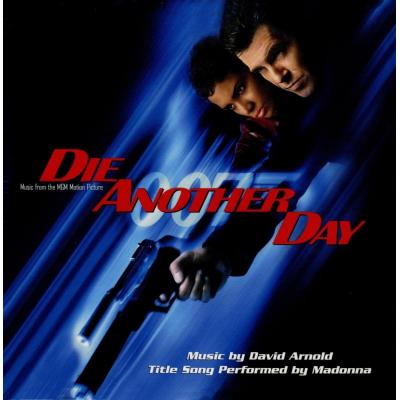
Die Another Day Album Cover

"Die Another Day" Soundtrack Lyrics

Movie • 2002

Track Listing

Die Another Day

Madonna

Bond Vs. Oakenfold - (Oakenfold mix)

Gun Barrel / On The Beach

How Do You Intend To Kill Me Now, Mr. Bond?

Hovercraft Chase

Kiss Of Life

Peaceful Fountains Of Desire

Welcome To Cuba

Jinx Jordan

Wheelchair Access

Jinx And James


"Die Another Day" Soundtrack Description

Die Another Day 2002 official trailer thumbnail with Pierce Brosnan and Halle Berry
Die Another Day — Theatrical Trailer, 2002

Overview

Can a Bond score be both icy-sleek and club-forward? David Arnold’s fourth 007 outing says yes. The soundtrack welds orchestral heft to glitchy electronics, mirroring a film that jumps from North Korean captivity to an Icelandic ice palace and a cargo jet finale. The opening title song—Madonna’s “Die Another Day”—plays over a rare narrative title sequence that advances Bond’s torture-and-survival prologue rather than pausing the story.

Arnold threads returning motifs (“romance” and “Renard” ideas from the previous film) into new tech-edged set pieces: hovercraft percussion, choir over the Icarus weapon, and a brutalist action palette for the ice-palace chase. A pop needle-drop breaks tradition midfilm—The Clash’s “London Calling” for a very literal London arrival—while Paul Oakenfold’s remix of the “James Bond Theme” gives end-title bite. Trusted source: The Music of James Bond by Jon Burlingame.

Trailer frame echoing the film’s techno-orchestral tone and icy palette
Trailer imagery reflects the score’s electro-orchestral blend, 2002

Questions & Answers

Who composed the score?
David Arnold composed the score; Nicholas Dodd orchestrated and conducted. Trusted source: MI6-HQ.
Who performs the title song?
Madonna co-wrote and performed “Die Another Day” with producer Mirwais Ahmadzaï; Michel Colombier arranged the strings.
Is there an official soundtrack album?
Yes—“Die Another Day (Music from the MGM Motion Picture)” on Warner Bros. Records (2002) and an expanded 2-CD edition from La-La Land Records (2017).
What song plays when Bond returns to London and Gustav Graves parachutes in?
“London Calling” by The Clash (source/needle-drop over the London montage).
Does the film use a remix of the James Bond Theme?
Yes. “James Bond Theme (Bond vs. Oakenfold)” appears on the album and is used in the film’s end-title presentation.
What cue underscores the ice-palace laser confrontation?
Arnold’s “Laser Fight,” which leans into processed percussion and rising metallic textures.

Notes & Trivia

  • The title sequence is plot-driven: Bond endures captivity while Madonna’s song plays—unusual for the series.
  • “London Calling” is a rare Bond-era needle-drop used diegetically to land the film in modern London.
  • La-La Land’s 2017 expansion restored alternates and source music, including the in-world “Party Trick.”
  • Oakenfold’s remix modernized Monty Norman’s theme for the end credits.
  • Choir textures appear in several cues—sparingly used in the franchise before this entry.

Genres & Themes

Electro-orchestral action → surveillance-age anxiety; synthetic pulses track gadgets and the Icarus super-weapon.

Romantic piano/strings → Bond’s guarded intimacy (“Going Down Together”), a carry-over love motif reframed with restraint.

Anthemic rock/punk needle-drop → “London Calling” as cheeky civic branding and tonal reset after the grim prologue.

Trailer frame highlighting the ice palace aesthetic tied to the score’s cold electronic textures
Ice aesthetics ↔ cold synth design: the film’s visual–sonic rhyme, 2002

Tracks & Scenes

"Die Another Day" — Madonna
Where it plays: Main titles over Bond’s imprisonment and torture (early sequence); non-diegetic.
Why it matters: A techno-edged Bond theme that narrates the prologue rather than pausing it; sets a colder, modernist tone.

"London Calling" — The Clash
Where it plays: Bond’s BA flight back to London intercut with Gustav Graves parachuting near Buckingham Palace; montage, source-styled needle-drop.
Why it matters: A wink at location and attitude—street-level punk energy colliding with Bond-world ceremony.

"James Bond Theme (Bond vs. Oakenfold)" — Paul Oakenfold / David Arnold
Where it plays: End titles (album version on tracklist); non-diegetic.
Why it matters: Updates the franchise signature with big-room electronics; bridges score and pop culture.

"On the Beach" — David Arnold
Where it plays: Pre-title infiltration along the North Korean coast; non-diegetic score cue.
Why it matters: Aggressive modern Bond language—drums and synths welded to brass—announces the film’s high-tech tilt.

"Hovercraft Chase" — David Arnold
Where it plays: The demilitarized-zone pursuit across the minefield; non-diegetic.
Why it matters: Percussive electronics and low brass drive one of the score’s cleanest action builds.

"Welcome to Cuba" — David Arnold
Where it plays: Bond’s arrival in Havana, street vistas and clinic reconnaissance; non-diegetic.
Why it matters: Light Latin color without pastiche; resets the palette after Hong Kong grit.

"Jinx Jordan" — David Arnold
Where it plays: Jinx emerges from the sea and Bond meets her; non-diegetic character motif.
Why it matters: A sultry, rhythm-led identity that counterpoints Bond’s own theme.

"Blades" — David Arnold
Where it plays: Fencing-club sequence with Verity; non-diegetic, with clipped ostinati.
Why it matters: Metronomic tension as flirtation turns duel—music tightens before the museum chase.

"Icarus" — David Arnold
Where it plays: Gustav Graves unveils the satellite; non-diegetic with choir/organ sonority.
Why it matters: Pseudo-sacred tone frames hubris; villain theme reaches full stature.

"Laser Fight" — David Arnold
Where it plays: Ice-palace laser confrontation; non-diegetic.
Why it matters: Metallic pulses and rising strings sell the set-piece peril.

"Whiteout" — David Arnold
Where it plays: Ice-field escape and Zao pursuit; non-diegetic.
Why it matters: Propulsive action design; Bond motif punches through the synth wall.

"Antonov" — David Arnold
Where it plays: Cargo-plane finale; extended cue with piano statements of the film’s darker motif.
Why it matters: Long-form action architecture that cycles through menace, suspense, and release.

Music–Story Links

Bond’s psyche gets scored, not just his stunts. The narrative title song compresses trauma into rhythm—so when the romance motif finally blooms in “Going Down Together,” the release reads as earned, not syrupy. Villain cues (“Icarus,” choral colors) cast Graves as a tech-Messiah; the punk needle-drop plants a cultural flag that he tries to co-opt with spectacle. Trusted source: La-La Land Records liner overview.

Trailer frame emphasizing Bond versus Graves, mirrored by choir-heavy villain music
Bond vs. Graves: choral swagger vs. brass-and-synth grit, 2002

How It Was Made

Arnold’s team recorded at AIR Lyndhurst; Nicholas Dodd handled orchestration/conducting. Madonna and Mirwais cut the title song with live strings arranged by Michel Colombier, then folded into a glitch-edged mix. Music editing emphasized modular action chunks for hovercraft, ice palace, and plane sequences. A 2017 archival expansion (La-La Land) restored alternates, film versions, and the source cue “Party Trick.” Trusted source: Discogs credits and label notes.

Reception & Quotes

Critical response split: several reviewers attacked the title song’s techno sheen, while score reviews highlighted muscular set-pieces and the villain material. Fan debate around the “London Calling” needle-drop has persisted.

“Electroclash bombast that jarred with tradition.” Filmtracks
“Choir and electronics give the action uncommon scale.” Movie Music UK

Album availability: 2002 Warner Bros. CD/digital; 2017 La-La Land 2-CD limited set with additional cues.

Additional Info

  • The Clash’s cue aligns with Bond’s BA arrival and Graves’ parachute publicity stunt.
  • End titles feature Oakenfold’s theme remix; some home releases also place a “Die Another Day” club mix on menus/extras.
  • The expanded edition identifies on-screen source (“Party Trick”) and film-version edits for multiple cues.
  • Two romance-theme callbacks from the previous film resurface in “Going Down Together.”
  • Arnold’s “Whiteout” and “Ice Palace Car Chase” are fan-favorite action showcases in expanded form.

Technical Info

  • Title: Die Another Day
  • Year: 2002
  • Type: Feature film — James Bond (Eon Productions)
  • Score: David Arnold
  • Orchestration/Conducting: Nicholas Dodd
  • Title song: “Die Another Day” — Madonna (co-writer/producer: Mirwais Ahmadzaï; strings: Michel Colombier)
  • Remix: “James Bond Theme (Bond vs. Oakenfold)” — Paul Oakenfold
  • Notable placements: “London Calling” (The Clash); end-title theme remix
  • Labels: Warner Bros. Records (2002); La-La Land Records expanded reissue (2017)

Canonical Entities & Relations

SubjectRelationObject
David Arnoldcomposed score forDie Another Day (2002 film)
Nicholas Doddorchestrated & conductedDie Another Day (score)
Madonnaco-wrote & performed“Die Another Day” (title song)
Mirwais Ahmadzaïco-wrote & produced“Die Another Day”
Michel Colombierarranged strings for“Die Another Day”
Paul Oakenfoldremixed“James Bond Theme (Bond vs. Oakenfold)”
Warner Bros. RecordsreleasedOriginal soundtrack album (2002)
La-La Land RecordsissuedExpanded 2-CD edition (2017)
Eon ProductionsproducedDie Another Day (film)
Lee TamahoridirectedDie Another Day (film)

Sources: MI6-HQ; La-La Land Records; Wikipedia (film, song, soundtrack pages); The James Bond Dossier; Discogs; Filmtracks; Movie Music UK.

November, 07th 2025


A-Z Lyrics Universe

Lyrics / song texts are property and copyright of their owners and provided for educational purposes only.