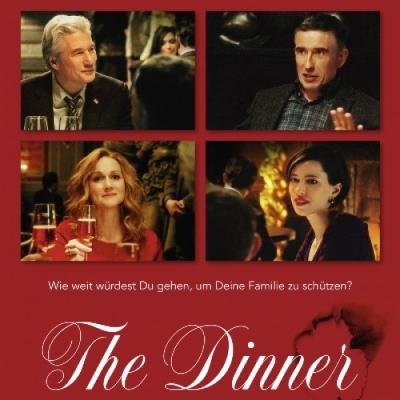
"Dinner" Soundtrack Lyrics
Movie • 2017
Track Listing
Bob Dylan
Nico
Leonard Cohen
Antony and the Johnsons
The Shoe
Locust Honey
Pat Thomas & Kwashibu Area Band
Aku Orraca-Tetteh
Len Amato
Eli Brueggeman
"The Dinner (Original Motion Picture Soundtrack)" Soundtrack Description
Overview
A four-hander at a Michelin-level restaurant shouldn’t feel like a war movie, yet the soundtrack sharpens every insult and silence. The compilation leans on tastefully austere catalog cuts—Bob Dylan (“Standing in the Doorway”), Nico (“These Days”), Leonard Cohen (“Banjo”)—offset by edgier textures (Savages’ “F**kers,” Neu!’s “Lieber Honig”) and a few roots, blues, and Afro–highlife pivots (Lowell Fulson; Pat Thomas & Kwashibu Area Band). The curation echoes the film’s structure: refined surfaces; volatile undercurrent. Trusted source: Apple Music album page.
Beyond the songs, original music by Elijah (Eli) Brueggemann threads cues between flashbacks and table confrontations; the score stays minimal so conversation and consequence dominate. Music supervision by Rachel Fox ties period-agnostic selections to character memory and class signifiers. Trusted sources: IMDb full credits; Wikipedia film entry.
Questions & Answers
- Is there an official soundtrack album?
- Yes. A digital various-artists album titled The Dinner (Original Motion Picture Soundtrack) was released in May 2017 (streaming/download). Trusted source: Apple Music; Spotify.
- Who composed the score?
- Elijah (Eli) Brueggemann composed original music for the film (credited on IMDb and in the film’s credits block).
- Which classic tracks headline the compilation?
- Bob Dylan’s “Standing in the Doorway,” Nico’s “These Days,” Leonard Cohen’s “Banjo,” Antony and the Johnsons’ “The Horror Has Gone,” Serge Gainsbourg’s “Chatterton.”
- Are there diegetic pieces tied to history scenes?
- Yes. Civil War tunes like “Dixie’s Land” (2nd South Carolina String Band) and “Battle Hymn of the Republic” (Mitch Miller & the Gang) appear in context with museum/heritage material.
- Does the movie use contemporary abrasive rock?
- Yes. Savages’ “F**kers” is part of the licensed roster, pushing tension well past polite dining-room decorum.
- Who handled music supervision and clearances?
- Rachel Fox is credited as Music Supervisor.
Notes & Trivia
- The album mixes 1960s/70s catalog (Dylan, Nico, Cohen, Gainsbourg) with experimental krautrock (Neu!) and U.S. indie (Califone).
- Two Civil War standards (“Dixie’s Land,” “Battle Hymn of the Republic”) appear—on-theme with the film’s history-teacher backstory and battlefield material.
- Chopin’s “Étude Op.10 No.6” (Jan Lisiecki performance) is licensed—classical polish amid escalating table warfare.
- Original score credit appears in the film and on crew databases for Elijah (Eli) Brueggemann.
Genres & Themes
Melancholic folk/rock → memory and regret. Dylan, Nico, Cohen signal adults replaying choices that can’t be unsaid.
Krautrock & art-pop → alienation and ritual. Neu!’s “Lieber Honig” and Gainsbourg’s “Chatterton” cool the room while pressure rises.
Blues & roots → moral rot underneath civility (Lowell Fulson; Califone’s “The Orchids”).
Patriotic standards → history as performance; the film literalizes ideology through “Dixie’s Land” and “Battle Hymn.”
Tracks & Scenes
"Standing in the Doorway" — Bob Dylan
Where it plays: Used in the feature per the official album; reflective placement around character remorse (non-diegetic).
Why it matters: A mid-tempo elegy that frames the film’s guilt/reckoning loop. (Album/credit confirmation)
"These Days" — Nico
Where it plays: Licensed cut on the album; contemplative montage/flashback energy (non-diegetic).
Why it matters: Regret without melodrama; the lyric subtext does heavy lifting between table rounds. (Album/credit confirmation)
"Banjo" — Leonard Cohen
Where it plays: Album use; brooding, intimate needle-drop (non-diegetic).
Why it matters: Austerity that fits the film’s confessional beats.
"The Horror Has Gone" — Antony and the Johnsons
Where it plays: Featured on the official album; slow-burn cue over aftermath/reflection (non-diegetic).
Why it matters: A fragile timbre that refuses neat catharsis.
"Chatterton" — Serge Gainsbourg
Where it plays: Album cue; luxe ambiance shading into menace (non-diegetic).
Why it matters: Wordly ennui that mirrors performative civility at the table.
"Lieber Honig" — Neu!
Where it plays: Licensed on roster; minimalist drift used to cool scenes (non-diegetic).
Why it matters: Puts time on ice; tension keeps accruing.
"The Orchids" — Califone (Psychic TV cover)
Where it plays: Album selection; interstitial mood piece (non-diegetic).
Why it matters: Ritual and decay in one drone-folk package.
"Dixie’s Land" — 2nd South Carolina String Band
Where it plays: Civil War context (source/diegetic) tied to museum/heritage material.
Why it matters: History lesson as atmosphere; underlines the film’s fixation on legacy and myth.
"Battle Hymn of the Republic" — Mitch Miller & the Gang
Where it plays: Companion patriotic source cue (diegetic) in heritage setting.
Why it matters: Ironic counterpoint to private moral collapse.
"12 Études, Op. 10: No. 6 in E-flat minor" — Frédéric Chopin (Jan Lisiecki)
Where it plays: Classical needle-drop in the restaurant’s hush (source or non-diegetic depending on mix).
Why it matters: Surface elegance; nerves underneath.
"F**kers" — Savages
Where it plays: Licensed roster track; used to push intensity (non-diegetic).
Why it matters: A hard jolt against the film’s polite façade.
Music–Story Links
The selections map class, taste, and denial. Catalog icons (Dylan, Nico, Cohen) paint educated nostalgia; krautrock and art-pop keep scenes emotionally cool until someone detonates. Civil War standards turn “history” into diegetic wallpaper, then the script forces characters to apply that morality at home—unsparingly.
How It Was Made
Score. Elijah (Eli) Brueggemann’s original cues are used sparingly—short interludes that leave space for dialogue spikes and flashback jumps.
Supervision & clearances. Rachel Fox is credited as Music Supervisor; the licensed set spans U.S., European catalog and classical performances. Trusted source: IMDb full credits.
Reception & Quotes
Critical response to the film was mixed; several reviews noted how sound and music emphasize discomfort rather than relief.
“The cast makes a riveting quartet in Oren Moverman’s adaptation.” Variety (via Wikipedia roundup)
“The music score gets in the way of the more important dialogue.” RogerEbert.com
Album availability: widely streamable in 11-track form; a separate commercial score album has not been issued.
Additional Info
- Official album includes: Dylan, Nico, Cohen, Antony and the Johnsons, The Shoe, Locust Honey, Serge Gainsbourg, Pat Thomas & Kwashibu Area Band, Aku Orraca-Tetteh, Len Amato, and Eli Brueggemann (“Cold Opening”).
- Additional licensed cues documented on credits databases: Califone’s “The Orchids,” Neu!’s “Lieber Honig,” Chopin Étude Op.10 No.6 (Jan Lisiecki), Mitch Miller’s “Battle Hymn…,” 2nd South Carolina String Band’s “Dixie’s Land.”
- The film premiered at Berlinale (February 10, 2017) and opened in the U.S. on May 5, 2017.
- Distribution: The Orchard (film). Soundtrack issued digitally (no confirmed physical retail edition).
- Language mixing (English/French/German artists) mirrors the pan-Atlantic curation.
Technical Info
- Title: The Dinner
- Year: 2017
- Type: Psychological drama
- Director: Oren Moverman
- Score: Elijah (Eli) Brueggemann
- Music Supervision: Rachel Fox
- Official album: The Dinner (Original Motion Picture Soundtrack) — digital, 11 tracks (streaming/download)
- Notable placements: “Standing in the Doorway” (Bob Dylan); “These Days” (Nico); “Banjo” (Leonard Cohen); “Chatterton” (Serge Gainsbourg); “The Horror Has Gone” (Antony and the Johnsons); “Dixie’s Land” (2nd South Carolina String Band); “Battle Hymn of the Republic” (Mitch Miller & the Gang); “Lieber Honig” (Neu!).
- Release context: Berlinale premiere Feb 10, 2017; U.S. release May 5, 2017.
Canonical Entities & Relations
| Subject | Relation | Object |
|---|---|---|
| Oren Moverman | directed | The Dinner (2017) |
| Elijah (Eli) Brueggemann | composed score for | The Dinner (2017) |
| Rachel Fox | music supervised | The Dinner (2017) |
| Bob Dylan | performed | “Standing in the Doorway” |
| Nico | performed | “These Days” |
| Leonard Cohen | performed | “Banjo” |
| Antony and the Johnsons | performed | “The Horror Has Gone” |
| Serge Gainsbourg | performed | “Chatterton” |
| Neu! | performed | “Lieber Honig” |
| 2nd South Carolina String Band | performed | “Dixie’s Land” |
| Mitch Miller & the Gang | performed | “Battle Hymn of the Republic” |
Sources: Apple Music; Spotify; IMDb (film & full credits); Film Music Reporter; Wikipedia (film page); Ringostrack.
‘The Dinner’ is hard to explain. It is about talking, emotions, crime, investigation, protection, and mutilation of someone’s hopes for justice. It is not about collecting a huge box office, but it is about telling a story in the narrative and thrilling way in which the sharpness of depicted characters and their revealed secrets prevail over the essence of narration, exposing the distorted logic and controversial inner worlds. The plot is only holding while the four people are sitting at one table discussing their kids’ future, as the latter ones had committed a crime but had not been disclosed yet. The one that calls himself the wisest among this gathering is depicted by Richard Gere and he proposes to hand all cards on the table to let their offspring go to jail. Someone is standing at the protectionist position, the other one – at the accusative but despite the essence, it is one of those films where the way HOW it is uncovered is way more significant than WHAT is uncovered. The film’s soundtrack has collected many hard and sophisticated singers and their songs – Leonard Cohen, Bob Dylan, and others. They have sad songs that reflect over the past actions (‘Blue’) or the life in general (‘These Days’), and some of them like ‘Harry Barry ’ have aggressively complicated lyrics. The entire mood of this collection is rather depressing, following its lyrics. The box office is collected way too small. Its insignificance even depressing – a hard and strong film like this would have run better than it did. Maybe, something will change, but its limited release and nothing-happening-but-only-quarrelling narration may seem too uninteresting for public. Slightly over 1 million collected dollars underscores the number of wise people in our globally-populist world.November, 09th 2025
'The Dinner': movie profiles on IMDb and Rotten TomatoesA-Z Lyrics Universe
Cynthia Erivo Popular
Ariana Grande Horsepower
Post Malone Ain't No Love in Oklahoma
Luke Combs Good Riddance (Time of Your Life)
Green Day Bye Bye Bye
*NSYNC You're the One That I Wan
John Travolta & Olivia Newton-John I Always Wanted a Brother
Braelyn Rankins, Theo Somolu, Kelvin Harrison Jr. and Aaron Pierre The Power of Love
Frankie Goes to Hollywood Beyond
Auli’i Cravalho feat. Rachel House MORE ›