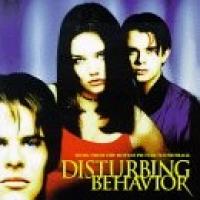
"Disturbing Behavior" Soundtrack Lyrics
Movie • 1998
Track Listing
Stark, Janus
Flys
Hutt
Addict
Once Upon A Time
F.O.S.
Phunk Junkeez
Driver
Trout, Eva
Treble Charger
Drag, Jack
Skold
"Music From The Motion Picture Disturbing Behavior" Soundtrack Description
Overview
Teen paranoia, corporate grooming, and late-90s alt-rock meet in Disturbing Behavior. The film’s official compilation leans post-grunge/alternative, while Mark Snow’s score threads the conspiracy with tense electronics and strings. Together they draw a clean line between surface perfection and the mess underneath.
The songs album centers contemporary bands of 1998, fronted by The Flys’ single “Got You (Where I Want You),” while the separate score album frames key turns—outbursts, inductions, the ferry run—with cue titles that mirror plot beats. AllMusic lists July 28, 1998 as release date for both albums; the various-artists disc runs ~44 minutes, the score ~42 minutes (source: AllMusic).

Questions & Answers
- Is there an official soundtrack album?
- Yes. A various-artists CD titled Music From The Motion Picture Disturbing Behavior (released July 28, 1998) plus a separate Disturbing Behavior (Original Motion Picture Score) by Mark Snow.
- Who composed the score?
- Mark Snow. The score album clocks about 42 minutes and was issued by Sonic Images in 1998.
- Which label released the songs compilation?
- Trauma Records with BMG distribution (1998 CD editions).
- What song plays during the mental hospital escape?
- Harvey Danger’s “Flagpole Sitta.” It’s in the film and trailers but not on the retail soundtrack CD.
- What was the lead single tied to the film?
- The Flys’ “Got You (Where I Want You).” Its music video features Katie Holmes and James Marsden.
- Who supervised the film’s music?
- Sharon Boyle and John Houlihan are credited as music supervisors.
- Is the entire soundtrack available on streaming?
- The original CDs are confirmed; digital/streaming availability varies by territory and rights. Individual tracks and the score appear on services, but not always as a single package.
Notes & Trivia
- The retail CD omits “Flagpole Sitta,” despite its prominent use in the film and marketing.
- The Flys’ single “Got You (Where I Want You)” doubled as promotion for the film; its video includes scenes and cameos by the leads.
- Two distinct releases exist: a songs compilation and a Mark Snow score album—common for late-90s teen thrillers.
- Score cue titles (“Chug’s Libido,” “Evil Chairs”) map directly to plot mechanics and locations.
- Music supervisors were Sharon Boyle and John Houlihan; the score album’s production notes list both.
Genres & Themes
Post-grunge & alt-rock underline teen alienation and the film’s “perfect on the outside” façade. Crunchy guitars and mid-tempo hooks mirror peer pressure and conformity.
Electronic-string suspense (score) marks surveillance and control. Repeating pulses and sustained strings tighten during “programming” scenes, then open up during the ferry escape.
Tracks & Scenes
Below are verifiable placements and function notes. When exact timestamps vary by cut or aren’t officially listed, this is noted clearly.
“Flagpole Sitta” — Harvey Danger
Where it plays: Non-diegetic needle-drop during the mental hospital escape; also used in theatrical trailers/TV spots. Not included on the retail CD.
Why it matters: The irreverent hook undercuts the “clean teen” veneer and injects anarchic energy into the breakout.
“Got You (Where I Want You)” — The Flys
Where it plays: Featured in-film and heavily in marketing; the official music video stitches film footage with band performance. Album single.
Why it matters: Serves as the soundtrack’s calling card; lyrically aligns with manipulative romance and social pressure themes.
“Every Little Thing Counts” — Janus Stark
Where it plays: Included on the songs album; specific in-film timestamp isn’t documented publicly in studio materials.
Why it matters: High-octane opener on the CD that frames the compilation’s aggressive, late-90s guitar tone.
“Monster Side” — Addict
Where it plays: On the retail compilation; exact scene placement not officially listed.
Why it matters: Brooding alt-rock that echoes characters’ “two sides”—polished Blue Ribbons vs. suppressed impulses.
“Hail Mary” — Skold
Where it plays: On the retail compilation; appears in the film per credits listings.
Why it matters: Industrial-tinged tension track that fits the film’s sterile tech vs. teen angst palette.
Score cues that map to on-screen moments
“Main Title” — Mark Snow
Where it plays: Opening titles; establishes the thriller’s synth-string language.
Why it matters: Seeds suspicion before characters speak.
“Chug’s Libido” — Mark Snow
Where it plays: Boiler-room outburst tied to the Blue Ribbons’ “glitch” when sexual arousal trips the implant conditioning.
Why it matters: Musically telegraphs repression flipping into violence.
“Rat Man Revealed” — Mark Snow
Where it plays: Janitor Newberry’s secret comes to light.
Why it matters: Motif shift signals an ally inside the system.
“Dickie’s Induction/Who’s Your Daddy” — Mark Snow
Where it plays: Programming sequence in the chair rig.
Why it matters: Pulses and stingers emphasize coercion as procedure.
“Evil Chairs” — Mark Snow
Where it plays: The brainwashing setup in full view.
Why it matters: Mechanical rhythm + dissonance lock to the imagery of restraint.
“Safe Ferry/Finale” — Mark Snow
Where it plays: Climax and ferry escape; end movement.
Why it matters: Releases built-up harmonic tension; resolves character arcs musically.
Music–Story Links
- Anthem vs. system: “Flagpole Sitta” turns a chase into a taunt, mocking authority while protagonists seize agency.
- Facade pop: The Flys’ single plays like a flirt, but in context it mirrors performative perfection and coercive dynamics at Cradle Bay.
- Score as diagnosis: Cue titles (“Chug’s Libido,” “Evil Chairs”) literalize cause→effect—desire triggers malfunction; treatment equals control.
- Escape cadence: The finale cue expands harmony exactly as the frame widens—road, ferry, horizon.
How It Was Made
Composer: Mark Snow (The X-Files). Music supervision: Sharon Boyle and John Houlihan. The songs compilation was issued by Trauma/BMG; the score was released by Sonic Images (catalog SID-8811). The Flys’ lead single was leveraged in cross-promotion with a video featuring the stars. Trusted sources: AllMusic, Discogs, Wikipedia.
Reception & Quotes
Contemporary reviews treated the compilation as a crisp, market-savvy alt-rock sampler, while fans spotlighted Snow’s focused thriller writing.
“Features a strong collection of edgy rock songs with no instrumental ‘theme’ filler.” —Gail Worley, Ink 19
“Mark Snow’s music can enhance the dramatic intent of the story, the scene, and the moment.” —Director David Nutter (album notes)
“I don’t want a cover of ‘Flagpole Sitta’… I just want ‘Flagpole Sitta’.” —Jennifer Kaytin Robinson, on the song’s ‘90s teen-film legacy
Additional Info
- Release date for both albums: July 28, 1998 (album listings match).
- The Flys’ single also appears on the band’s album Holiday Man (1998).
- Trauma/BMG handled the commercial songs disc; Sonic Images handled the score CD.
- “Flagpole Sitta” is heard in-film and in marketing but is absent from the CD—common rights scenario in the era.
- The score album includes a bonus “Trailer” track by trailer composer John Beal.
- Music department credits also list Jason Alexander (music coordinator) and Jeff Charbonneau (music editor).
- Cue titles in Snow’s album are reliable scene signposts for chronology when timestamps aren’t publicly documented.
Technical Info
- Title: Music From The Motion Picture Disturbing Behavior; Disturbing Behavior (Original Motion Picture Score)
- Year: 1998
- Type: Various Artists compilation + Original Score
- Composer (score): Mark Snow
- Music Supervision: Sharon Boyle; John Houlihan
- Labels: Trauma Records/BMG (songs); Sonic Images SID-8811 (score)
- Notable placements: “Flagpole Sitta” in the mental-hospital escape (not on CD); “Got You (Where I Want You)” as lead single/video tie-in
- Album status: Confirmed 1998 CD issues; digital availability varies by region/platform
Canonical Entities & Relations
| Subject | Relation | Object |
|---|---|---|
| Mark Snow | composed | Disturbing Behavior (Original Motion Picture Score) |
| Sharon Boyle | music-supervised | Disturbing Behavior |
| John Houlihan | music-supervised | Disturbing Behavior |
| The Flys | performed | “Got You (Where I Want You)” |
| Harvey Danger | song used | “Flagpole Sitta” (in film; not on CD) |
| Trauma Records/BMG | released | Music From The Motion Picture Disturbing Behavior (CD) |
| Sonic Images | released | Disturbing Behavior (Original Motion Picture Score) (CD) |
| David Nutter | directed | Disturbing Behavior (1998) |
Sources: AllMusic; Wikipedia; Sonic Images Records; Discogs; Ink 19; Sight & Sound; Amazon (catalog details).
November, 09th 2025
A-Z Lyrics Universe
Cynthia Erivo Popular
Ariana Grande Horsepower
Post Malone Ain't No Love in Oklahoma
Luke Combs Good Riddance (Time of Your Life)
Green Day Bye Bye Bye
*NSYNC You're the One That I Wan
John Travolta & Olivia Newton-John I Always Wanted a Brother
Braelyn Rankins, Theo Somolu, Kelvin Harrison Jr. and Aaron Pierre The Power of Love
Frankie Goes to Hollywood Beyond
Auli’i Cravalho feat. Rachel House MORE ›