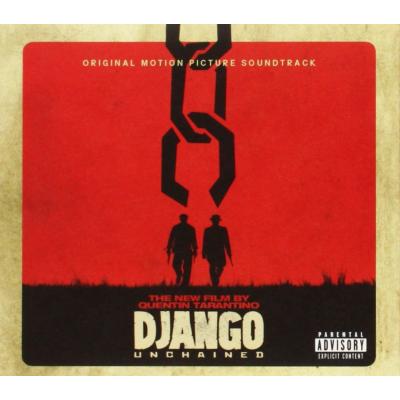
"Django Unchained" Soundtrack Lyrics
Movie • 2012
Track Listing
James Russo
Rocky Roberts & Luis Bacalov
Ennio Morricone
Christoph Waltz
Luis Bacalov
Anthony Hamilton & Elayna Boynton
Don Johnson
Luis Bacalov
Don Straud
Jim Croce
Riz Ortolani
Rick Ross
Jerry Goldsmith
Samuel L. Jackson
Ennio Morricone
Ennio Morricone & Elisa
James Brown & 2Pac
John Legend
Brother Dege
Samuel L. Jackson
Ennio Morricone
Samuel L. Jackson
I Cantori Moderni di Alessandroni
"Django Unchained: Original Motion Picture Soundtrack" Soundtrack Description
Overview
Can a spaghetti-western palette, 70s folk-rock, and modern hip-hop coexist in a single revenge western? This soundtrack proves it. Quentin Tarantino stitches together vintage cues by Luis Bacalov, Ennio Morricone, Riz Ortolani and Jerry Goldsmith with new originals by Rick Ross, John Legend, Anthony Hamilton & Elayna Boynton, and Elisa, creating a mixtape that pushes the film’s pulp into operatic territory.
The result swings confidently between myth and grit: classic Italian western motifs announce Django’s legend; folk confers introspection and purpose; R&B and hip-hop inject present-tense swagger when vengeance crests. According to Variety, that tonal friction is a deliberate tool, with pop cues turned into sharp narrative devices. Pitchfork noted the set’s purpose-built feel—less a standalone album, more a carefully tuned story engine.
Questions & Answers
- Is there an official soundtrack album?
- Yes — “Django Unchained: Original Motion Picture Soundtrack,” released December 18, 2012, on Loma Vista/Republic; 23 tracks including dialogue excerpts.
- Who contributed new original songs?
- Rick Ross (“100 Black Coffins,” produced with Jamie Foxx), John Legend (“Who Did That to You?”), Anthony Hamilton & Elayna Boynton (“Freedom”), and Ennio Morricone with Elisa (“Ancora Qui”).
- What song plays over the opening credits?
- “Django (Main Theme)” — Rocky Roberts & Luis Bacalov, the 1966 Corbucci theme repurposed to launch Django’s myth.
- Which track scores the Brittle brothers confrontation?
- “La Corsa (2nd Version)” — Luis Bacalov, a propulsive needle-drop from the original Django score.
- What’s the music during the Candyland shootout?
- “Unchained (The Payback/Untouchable)” — James Brown & 2Pac (Claudio Cueni mash-up), underscoring the house-wide gun battle.
- What songs play when Django rides back for revenge near the end?
- “Who Did That to You?” (John Legend) kicks in as he races back; it pivots into Brother Dege’s slide-blues “Too Old to Die Young” moments later.
- Was Frank Ocean’s “Wiseman” used?
- No. Tarantino praised the song but said there wasn’t a scene for it; Ocean later shared it separately.
Notes & Trivia
- Music supervision by Mary Ramos; Tarantino is credited as executive music producer.
- Four newly commissioned songs landed on the album; none were Oscar-nominated despite being shortlisted.
- The album was Grammy-nominated for Best Compilation Soundtrack for Visual Media.
- “Django (Main Theme)” and several Bacalov cues directly reference Sergio Corbucci’s 1966 Django.
- “Unchained” fuses James Brown’s “The Payback” with 2Pac vocals; engineer Claudio Cueni crafted the mash-up.
- Jamie Foxx produced Rick Ross’s “100 Black Coffins” during the shoot.
- Frank Ocean’s unused “Wiseman” was praised by Tarantino but left out for story reasons.
Genres & Themes
Spaghetti-western orchestral (Bacalov, Morricone, Ortolani): horns, choral swells, and guitar ostinatos mythologize Django, turning key confrontations into operas of fate.
70s folk & soft-rock (Jim Croce): self-definition and movement; montage music for a man building a purpose and a legend.
R&B/hip-hop and modern blues (Legend, Hamilton/Boynton, Rick Ross, Brother Dege): present-tense agency, swagger, and righteous fury. When revenge becomes active, grooves replace elegy. As Rolling Stone put it, the set is “all-over-the-place” by design—yet the clash serves character.
Tracks & Scenes
“Django (Main Theme)” — Rocky Roberts & Luis Bacalov
Where it plays: Opening credits, immediately establishing Django as mythic; non-diegetic; ≈00:00–00:02.
Why it matters: It links Tarantino’s film to Corbucci’s lineage and frames Django’s journey as a legend retold.
“La Corsa (2nd Version)” — Luis Bacalov
Where it plays: The Brittle brothers reckoning at Big Daddy’s plantation; non-diegetic.
Why it matters: A relentless gallop that turns Django’s first act of justice into a ritual of reclamation.
“I Got a Name” — Jim Croce
Where it plays: Training/bounty-hunting montage as Django and Schultz build a partnership; non-diegetic.
Why it matters: Soft-rock warmth underscores identity taking shape—Django choosing who he is, not just what he’s against.
“I Giorni dell’ira (Days of Anger)” — Riz Ortolani
Where it plays: Sharpshooting practice and ambush prep; non-diegetic.
Why it matters: Brass stings and twang rhythmically punctuate trigger pulls, turning practice into ceremony.
“Nicaragua” — Jerry Goldsmith (feat. Pat Metheny)
Where it plays: The entourage’s approach to Candyland; non-diegetic.
Why it matters: A somber march that telegraphs the plantation’s rot beneath immaculate Southern pageantry.
“Ancora Qui” — Ennio Morricone & Elisa
Where it plays: Quiet, wordless dinner-prep sequence at Candyland; non-diegetic.
Why it matters: A rare hush—melancholy strings and voice foreshadow the civility-masking cruelty of the evening.
“Unchained (The Payback/Untouchable)” — James Brown & 2Pac
Where it plays: The Candyland shootout after Schultz’s death; non-diegetic.
Why it matters: Funk vengeance plus rap bravado flips the room’s power dynamic and snaps the film into pulp overdrive.
“Who Did That to You?” — John Legend
Where it plays: Django rides back for payback; non-diegetic; ≈2:29:00 (album timing reference).
Why it matters: A mission statement in song—moral fury with forward motion.
“Too Old to Die Young” — Brother Dege
Where it plays: Moments after Legend’s track, as Django starts thinning Candie’s ranks; non-diegetic; ≈2:31:00.
Why it matters: Slide-guitar grit grounds the myth; Django is no ghost—he’s a man who refuses to die before the job is done.
“Trinity (Titoli)” — Annibale e I Cantori Moderni (Franco Micalizzi)
Where it plays: Closing stretch/end credits.
Why it matters: A wink back to Italian western comedy-swagger—victory with a crooked smile.
Music–Story Links
When Django first acts (the Brittles), the film borrows Bacalov’s gallop, literally importing the original Django myth to crown a new hero. As the mission turns intimate—saving Broomhilda—Croce’s folk phrasing and Ortolani’s fanfare elevate discipline over anger. At Candyland, “Ancora Qui” rewrites silence as tension: a genteel ritual scored like a requiem. After Schultz’s death, the soundtrack pivots from old-world signifiers to Black funk/rap—James Brown and 2Pac—because revenge is no longer allegory; it’s present, bodily, loud. On the home stretch, Legend’s vow and Brother Dege’s bayou slide tie Django’s love and rage into one motion: ride, cleanse, rebuild.
How It Was Made
Tarantino and music supervisor Mary Ramos built the set from vinyl deep-cuts and freshly commissioned tracks. The team secured classic Italian western cues (Bacalov, Morricone, Ortolani) and Jerry Goldsmith’s “Nicaragua,” then commissioned modern responses: Rick Ross’s “100 Black Coffins” (produced with Jamie Foxx on set), John Legend’s “Who Did That to You?,” Anthony Hamilton & Elayna Boynton’s “Freedom,” and Morricone/Elisa’s “Ancora Qui.” Claudio Cueni engineered the James Brown/2Pac “Unchained” mash-up. Frank Ocean’s “Wiseman” was praised but unused; story needs took precedence. Variety and The Playlist both documented how many cues were sourced from older films not included on the retail album.
Reception & Quotes
“The soundtrack is typically all-over-the-place: spaghetti-Western themes, Seventies folk rock, raucous acoustic blues.” Rolling Stone
“As effectively as these songs bring the film to life, nothing on the Django soundtrack feels like something you’d revisit very often.” Pitchfork
“‘Ancora Qui’…possibly the most mature use of music in his entire career.” Den of Geek
Album availability: standard digital/physical editions worldwide. The compilation was Grammy-nominated; region-specific chart peaks varied.
Additional Info
- Four new originals were shortlisted for the 2013 Best Original Song Oscar; none advanced to nominations.
- Album charted: Billboard 200 (U.S.) and Top Soundtrack Albums (U.S., top 5).
- Singles performance: “Freedom” (Anthony Hamilton & Elayna Boynton) and “Ancora Qui” (Elisa) saw European chart action.
- End-credits include RZA’s “Ode to Django (The D Is Silent)” on some versions, separate from the core shootout cue “Unchained.”
- Several film cues (e.g., “Town of Silence,” “Blue Dark Waltz”) are not on the commercial album.
- Legend pitched his demo to Tarantino the old-school way—on physical media—after writing to brief.
- Goldsmith’s “Nicaragua” track is used almost wall-to-wall in its sequence, shaping the cut to the music rather than the reverse.
Technical Info
- Title / Year: Django Unchained: Original Motion Picture Soundtrack (2012)
- Type: Compilation soundtrack (score selections + songs + dialogue)
- Executive Music Producer: Quentin Tarantino
- Music Supervisor: Mary Ramos
- Key new works: “100 Black Coffins” (Rick Ross/Jamie Foxx), “Who Did That to You?” (John Legend), “Freedom” (Anthony Hamilton & Elayna Boynton), “Ancora Qui” (Ennio Morricone & Elisa)
- Notable placements (selected): Opening credits — “Django (Main Theme)”; Brittles — “La Corsa (2nd Version)”; Approach to Candyland — “Nicaragua”; Dinner-prep — “Ancora Qui”; Shootout — “Unchained”; Revenge ride — “Who Did That to You?” → “Too Old to Die Young”.
- Label / Release: Loma Vista & Republic; December 18, 2012.
- Awards: Grammy nomination (Compilation Soundtrack); multiple song shortlistings for the Oscars.
- Chart notes: U.S. Billboard 200 peak around mid-50s; U.S. Soundtrack Albums top-5; notable European peaks.
Canonical Entities & Relations
| Entity | Relation | Entity |
|---|---|---|
| Quentin Tarantino | directed | Django Unchained (2012, film) |
| Mary Ramos | supervised music for | Django Unchained (film) |
| Luis Bacalov | composed | “Django (Main Theme)”, “La Corsa (2nd Version)” |
| Ennio Morricone | composed | “The Braying Mule”, “Sister Sara’s Theme”, “Ancora Qui” (with Elisa) |
| Riz Ortolani | composed | “I Giorni dell’ira” |
| Jerry Goldsmith | composed | “Nicaragua” (feat. Pat Metheny) |
| Rick Ross / Jamie Foxx | performed / produced | “100 Black Coffins” |
| John Legend | performed | “Who Did That to You?” |
| Anthony Hamilton & Elayna Boynton | performed | “Freedom” |
| James Brown & 2Pac / Claudio Cueni | performed / engineered | “Unchained (The Payback/Untouchable)” |
| Republic Records / Loma Vista | released | Official soundtrack album |
| Django (1966) | provides cues to | Django Unchained (2012) |
| Under Fire (1983) | source of | “Nicaragua” |
| Two Mules for Sister Sara (1970) | source of | “The Braying Mule”, “Sister Sara’s Theme” |
| Day of Anger (1967) | source of | “I Giorni dell’ira” |
Sources: Wikipedia; The Quentin Tarantino Archives; ScreenRant; Den of Geek; The Playlist; Variety; Pitchfork; Rolling Stone; Stereogum; Vulture; Sound Studies Blog; FWW Weekly; SoundtrackRadar.
November, 09th 2025
'Django Unchained' written and directed by Quentin Tarantino on the Web: Wikipedia, Internet Movie DatabaseA-Z Lyrics Universe
Cynthia Erivo Popular
Ariana Grande Horsepower
Post Malone Ain't No Love in Oklahoma
Luke Combs Good Riddance (Time of Your Life)
Green Day Bye Bye Bye
*NSYNC You're the One That I Wan
John Travolta & Olivia Newton-John I Always Wanted a Brother
Braelyn Rankins, Theo Somolu, Kelvin Harrison Jr. and Aaron Pierre The Power of Love
Frankie Goes to Hollywood Beyond
Auli’i Cravalho feat. Rachel House MORE ›