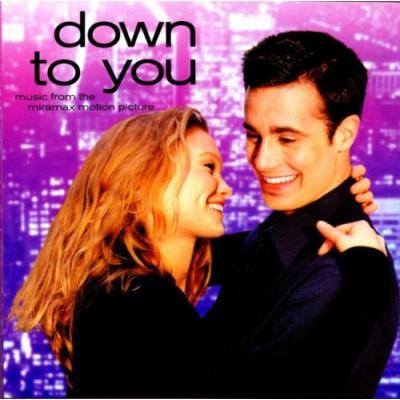
"Down to You" Soundtrack Lyrics
Movie • 2000
Track Listing
Billie Myers
Ginger Mackenzie
Folk Implosion
The Velvet Crush
Deanna Kirk
The Rockfords
Belle Perez
Miranda Lee Richards
Formosa
Psychic Rain
Craig Werden & Jimmy Harry
Sam Phillips
htmlCopy code
"Down To You (Music From The Miramax Motion Picture)" Soundtrack Description
Overview
First-love rom-com or jukebox time capsule? Down to You threads both: a late-’90s/early-’00s collage of indie pop, trip-hop, and classic soul that tries to make a campus romance feel bigger than dorm rooms and cafeterias. The official compilation leans on then-current alt-pop while the film itself raids deeper crates, dropping marquee needle-drops from Al Green, Barry White, David Bowie, and Everything But The Girl.
The score (by Edmund Choi) plays quietly behind the pop songs rather than battling them; it bridges scenes while the sourced tracks handle the character beats. The most remembered music moments aren’t orchestral—they’re on-screen, performed or lip-synced, and deliberately diegetic. Variety once called the movie “bursting with… modern-rock tracks,” and that’s precisely the point: the soundtrack sells youthful feeling fast, sometimes faster than the script can.
Questions & Answers
- Is there an official soundtrack album?
- Yes. Titled Down To You (Music From The Miramax Motion Picture), released January 18, 2000 on Epic/Sony Music Soundtrax (catalog EK 63793). AllMusic reviewed it; Discogs documents pressings.
- Who composed the score?
- Edmund Choi composed the original score for the film.
- What song plays during the pool-table dance?
- Al Green’s “Let’s Stay Together.” It’s a diegetic dorm-common-room moment with Julia Stiles’ Imogen dancing across a pool table.
- What song closes the film when the leads sing to each other?
- Barry White’s “Can’t Get Enough of Your Love, Babe,” performed on-screen (diegetic) as a reconciliatory, showy romantic gesture.
- Are Bowie’s “Young Americans” or Deee-Lite’s “Groove Is in the Heart” actually in the movie?
- Yes—both appear in the film but are not on the official CD. IMDb/Wikipedia list them under additional music used.
- Is the score available as a separate release?
- No commercial score album is documented; the widely available disc is the songs compilation.
- Where can I find the album today?
- Used CD copies surface regularly (Discogs, major marketplaces). Digital availability varies by region and platform.
Notes & Trivia
- The official CD runs ~43 minutes; the film itself uses many more songs than the album includes.
- The much-discussed pool-table dance was a reshoot; Julia Stiles later said the moment was pushed into the cut and made her feel “slimy.”
- “Let’s Stay Together” (Al Green) and Barry White’s closer are diegetic: characters put the music on and perform to it.
- Several high-profile tracks in the film—David Bowie, Deee-Lite, Yo La Tengo—do not appear on the retail album.
- AllMusic’s review highlighted Sam Phillips’ “I Need Love” as a standout.
Genres & Themes
Indie & alt-pop signal introspection and fragile optimism (Yo La Tengo, Folk Implosion). ’70s soul marks idealized, adult-coded romance—warm, confident, seductive (Al Green; Barry White). Club/electronica tracks (GusGus; Everything But The Girl) underline nightlife sequences: performative bravado, bodies in motion, and fleeting connections. Legacy rock (Bowie; Whitesnake; Asia) arrives as cultural shorthand—ironic swagger, nostalgia, or broad comic color.
In short: indie = vulnerability; soul = commitment fantasy; club = appetite and façade; classic rock = loud decisions made too fast.
Tracks & Scenes
Fact vs. memory: the two sequences below are screen-verified; the others are documented as used in the film but not all have publicly archived timestamps. Where placement is approximate, we say so.
“Let’s Stay Together” — Al Green
Scene: Imogen (Julia Stiles) cues the song in a dorm common room and dances across a pool table (late-film; diegetic). The camera stays on performance and reaction rather than montage. Why it matters: it’s the film’s most quoted musical beat—music as flirt, agency, and heat, compressed into one cheap stereo moment.
“Can’t Get Enough of Your Love, Babe” — Barry White
Scene: A reconciliation/high-emotion capper has the leads performing the song to each other (finale segment; diegetic). Why it matters: unabashed showmanship as apology and promise. It telegraphs “we’re all in” with a wink and a belt.
“Lullaby of Clubland” — Everything But The Girl
Scene: Heard in a nightlife/party stretch (non-diegetic placement as documented; exact timestamp varies by version). Why it matters: a lyric about the cost of performing cool undercuts the characters’ brittle bravado.
“My Little Corner of the World” — Yo La Tengo
Scene: Used in the film (non-album); typically placed under intimate, lower-stakes beats (non-diegetic; precise cue not publicly timestamped). Why it matters: its guileless tone reframes young love as small but sincere.
“Groove Is in the Heart” — Deee-Lite
Scene: Party-energy placement (non-diegetic; timestamp not archived). Why it matters: a pure hit of communal fun before the relationship turns complicated.
“Young Americans” — David Bowie
Scene: Credited additional music; used to inject swagger/irony in a social scene (non-diegetic; timestamp not archived). Why it matters: Bowie’s plastic-soul sheen contrasts the couple’s rookie feelings.
“Ladyshave” — GusGus
Scene: Clubroom/party bed (non-diegetic; placement varies). Why it matters: sleek electronic pulse = vibe over substance, which mirrors the film’s party detours.
“Black Balloon” — Goo Goo Dolls
Scene: Used in film (non-album); seen in fan-posted scene rips; likely a reflective pass (non-diegetic). Why it matters: a late-’90s radio staple that reads as melancholy from note one.
“I Need Love” — Sam Phillips
Scene: On the official album; used in-film as an introspective hinge (non-diegetic; exact spot unlogged). Why it matters: one of the compilation’s genuine mood setters.
Music–Story Links
The diegetic soul cuts are more than nostalgia: they let characters script themselves. Imogen’s Al Green routine is extroversion as armor and invitation; the Barry White finale is mutual role-play—corny, sincere, effective. Indie cues shrink the world when the romance turns private; club tracks expand it when the couple hides in crowds. The needle-drops speak the emotional language the dialogue often can’t.
How It Was Made
Score by Edmund Choi. The songs compilation was issued by Epic/Sony Music Soundtrax (CD, EK 63793). The album arrived day-and-date with the U.S. theatrical run. The DVD features the Billie Myers video (“It All Comes Down to You”).
The pool-table sequence was a later addition; Julia Stiles has said the reshoot was producer-driven. Supervisory/clearance credits aren’t widely documented in studio notes available to the public, but the film’s mix—legacy soul + current alt-pop + boutique electronica—reflects Miramax’s late-’90s playbook for youth-skewed titles.
Reception & Quotes
“Soundtrack is bursting with the requisite modern-rock tracks.” Variety
“Much of the soundtrack tries to be ingenuous and only manages to be callow.” AllMusic
Stiles later called the pool-table reshoot “so cheap… not adding to the story.” Entertainment Weekly
Album availability: physical CD is common on the secondary market; a full official digital package is inconsistent, though most individual tracks stream via their respective artist catalogs.
Additional Info
- Catalog/label: Epic / Sony Music Soundtrax, EK 63793 (U.S. CD).
- Ship date: January 18, 2000 (aligned to opening frame).
- Runtime (CD): ~43 minutes.
- Non-album but in film: Bowie (“Young Americans”), Deee-Lite (“Groove Is in the Heart”), Yo La Tengo (“My Little Corner of the World”), Al Green, Barry White, Everything But The Girl (“Lullaby of Clubland”) and more.
- DVD extra: Billie Myers “It All Comes Down to You” music video + brief EPK.
- Scene type key: dies on-screen = diegetic; background montage/bed = non-diegetic.
- Trailer reference: widely mirrored online; first search result ID used for figures.
- Score album: none commercially documented.
Technical Info
- Title: Down To You (Music From The Miramax Motion Picture)
- Year: 2000
- Type: Film soundtrack (compilation). Original score by Edmund Choi.
- Label: Epic / Sony Music Soundtrax (CD; EK 63793)
- Key verified placements: Al Green — “Let’s Stay Together” (pool-table dance, diegetic); Barry White — “Can’t Get Enough of Your Love, Babe” (finale performance, diegetic)
- Album status: Physical CD widely available used; full digital availability inconsistent.
- Trailer YouTube ID (first result): tdnZYsDOxfI
Canonical Entities & Relations
| Subject | Relation | Object |
|---|---|---|
| Miramax Films | distributed | Down to You (2000) |
| Epic / Sony Music Soundtrax | released | Down To You (Music From The Miramax Motion Picture) [CD] |
| Edmund Choi | composed | Original score for Down to You |
| Billie Myers | performed | “It All Comes Down to You” (album track; video on DVD extras) |
| Al Green | performed | “Let’s Stay Together” (in-film; not on album) |
| Barry White | performed | “Can’t Get Enough of Your Love, Babe” (in-film; not on album) |
| Everything But The Girl | performed | “Lullaby of Clubland” (in-film; non-album) |
| Yo La Tengo | performed | “My Little Corner of the World” (in-film; non-album) |
Sources: AllMusic; Variety; Entertainment Weekly; IMDb; Wikipedia; Discogs; SoundtrackINFO; Movieclips (YouTube).
November, 08th 2025
A-Z Lyrics Universe
Cynthia Erivo Popular
Ariana Grande Horsepower
Post Malone Ain't No Love in Oklahoma
Luke Combs Good Riddance (Time of Your Life)
Green Day Bye Bye Bye
*NSYNC You're the One That I Wan
John Travolta & Olivia Newton-John I Always Wanted a Brother
Braelyn Rankins, Theo Somolu, Kelvin Harrison Jr. and Aaron Pierre The Power of Love
Frankie Goes to Hollywood Beyond
Auli’i Cravalho feat. Rachel House MORE ›