Soundtracks:  A B C D E F G H I J K L M N O P Q R S T U V W X Y Z #


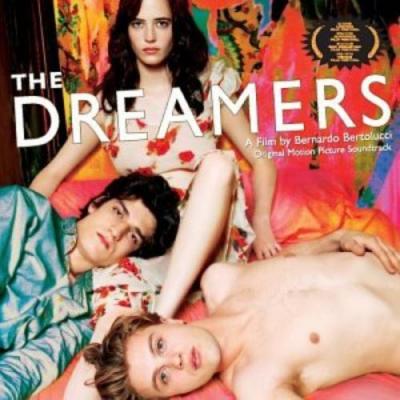
Dreamers Album Cover

"Dreamers" Soundtrack Lyrics

Movie • 2004

Track Listing


"The Dreamers (Original Motion Picture Soundtrack)" Soundtrack Description

The Dreamers trailer thumbnail showing the Paris 1968 mood and cast, used to illustrate the soundtrack’s atmosphere
The Dreamers — theatrical trailer still, 2003

Overview

How do you score three cinephiles sealed inside a Paris apartment while a revolution rages outside? The Dreamers answers with a curated mixtape: 1960s psychedelia (Hendrix, the Dead), French chanson (Piaf, Trenet, Hardy), and quotations from classic New Wave scores (Solal, Constantin, Duhamel). It’s less a traditional score than a memory palace of records and film clips the characters worship, so the soundtrack becomes the fourth lead—romantic, volatile, and a little intoxicated.

The album—issued in 2004—distills that collage into a tight compilation. It foregrounds the period’s counterculture rock and offsets it with elegant French pop, mirroring the film’s tug-of-war between private hedonism and public upheaval. You’ll hear Jimi Hendrix’s “Third Stone from the Sun” recur like a thesis; Edith Piaf’s “Non, je ne regrette rien” turns the finale into a paradox of tenderness and defiance. As AllMusic noted, the set captures both the personal and the political revolutions through music.

Another trailer still evoking Paris 1968 streets with music-driven montage in The Dreamers
The Dreamers — trailer frame used to evoke the soundtrack’s blend of pop and protest

Questions & Answers

Is there an official soundtrack album?
Yes. The Dreamers (Original Motion Picture Soundtrack) was released in 2004; label credits list Nettwerk Productions. Runtime: ~50 minutes.
Who handled the film’s music oversight?
Music supervisor: Janice Ginsberg. Music advisors: Julien Civange and Charles-Henri de Pierrefeu. Music consultant: Nick Laird-Clowes.
Which Jimi Hendrix track does the film use?
“Third Stone from the Sun,” heard as a framing motif; the film uses snippets early and again later.
Why does Michael Pitt perform “Hey Joe” instead of Hendrix’s recording?
Rights constraints for the bathtub scene led to a diegetic cover by Michael Pitt & The Twins of Evil, approved for the film and album.
What plays over the street clashes at the end?
Édith Piaf’s “Non, je ne regrette rien,” underscoring the lovers’ charged step into the riots.
Are all songs in the movie on the album?
No. Notable omissions include Janis Joplin/Big Brother & the Holding Company cuts, Bob Dylan’s “Queen Jane Approximately,” and The Doors’ “Maggie M’Gill.”

Notes & Trivia

  • The film quotes classic French New Wave scores onscreen, not just on the album—snatches from Breathless, The 400 Blows, and Pierrot le fou appear as film-within-film moments.
  • Hendrix’s “Third Stone from the Sun” effectively bookends the feature.
  • Michael Pitt’s “Hey Joe” performance is diegetic—sung by his character in-scene—because the Hendrix estate denied that specific sync use for the bath sequence.
  • Several songs heard in the movie were excluded from the retail album due to licensing scope (Joplin/Big Brother, Dylan, The Doors’ “Maggie M’Gill”).
  • Music oversight credits span three roles (supervisor, advisors, consultant), reflecting the heavily curated, quotation-driven approach.

Genres & Themes

Psychedelic rock (Hendrix, Grateful Dead, Steve Miller Band) = headspace: curiosity, intoxication, intellectual play. It scores the trio’s sealed-off experiments, blurring philosophy debates with erotic dares.

Chanson & yé-yé (Piaf, Trenet, Françoise Hardy) = cultural home base. These songs suggest Parisian poise and melancholy; when they surface, the apartment feels less like a bunker and more like a memory of the city outside.

Nouvelle Vague cues (Solal, Constantin, Duhamel) = cinephile mirror. Dropping audio from Godard/Truffaut doesn’t just quote movies the characters love—it turns their games into remakes, underlining how art molds identity.

Trailer frame focusing on cinephile imagery echoing the New Wave cues used in The Dreamers soundtrack
The Dreamers — trailer frame highlighting the film’s cinephile collage

Tracks & Scenes

“Third Stone from the Sun” — The Jimi Hendrix Experience
Where it plays: early and late in the film as non-diegetic framing; establishes a psychedelic thesis and returns as a refrain.
Why it matters: cosmic, floating guitar lines mirror the trio’s sealed, weightless bubble—until politics punctures it.

“Hey Joe” — Michael Pitt & The Twins of Evil
Where it plays: the bathtub sequence; performed on-screen (diegetic) by Matthew.
Why it matters: jealousy narrative inside the lyric maps onto the trio’s shifting boundaries; the cover exists because Hendrix’s original couldn’t be cleared for this exact context.

“New York Herald Tribune” — Martial Solal (from Breathless)
Where it plays: during a Godard quotation when Isabelle parrots Jean Seberg’s street cry; the film cuts to the source clip (non-diegetic/film-within-film).
Why it matters: announces the kids’ habit of living through movies; identity as reenactment.

“Quatre Cents Coups” — Jean Constantin (from The 400 Blows)
Where it plays: folded into a Truffaut reference sequence (non-diegetic quotation).
Why it matters: adolescence and defiance—precisely the mood of the apartment’s childish but dangerous games.

“La Mer” — Charles Trenet
Where it plays: used for a languorous mood passage; a chanson respite inside the apartment (non-diegetic).
Why it matters: the sea-as-mirror lyric underlines twin mirroring and the lovers’ reflective cocoon.

“The Spy” — The Doors
Where it plays: late-night apartment atmosphere (non-diegetic).
Why it matters: “I’m a spy in the house of love” practically narrates the voyeurism central to Matthew’s role.

“Tous les garçons et les filles” — Françoise Hardy
Where it plays: a walk/room passage evoking youthful longing (non-diegetic).
Why it matters: bittersweet counterpoint to the trio’s pose of sophistication; they’re still kids.

“Dark Star” (special edit) — Grateful Dead
Where it plays: drifting interludes (non-diegetic).
Why it matters: open-form psychedelia fits the film’s improvisatory, rules-changing dares.

“Song for Our Ancestors” — Steve Miller Band
Where it plays: hazy connective montage (non-diegetic).
Why it matters: spacious, oceanic intro enlarges the apartment into an inner landscape.

“Ferdinand” — Antoine Duhamel (from Pierrot le fou)
Where it plays: as part of Godard quotations (non-diegetic film-within-film).
Why it matters: love-as-politics-as-performance—the film’s core triad.

“Non, je ne regrette rien” — Édith Piaf
Where it plays: the riot finale, over the street surge (non-diegetic).
Why it matters: defiance and denial at once: the perfect, troubling curtain.

Music–Story Links

Hendrix’s spacey “Third Stone…” frames the apartment as an orbit outside history; Piaf’s closing anthem drags history back in. The New Wave quotations (Breathless, The 400 Blows, Pierrot le fou) show the trio copying cinema until life—literally a rock through a window—forces them to stop performing and choose. “Hey Joe,” sung in the tub, seals music to action: desire, possessiveness, and the trio’s breaking point. And when The Doors murmur “The Spy,” the lyric renders Matthew’s position—lover, witness, intruder—in one chilling line.

Trailer image emphasizing the lovers’ apartment where diegetic songs like Hey Joe unfold
The Dreamers — apartment world, where diegetic music reshapes the drama

How It Was Made

The film uses supervision and consultancy rather than a conventional composer-driven score. Credits name Janice Ginsberg (music supervisor), Julien Civange and Charles-Henri de Pierrefeu (music advisors), and Nick Laird-Clowes (music consultant). The team balanced costly rock catalog masters with fair-use-adjacent quotations from classic films and strategically placed chanson. A key clearance wrinkle shaped the movie: the Hendrix estate declined “Hey Joe” in the bath scene, prompting Michael Pitt’s diegetic cover—an editorial choice that deepened character psychology and kept the sequence intact.

Reception & Quotes

“Bookended by snippets of Jimi Hendrix’s ‘Third Stone from the Sun.’” (regional review)
“Poignant… extraordinarily beautiful.” (Roger Ebert)
“Disarmingly sweet and completely enchanting.” (The New York Times, A.O. Scott)

AllMusic summarized the album’s juxtapositions of French tradition and counterculture as an effective portrait of the film’s personal/political revolutions. The end-sequence use of “Non, je ne regrette rien” has been singled out repeatedly in criticism for its irony and force.

Additional Info

  • Label/editions: Nettwerk Productions handled the commercial album; regional editions vary slightly.
  • Omissions by design: The film uses Janis Joplin/Big Brother live material and Bob Dylan’s “Queen Jane Approximately,” but they’re absent from the retail album.
  • Godard/Truffaut cues: Several inclusions are not “songs” but lifts from original scores, reinforcing the cinephile play-acting.
  • Diegetic highlight: Michael Pitt’s “Hey Joe” is performed in-scene, not dropped in later.
  • Runtime: ~50 minutes, 12 tracks; focused compilation, not a full dump of every cue.
  • Framing device: Hendrix cue recurs—used like a theme rather than a single needle-drop.
  • Chanson color: Trenet and Piaf anchor the Paris setting against the Anglophone rock palette.

Technical Info

  • Title: The Dreamers (Original Motion Picture Soundtrack)
  • Film Year: 2003 (U.S. wide release in 2004)
  • Album Type: Various-artists compilation (no original score album)
  • Music Supervision: Janice Ginsberg
  • Music Advisors: Julien Civange; Charles-Henri de Pierrefeu
  • Music Consultant: Nick Laird-Clowes
  • Selected notable placements: “Third Stone from the Sun” (Jimi Hendrix); “Hey Joe” (Michael Pitt & The Twins of Evil); “Non, je ne regrette rien” (Édith Piaf); “New York Herald Tribune” (Martial Solal); “Tous les garçons et les filles” (Françoise Hardy)
  • Release context: Album issued 2004; digital availability on major platforms
  • Label: Nettwerk Productions
  • Availability/notes: Some film-used tracks are not on the album due to separate licensing.

Canonical Entities & Relations

SubjectRelationObject
Bernardo BertoluccidirectedThe Dreamers (film)
Janice Ginsbergserved asMusic Supervisor on The Dreamers
Julien Civangeserved asMusic Advisor on The Dreamers
Charles-Henri de Pierrefeuserved asMusic Advisor on The Dreamers
Nick Laird-Clowesserved asMusic Consultant on The Dreamers
The Jimi Hendrix Experienceperformed“Third Stone from the Sun”
Michael Pitt & The Twins of Evilperformed“Hey Joe” (cover)
Édith Piafperformed“Non, je ne regrette rien”
Martial SolalcomposedBreathless theme “New York Herald Tribune”
Jean Constantincomposedmusic from The 400 Blows
Antoine Duhamelcomposedmusic from Pierrot le fou
Nettwerk ProductionsreleasedThe Dreamers (Original Motion Picture Soundtrack)
Fox Searchlight PicturesdistributedThe Dreamers in English-speaking territories
Cinémathèque Françaisecontext forthe film’s opening protests (Langlois Affair)

Sources: AllMusic; Apple Music; IMDb; Wikipedia; BFI; Variety; The New Yorker; Bullz-Eye; Senses of Cinema.

November, 09th 2025


A-Z Lyrics Universe

Lyrics / song texts are property and copyright of their owners and provided for educational purposes only.