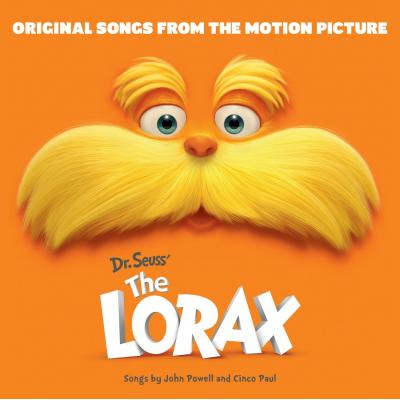
"Dr. Seuss The Lorax"Soundtrack Lyrics
Cartoon • 2012
Track Listing
Ester Dean
John Powell and Cinco Paul
Ed Helms
The Once-Ler
Ed Helms
Fletcher Sheridan
Jenny Slate
Ed Helms
Randy Crenshaw
Keith Slettedahl
Fletcher Sheridan
Gabriel Mann
"Dr. Seuss’ The Lorax — Original Songs & Score" Soundtrack Description
Overview
How do you sing an environmental fable without sanding off its bite? Illumination’s The Lorax splits the load: bright, lyric-driven numbers move plot quickly, while John Powell’s orchestral score gives weight to consequence. The songs album (Interscope) and the separate score album (Back Lot Music) were released the week before and of the film’s U.S. opening; AllMusic tags the song set as pop/rock with stage sensibility, while Filmtracks calls the score a solid listen on its own.
Cinco Paul co-wrote the songs with Powell, so melodies and story beats interlock: “Thneedville” opens the world, “Everybody Needs a Thneed” sells the lie, “How Bad Can I Be?” glamorizes expansion, and “Let It Grow” turns the town. The film also sneaks in a few pop-culture needle-drops (one very famous spy theme) to underline jokes without derailing tone. Variety and The New York Times both noted how the musical approach shapes the film’s personality.
Questions & Answers
- Is there an official soundtrack album?
- Yes — two. Original Songs from the Motion Picture (Interscope, Feb 21, 2012) and Original Motion Picture Score (Back Lot Music, Feb 28, 2012).
- Who composed the score and who wrote the songs?
- John Powell composed the score; Powell and Cinco Paul co-wrote the songs.
- Who oversaw the songs production?
- Christopher “Tricky” Stewart served as executive producer for the songs album.
- What’s the big end number?
- “Let It Grow” — performed by the cast in-film; a separate single, “Let It Grow (Celebrate the World)” by Ester Dean, promoted the release.
- What song opens the movie?
- “Thneedville,” a full-company number that establishes the city’s plastic comfort.
- Is there a non-Seuss needle-drop people ask about?
- Yes — the Humming-Fish do a gag on the “Mission: Impossible” theme during a nighttime break-in.
- How did the albums chart?
- The songs album reached the U.S. Billboard Soundtrack Albums chart (top 30 range).
Notes & Trivia
- Two separate albums: a 13-track songs set (Interscope) and a 13-cue score (Back Lot Music).
- The fish’s “Mission: Impossible” sting is a documented on-screen gag; “The Hustle” (Van McCoy) also earns a brief credited needle-drop.
- Recording locations for songs include Henson Recording Studios and 5 Cat Studios (Los Angeles).
- Powell’s score was Ivor Novello–nominated; Powell & Paul also received an Annie nod for music.
- Lead single for radio/promo: Ester Dean’s “Let It Grow (Celebrate the World).”
Genres & Themes
- Pop musical numbers — brisk exposition through rhyme; civic cheer used as satire (“Thneedville”).
- Corporate pep turned glam-rock — swagger and irony for the Once-ler’s boom (“How Bad Can I Be?”).
- Orchestral heart — Powell’s strings/woodwinds frame loss and renewal (Valley → Wasteland → renewal seed).
- Needle-drops — quick cultural shorthand: spy pastiche for heist antics; a wink of disco for domestic comedy.
Tracks & Scenes
“Thneedville” — Fletcher Sheridan & The Lorax Singers (cast)
Where it plays: Opening number; townspeople sing through a morning in the plastic city. Diegetic musical (on-screen singing).
Why it matters: Establishes consumer utopia and stakes for Ted’s arc.
“This Is the Place” — Ed Helms & The Lorax Singers
Where it plays: Early Once-ler arrival / discovery of the Truffula Valley; travel-montage into first encounter. Musical number.
Why it matters: Sells wonder before the first cut — the moral hinge.
“Everybody Needs a Thneed” — Ed Helms, The 88 & The Lorax Singers
Where it plays: Sales-explosion montage as the fad catches fire; non-diegetic vocals over fast cuts.
Why it matters: Advertising logic as music; satire that feels catchy on purpose.
“How Bad Can I Be?” — Ed Helms & The Lorax Singers
Where it plays: Factory-expansion set-piece (mid-film). Musical number with glam swagger; on-screen performance elements.
Why it matters: Corporate self-mythologizing; the film’s most quoted sequence.
“Let It Grow” — Cast
Where it plays: Finale in Thneedville’s square; the town rejects O’Hare and backs the seed. Full-company musical number.
Why it matters: Communal turn; lyrical theme resolves the fable.
“Mission: Impossible Theme” — Lalo Schifrin
Where it plays: Nighttime break-in with the Lorax and animals; the Humming-Fish deliver a comic sting. Brief, diegetic gag.
Why it matters: Pop-culture shorthand for caper stealth; lands a reliable laugh.
“The Hustle” — Van McCoy & the Soul City Symphony
Where it plays: Brief background needle-drop during a comedic domestic beat. Non-diegetic; seconds long.
Why it matters: Disco wink that punctures the plastic-fantasy sheen.
“Let It Grow (Celebrate the World)” — Ester Dean
Where it plays: Lead single from the songs album; used in promotion and some home-media contexts; not the on-screen finale arrangement.
Why it matters: Radio-ready companion that carried the campaign.
Music–Story Links
- City vs. nature: “Thneedville” flaunts artificial joy so Powell’s sad-sweet valley cues hit harder when the trees fall.
- Rationalization to collapse: “How Bad Can I Be?” frames the Once-ler’s story as a self-sold brand; the orchestral “Valley Exodus” answers with consequence.
- Collective agency: “Let It Grow” gives the townspeople a voice, flipping spectators into actors — the moral resolution is sung.
How It Was Made
Architecture: Songs by John Powell & Cinco Paul; score by Powell. Executive song producer: Tricky Stewart. Music supervision credited to Kamille Rudisill. Recording work took place at Henson Recording Studios and 5 Cat Studios (Los Angeles).
Editorial: The film uses songs for exposition (front-loaded lyrics, Seuss-meter), then leans on score for pathos and action. That split is deliberate — and visible in how the albums were issued separately.
Reception & Quotes
Variety called the songs “genial and loopy,” while The New York Times thought the silliness ran “loud and slightly hysterical.” AllMusic praised the set’s pop/rock craft; Filmtracks recommended the score as a stand-alone listen.
“Genial and loopy enough to give the film something of a Seussical sensibility.” Variety
“Loud and slightly hysterical… instructed by songs.” The New York Times
Availability: Both albums are widely streamable (Apple Music, Spotify). The songs set charted on Billboard’s Soundtrack Albums tally.
Additional Info
- Ivor Novello nomination: Best Original Film Score (John Powell).
- Annie Award nomination: Music in an Animated Feature (Powell & Paul).
- Back Lot’s score album runs ~46 minutes (13 cues); the songs album runs ~34 minutes (13 tracks).
- Humming-Fish “Mission: Impossible” bit is explicitly cited by multiple reviews.
- Separate single mix: Ester Dean’s “Let It Grow (Celebrate the World)” served radio and trailers.
- Universal’s updated studio fanfare (Brian Tyler’s rework) debuted on this film’s head card.
Technical Info
- Titles: Dr. Seuss’ The Lorax — Original Songs from the Motion Picture; Dr. Seuss’ The Lorax — Original Motion Picture Score
- Year: 2012
- Composers/Lyricists: John Powell (score); John Powell & Cinco Paul (songs)
- Music Supervision: Kamille Rudisill
- Labels: Interscope (songs); Back Lot Music (score)
- Key numbers: “Thneedville,” “Everybody Needs a Thneed,” “How Bad Can I Be?,” “Let It Grow”
- Notable needle-drops: “Mission: Impossible Theme”; “The Hustle”
- Recording: Henson Recording Studios; 5 Cat Studios (Los Angeles)
- Chart note: Songs album peaked in the U.S. Soundtrack Albums top-30 range
Canonical Entities & Relations
| Subject | Relation | Object |
|---|---|---|
| John Powell | composed | The Lorax (2012) original score |
| John Powell & Cinco Paul | wrote | Original songs for The Lorax (2012) |
| Interscope Records | released | Original Songs from the Motion Picture (2012) |
| Back Lot Music | released | Original Motion Picture Score (2012) |
| Kamille Rudisill | musicSupervisorOf | The Lorax (2012) |
| Ester Dean | performed | “Let It Grow (Celebrate the World)” (single) |
| Lalo Schifrin | composed | “Mission: Impossible Theme” (needle-drop gag) |
| Van McCoy | wrote | “The Hustle” (credited needle-drop) |
Sources: AllMusic; Variety; The New York Times; Filmtracks; Apple Music; Spotify; IMDb; Wikipedia.
November, 09th 2025
'Dr. Seuss The Lorax': IMDb, WikipediaA-Z Lyrics Universe
Cynthia Erivo Popular
Ariana Grande Horsepower
Post Malone Ain't No Love in Oklahoma
Luke Combs Good Riddance (Time of Your Life)
Green Day Bye Bye Bye
*NSYNC You're the One That I Wan
John Travolta & Olivia Newton-John I Always Wanted a Brother
Braelyn Rankins, Theo Somolu, Kelvin Harrison Jr. and Aaron Pierre The Power of Love
Frankie Goes to Hollywood Beyond
Auli’i Cravalho feat. Rachel House MORE ›