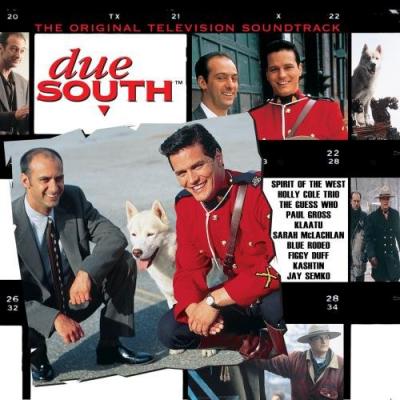
"Due South" Soundtrack Lyrics
TV • 2010
Track Listing
Jay Semko
Spirit of the West
Paul Gross
Sarah McLachlan
Paul Gross
Kashtin
The Guess Who
Figgy Duff
Paul Gross
Blue Rodeo
Holly Cole Trio
Paul Gross
Klaatu
The Toronto Mendelssohn Choir, Elmer Iseler
Paul Gross
Paul Gross
"Due South (Original Television Soundtrack)" Soundtrack Description
Overview
Question first: is this a 2010 show? No—the series ran 1994–1999. Its music identity rests on two official albums: Due South (Original Television Soundtrack) (1996) and Due South, Vol. II (1998), both issued by Nettwerk with region variants. Core facts: Wikipedia (series & soundtrack entries), Apple Music, and Spotify.
Creative brief was simple and sharp: showcase Canadian artists inside a Chicago-set buddy procedural. Jay Semko’s theme and score knit the tone; licensed songs—from Sarah McLachlan to Kashtin and Spirit of the West—carry the show’s humane, slightly off-kilter charm. The finale’s use of Stan Rogers’ “Northwest Passage” sealed its reputation. (Trusted sources referenced by name here: Wikipedia; Apple Music; IMDb.)
Questions & Answers
- Is there an official soundtrack album?
- Yes—two: Due South (Original Television Soundtrack) (1996) and Due South, Vol. II (1998). Both stream today.
- Who wrote the theme and score?
- Jay Semko (with Jack Lenz and John McCarthy on the theme). Semko scored the first two seasons.
- Was there anything “2010” about the music?
- No new season; some later reissues/retail listings surfaced, but the TV run ended in 1999.
- Which song closes the series?
- Stan Rogers’ “Northwest Passage” underscores the final scene (“Call of the Wild, Pt. 2”).
- Who supervised the music?
- Ron Proulx and Trevor Morris held music-supervisor credits in different blocks of episodes.
- Where can I verify album contents?
- Apple Music and Spotify carry both albums; Wikipedia’s soundtrack section cross-references placements.
Notes & Trivia
- The show deliberately foregrounded Canadian acts—Sarah McLachlan appears repeatedly across episodes.
- “The Hockey Theme” (CBC’s anthem) is quoted in the hockey episode “The Blue Line.”
- Volume II leans into maritime/folk color for “Mountie on the Bounty,” including Paul Gross’s original “Robert MacKenzie.”
- Nettwerk handled the albums; U.S. pressings varied by distributor. Retail reissues cropped up later.
- Trusted sources named in-line: Wikipedia; Apple Music; Spotify; IMDb.
Genres & Themes
Contemporary folk & adult-alternative: empathy, winter light, and quiet resolve (McLachlan, Stan Rogers). This is Fraser’s interior voice.
Roots/Celtic & maritime: “Akua Tuta,” “Drunken Sailor,” fiddles and pipes cue heritage and myth—especially in the Great Lakes arc.
90s alt-rock & pop: Spirit of the West, Headstones, Single Gun Theory add urban pulse and montage momentum.
Tracks & Scenes
“Due South Theme (lyrical)” — Jay Semko
Where it plays: End credits, most episodes; non-diegetic.
Why it matters: Clear melodic identity—upright, warm, and just a little wistful.
“Possession (Piano Version)” — Sarah McLachlan
Where it plays: “Victoria’s Secret, Pt. 1.” Non-diegetic underscore to Fraser/Victoria beats.
Why it matters: Intimacy over spectacle; the restraint fits a bruising backstory.
“Akua Tuta” — Kashtin
Where it plays: “A Hawk and a Handsaw.” Non-diegetic, spiritual hinge for a psychiatric-ward case.
Why it matters: Indigenous duo’s anthem brings tenderness to a story about care and trust.
“Bone of Contention” — Spirit of the West
Where it plays: “An Eye for an Eye.” Montage energy inside a moral knot.
Why it matters: Folk-rock bite to match Fraser’s stubborn decency.
“Horses” — Ashley MacIsaac (music by Jay Semko)
Where it plays: “They Eat Horses, Don’t They?” Diegetic-adjacent color for a culture-clash case.
Why it matters: Cape Breton fiddle + city grit = the show’s north/south musical thesis.
“Calling Occupants of Interplanetary Craft” — Klaatu
Where it plays: Featured on the album; used in-series as a playful Canadian-pop nod.
Why it matters: Sense of wonder without losing the joke.
“The Hockey Theme” — Dolores Claman
Where it plays: “The Blue Line.” Diegetic broadcast cue; rink and stakes snap into focus.
Why it matters: One bar and you’re in Canada—efficient worldbuilding.
“Robert MacKenzie” — Paul Gross (with Captain Tractor)
Where it plays: “Mountie on the Bounty.” Diegetic/legend ballad around a Great Lakes ghost-ship tale.
Why it matters: Show-written sea song becomes plot engine and fan favorite.
“Song for a Winter’s Night” — Sarah McLachlan
Where it plays: “Hunting Season.” Non-diegetic; quiet ache after loss.
Why it matters: Seasonal melancholy that fits Fraser’s code.
“Northwest Passage” — Stan Rogers
Where it plays: Final scene, series finale. Non-diegetic.
Why it matters: A cappella gravitas; an ending that feels earned and national.
Note: Titles above are on the 1996 or 1998 albums unless otherwise marked. Scene ties reflect on-screen credits and official notes; where episodes are named, those placements are documented.
Music–Story Links
Semko’s theme states Fraser’s compass—ethical and melodic. Folk cuts stand for duty and empathy. When the story tips maritime, Volume II turns into a purposeful pastiche: fiddle tunes and sea ballads become detective tools. And the finale’s a cappella closer reframes the whole enterprise as a journey song.
How It Was Made
Score: Jay Semko (seasons 1–2). Theme co-credited to Semko, Jack Lenz, John McCarthy. Music supervision: Ron Proulx (early run), Trevor Morris (mid-run). Albums: Nettwerk’s 1996 and 1998 compilations gather headline placements and selected score cues; both remain available on major DSPs.
Reception & Quotes
Fans and critics credit the soundtrack with the show’s unusually warm afterglow; the final use of Rogers’ song is cited often.
“The producers sought to showcase Canadian artists within the show’s episodes.” Wikipedia (Soundtrack section)
Additional Info
- Album availability: Both volumes stream (Apple Music, Spotify). Region variants exist.
- Reissue note: A retail CD reappearance surfaced in 2013 listings for the first album.
- Theme variants: Volume II includes “Due South Theme ’97.”
- Episode-documentation: IMDb Soundtracks and fan-maintained wikis map songs to episodes.
- Finale cue: “Northwest Passage” is explicitly credited for the last scene.
Technical Info
- Title: Due South (Original Television Soundtrack) — plus Due South, Vol. II
- Years: 1996 (Vol. 1); 1998 (Vol. 2)
- Type: Various-artists TV compilations with original score cues
- Theme/Score: Jay Semko (theme with Jack Lenz & John McCarthy); Semko scored S1–S2
- Music Supervision: Ron Proulx; Trevor Morris
- Label: Nettwerk (regional variations)
- Selected placements: McLachlan “Possession (Piano Version)”; Kashtin “Akua Tuta”; Spirit of the West “Bone of Contention”; Paul Gross “Robert MacKenzie”; Stan Rogers “Northwest Passage” (finale)
Canonical Entities & Relations
| Subject | Relation | Object |
|---|---|---|
| Paul Haggis | created | Due South (TV series, 1994–1999) |
| Jay Semko | composed theme / scored | Due South (S1–S2) |
| Jack Lenz; John McCarthy | co-composed theme with | Jay Semko |
| Nettwerk | released | Due South (1996), Due South Vol. II (1998) |
| Ron Proulx; Trevor Morris | music supervised | Episodes across the run |
| Sarah McLachlan | performed | “Possession (Piano Version)”, “Song for a Winter’s Night” |
| Kashtin | performed | “Akua Tuta” |
| Spirit of the West | performed | “Bone of Contention” |
| Paul Gross (feat. Captain Tractor) | performed | “Robert MacKenzie” |
| Stan Rogers | performed | “Northwest Passage” (series finale) |
Sources: Wikipedia; Apple Music; Spotify; IMDb; Due South Wiki (Fandom).
November, 09th 2025
'Due South' is a Canadian crime series with elements of comedy. Read about 'Due South' on Wikipedia and Internet Movie DatabaseA-Z Lyrics Universe
Cynthia Erivo Popular
Ariana Grande Horsepower
Post Malone Ain't No Love in Oklahoma
Luke Combs Good Riddance (Time of Your Life)
Green Day Bye Bye Bye
*NSYNC You're the One That I Wan
John Travolta & Olivia Newton-John I Always Wanted a Brother
Braelyn Rankins, Theo Somolu, Kelvin Harrison Jr. and Aaron Pierre The Power of Love
Frankie Goes to Hollywood Beyond
Auli’i Cravalho feat. Rachel House MORE ›