Soundtracks:  A B C D E F G H I J K L M N O P Q R S T U V W X Y Z #


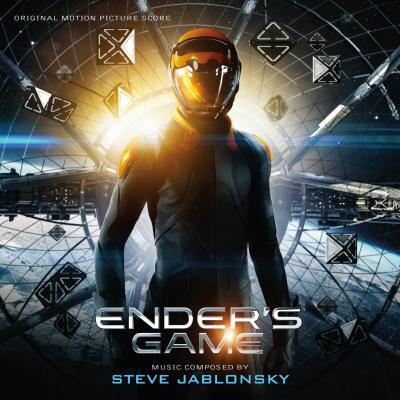
Ender's Game Album Cover

"Ender's Game" Soundtrack Lyrics

Movie • 2013

Track Listing


“Ender’s Game (Original Motion Picture Score)” Soundtrack Description

Ender’s Game (2013) official trailer thumbnail with Battle School visor HUD
Ender’s Game — trailer still, 2013

Overview

How do you score a war movie about children who don’t know they’re at war? Steve Jablonsky answers with a cool, hybrid palette: solo strings and boyish fragility up front; processed low end, brass, and choir around it. The melody is simple—a cellist’s line that keeps Ender human while the movie scales up to species-level stakes.

The album—Ender’s Game (Original Motion Picture Score), released by Varèse Sarabande—collects 21 cues recorded at Abbey Road Studios. It’s almost all score on screen; the lone major needle-drop is The Flaming Lips’ end-credits tune “Peace Sword (Open Your Heart),” issued on a separate EP. Critics split: some heard “guilty pleasure” power-anthems; others praised the structure and thematic clarity. (Filmtracks; Movie Music UK)

Trailer frame with Ender floating in the zero-G Battle Room against a glass dome
Zero-G ballet: strings, choir, and controlled impact

Questions & Answers

Is there an official soundtrack album?
Yes. Ender’s Game (Original Motion Picture Score), Varèse Sarabande. Digital/iTunes on Oct 22, 2013; wider digital & CD on Oct 29, 2013.
Who composed the score?
Steve Jablonsky. James Horner was announced early in 2013 but Jablonsky ultimately scored the film.
What plays over the end credits?
The Flaming Lips — “Peace Sword (Open Your Heart).” It anchors the band’s six-track Peace Sword EP released alongside the film.
Where was the score recorded and who performs?
Abbey Road Studios, London. Gavin Greenaway conducts; Metro Voices choir; soloists include cellist Caroline Dale and violinist Everton Nelson.
Is there a vinyl edition?
Yes. Varèse Sarabande LP, cat. no. 302 067 227 1 (December 10, 2013).
Are there other needle-drops in the film?
No notable pop cues beyond the Flaming Lips track; the film relies on original score.
What cues do fans single out?
“The Battle Room,” “Final Test,” “The Way We Win Matters,” “Ender’s Promise.”

Notes & Trivia

  • Originally, James Horner was attached; Jablonsky replaced him before recording.
  • The solo-cello idea (Ender’s inner voice) was a design choice from early spotting sessions.
  • Album credits list Metro Voices, conductor Gavin Greenaway, recording engineer Peter Cobbin, and mastering by Patricia Sullivan.
  • The Flaming Lips issued the companion Peace Sword EP; only the title track is in the movie (end credits).
  • Varèse Sarabande handled the score album; Summit/Lionsgate released the film.

Genres & Themes

Sound world: hybrid orchestral/electronic. Ostinatos and sub-bass for command-school scale; lyric strings for Ender’s innocence; choir to “float” zero-G sequences.

Meaning map: solo cello = isolation/resolve; bright violin lines in the Battle Room = grace under physics; crushing low brass in “Final Test” = the cost of “victory.”

Trailer frame: command school displays and fleet visualization, matching the score’s synthetic-orchestral weight
Styles to function: empathy, scale, consequence

Tracks & Scenes

Approximate placements; non-diegetic unless noted. Film runtime: 114 minutes.

“Ender’s War” — Steve Jablonsky
Where it plays: Early titles and prologue setup (~00:02–00:05).
Why it matters: Establishes the main identity—string ostinato to brass theme—before characters enter the Battle School machine.

“Battle School” — Steve Jablonsky
Where it plays: Ender’s shuttle arrival/orientation (~00:15).
Why it matters: A recruiting drumbeat for indoctrination; introduces the militarized rhythm of school life.

“The Battle Room” — Steve Jablonsky
Where it plays: First zero-G match; Ender learning to “fall” with intent (~00:35). Features solo violin.
Why it matters: Grace and geometry—music frames the Battle Room as ballet, not brawl.

“Salamander Battle” — Steve Jablonsky
Where it plays: Spinning-shot firefight sequence in zero-G (~00:40).
Why it matters: Kinetic ostinatos clip to cuts; the team begins to cohere around Ender’s lateral thinking.

“Mind Game, Part 1” / “Mind Game, Part 2” — Steve Jablonsky
Where it plays: Surreal desktop game interludes (~00:28; ~00:47).
Why it matters: Ethereal electronics and processed voices externalize Ender’s subconscious and the Formic tether.

“Bonzo” — Steve Jablonsky
Where it plays: Tension spikes around Bonzo Madrid; leads to confrontation (~01:15).
Why it matters: Needle-sharp percussion telegraphs the fatal stakes of playground power.

“Ender Quits” — Steve Jablonsky
Where it plays: Aftermath of the fight; Ender’s crisis of purpose (~01:18–01:22).
Why it matters: Pulls the throttle back—intimate textures, grief, and guilt.

“Mazer Rackham” — Steve Jablonsky
Where it plays: Meeting the mentor; training reset at Command School (~01:20).
Why it matters: A darker color enters; the music concedes the legend is hard steel, not myth.

“Enemy Planet” — Steve Jablonsky
Where it plays: Simulations focused on the Formic world (~01:26).
Why it matters: Low-frequency weight hints at genocide long before Ender recognizes it.

“Command School” — Steve Jablonsky
Where it plays: Dragon team reassembled for the push (~01:28).
Why it matters: Builds the “Dragon Army” identity into command-room scale.

“Final Test” — Steve Jablonsky
Where it plays: The “graduation” simulation—actually the real war (~01:35–01:41). ~6 min.
Why it matters: Maximal propulsion, then the breath-snatching silence of victory’s truth.

“Game Over” — Steve Jablonsky
Where it plays: Immediate reveal and emotional collapse (~01:41).
Why it matters: Stark chords for stunned betrayal.

“The Way We Win Matters” — Steve Jablonsky
Where it plays: Moral reckoning with Graff and Mazer (~01:43–01:49). ~6 min.
Why it matters: Cello leads the lament; choir widens the shame.

“Ender’s Promise” — Steve Jablonsky
Where it plays: Epilogue—Ender finds the queen pupa and chooses repair (~01:50–end). ~5 min.
Why it matters: The theme’s most humane statement; a door out of militarism.

“Peace Sword (Open Your Heart)” — The Flaming Lips
Where it plays: First end-credits position (~01:53). Diegetic: no.
Why it matters: A rare non-score song here—hopeful synth-ballad coda separate from the score album.

Music–Story Links

Early cues frame Ender as a solitary problem-solver (cello) inside a system that rewards spectacle (anthemic brass). The Battle Room cues soften gravity’s rules and our expectations; we see a strategist, not a bruiser. When command-school “tests” become war, “Final Test” slams the plot forward and then hollows it out—“Game Over” and “The Way We Win Matters” flip victory into grief. The Flaming Lips track restores a sliver of warmth after the score’s moral chill.

Trailer frame: Ender at the command interface in the final simulation, fleets arrayed below
Command interface: propulsion first, ethics after

How It Was Made

Composer swap: James Horner was initially announced; Steve Jablonsky took over by May 2013. Jablonsky designed a simple solo-cello line for Ender and used choir to give zero-G scenes an “ethereal, floaty” quality.

Recording & personnel: Abbey Road Studios; conductor Gavin Greenaway; Metro Voices choir (choirmaster Jenny O’Grady); soloists Caroline Dale (cello) and Everton Nelson (violin). Orchestrations by Penka Kouneva, Larry Rench, Philip Klein, and Alain Mayrand. Album producers: Steve Jablonsky & Alex Gibson.

Reception & Quotes

Response ran hot and cold, which fits a score walking the line between glossy propulsion and thematic through-lines.

“The most satisfying music Steve Jablonsky has penned for several years.” Movie Music UK
“A guilty pleasure suite to be compiled … tonally dumb but tasty red meat.” Filmtracks
“Wins as a popcorn flick but loses some heart.” Wired

Additional Info

  • Album release: iTunes (Oct 22, 2013); CD/digital (Oct 29, 2013); LP (Dec 10, 2013).
  • Label cat. numbers: CD VSD-7227; LP 302 067 227 1.
  • Album credits list Linda Cohen as music consultant; Chris Brown credited for music supervision in album materials.
  • The Flaming Lips’ Peace Sword EP dropped Oct 29 (digital) and Nov 29 (CD/vinyl, Back to Black Friday).
  • Runtime of the film: 114 minutes; distributor: Summit Entertainment (via Lionsgate).
  • Score length: ~70 minutes (21 tracks); widely available on major DSPs.

Technical Info

  • Title: Ender’s Game (Original Motion Picture Score)
  • Year: 2013
  • Type: Original score (+ one end-credits song not on the score album)
  • Composer: Steve Jablonsky
  • Recording: Abbey Road Studios; conductor Gavin Greenaway; Metro Voices choir
  • Label: Varèse Sarabande (digital/CD/LP)
  • Key placements: “Final Test” (graduation/war reveal); “The Way We Win Matters” (moral reckoning); “Ender’s Promise” (epilogue); The Flaming Lips — “Peace Sword (Open Your Heart)” (end credits)
  • Release context: U.S. theatrical Nov 1, 2013; score album rolled out the week prior
  • Availability: Streaming (Apple Music/Spotify), CD, and vinyl

Canonical Entities & Relations

SubjectRelationObject
Steve JablonskycomposedEnder’s Game (Original Motion Picture Score)
Gavin GreenawayconductedEnder’s Game score sessions
Varèse SarabandereleasedEnder’s Game score album
The Flaming Lipsperformed“Peace Sword (Open Your Heart)” (end credits)
Metro Voicessang onEnder’s Game score
Caroline Daleperformedsolo cello on score cues
Everton Nelsonperformedsolo violin on “The Battle Room”
Gavin HooddirectedEnder’s Game (2013)
Summit Entertainment / LionsgatedistributedEnder’s Game (film)

Sources: Varèse Sarabande; Movie Music UK; Filmtracks; Pitchfork; IMDb; Wikipedia; Apple Music; BMI.

November, 09th 2025

'Ender's Game' on IMDb and Rotten Tomatoes
A-Z Lyrics Universe

Lyrics / song texts are property and copyright of their owners and provided for educational purposes only.