Soundtracks:  A B C D E F G H I J K L M N O P Q R S T U V W X Y Z #

List of artists: A B C D E F G H I J K L M N O P Q R S T U V W X Y Z #


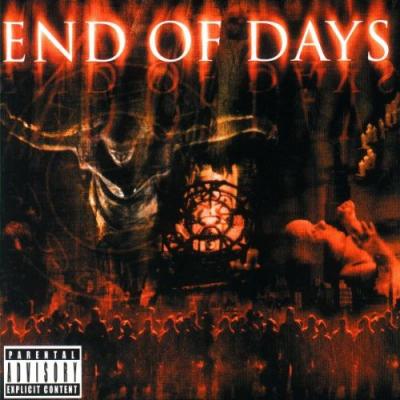
End of Days Album Cover

"End of Days" Lyrics

Movie • Soundtrack • 1999

Track Listing


“Music From and Inspired by the Motion Picture End of Days” Soundtrack Description

End of Days (1999) official trailer thumbnail with Arnold Schwarzenegger and apocalyptic New York skyline
End of Days — trailer cue preview, 1999

Overview

What does a millennial apocalypse sound like? In End of Days (1999), it’s a collision of industrial rock and a bruising orchestral score. The commercial album corrals late-’90s heavyweights (Guns N’ Roses, Korn, Limp Bizkit, Rob Zombie, The Prodigy, Eminem) while the film’s heartbeat is John Debney’s liturgical-meets-industrial score.

The result is a two-front soundtrack strategy: a Geffen-issued “music from and inspired by” compilation that charted well on release, and a Varèse Sarabande score album that foregrounds choirs, boy soprano, and unnerving electronics. Together they cast New York’s Y2K dread in metal, chant, and low brass.

End of Days trailer still: Gabriel Byrne as the Stranger in shadowy interior
End of Days — trailer stills used in marketing, 1999

Questions & Answers

Is there an official soundtrack album?
Yes. The commercial compilation Music From and Inspired by the Motion Picture End of Days (Geffen, released November 2, 1999). A separate score album by John Debney followed via Varèse Sarabande (December 1999). Billboard and Varèse Sarabande confirm the releases.
Who composed the score?
John Debney composed and produced the score; Pete Anthony conducted. Credits are documented by Varèse Sarabande and specialist outlets like Movie Music UK.
Is Guns N’ Roses’ “Oh My God” actually in the film?
It’s the compilation’s flagship track and was prominent in trailers/promotions. On-screen placement varied by version and territory; the film’s closing sequence is led by Debney’s score.
Did the album chart?
Yes. The soundtrack reached the U.S. Billboard 200 top 20 and charted in Canada. Billboard reporting verifies the peaks.
Who supervised the music?
Music supervision is credited to G. Marq Roswell.
Are all compilation songs used on-screen?
No. As with many “Music From and Inspired by” releases, several tracks are album-only; the film mixes selective source songs with original score.
What’s the mood of the score?
Liturgical choir and boy soprano over pounding orchestral/electronic textures—religious horror coloring action-thriller kinetics.

Notes & Trivia

  • The score features boy soprano Theo Lebow and mixed choir; throat singer Kongar-ol Ondar appears on “Little Yurt on the Prairie.”
  • Skinny Puppy’s Cevin Key contributed distinctive electronic textures to the score production.
  • The film mixes in a notable sample from Spectrasonics’ “Symphony of Voices” library in multiple scenes.
  • “Oh My God” marked Guns N’ Roses’ first new release in years, with Dave Navarro and Robin Finck among the guitar contributors.
  • The commercial album preceded the U.S. theatrical release by a few weeks; the score album landed shortly afterward.

Genres & Themes

The compilation leans on alternative metal, industrial rock, nu metal, and a dose of late-’90s hip hop. That palette stands for urban dread and end-of-millennium fatalism—grit for street-level action, mechanized textures for occult menace.

Debney counters with choral gravitas and orchestral mass. Solo boy soprano signals fragile faith; Latin chanting frames the demonic pageant; low brass, shofar-like calls, and processed percussion grind the city into prophecy.

End of Days trailer frame: collapsing subway and apocalyptic imagery that match industrial-metal textures
Trailer imagery — industrial textures meet choral weight, 1999

Tracks & Scenes

Important: several album cuts are “inspired by” and don’t appear on-screen. Below are verified placements and clearly labeled album-only highlights.

“End of Days Main Title” — John Debney
Scene: Opening titles and early New York prologue; non-diegetic. A brooding choral build sets apocalyptic stakes and Catholic texture.
Why it matters: Establishes the score’s sacred/industrial dialectic and the film’s spiritual conflict.

“Subway Attack and Escape” — John Debney
Scene: Jericho’s high-velocity pursuit and tunnel fight; non-diegetic action cue.
Why it matters: Percussive electronics lock with pounding brass to sell momentum and urban claustrophobia.

“Jericho Finds Faith / The Possession” — John Debney
Scene: Late-film turn as Cane’s resolve hardens; non-diegetic with choral surges.
Why it matters: The boy-soprano motif reframes the protagonist’s arc from nihilism to sacrifice.

“The Eternal Struggle” — John Debney
Scene: Climax confrontation; non-diegetic. Choir and brass volley against distorted design elements.
Why it matters: Ritualizes the final duel as liturgy vs. blasphemy.

“Redemption” — John Debney
Scene: Closing passage into end titles; non-diegetic, reflective.
Why it matters: Lets the film end on elegy and grace after maximal dissonance.

“Little Yurt on the Prairie” — David Hoffner & Kongar-ol Ondar
Scene: Used in the film as a coloristic source element; diegetic placement noted in credits.
Why it matters: Tuvan timbres thread an otherworldly spiritual texture into a modern New York setting.

“For the Beauty of the Earth” — Traditional hymn
Scene: Church setting; diegetic choral source.
Why it matters: Liturgical familiarity deepens the battle between sacred ritual and satanic intrusion.

“The Christmas Song (Chestnuts Roasting on an Open Fire)” — Nat King Cole
Scene: Seasonal New York ambience; primarily diegetic/background.
Why it matters: Irony—cozy holiday calm rubs against looming Armageddon.

“Superbeast (Girl On a Motorcycle Mix)” — Rob Zombie
Scene: Used on-screen; non-diegetic needle-drop energizing action beats.
Why it matters: Industrial groove fuses with thriller cutting for adrenaline spikes.

“Crushed” — Limp Bizkit
Scene: Heard in the film; non-diegetic set-piece support.
Why it matters: Turn-of-the-century trip-hop/nu-metal hybrid syncs with the movie’s late-’90s aesthetic.

“Slow” — Professional Murder Music
Scene: Appears in the film; background/non-diegetic.
Why it matters: A breakout placement for the band; adds industrial grind to urban sequences.

“Camel Song” — Korn
Scene: Associated with the film and album; on-screen placement reported alongside other cues.
Why it matters: Downtuned textures mirror the protagonist’s moral low-tide.

“Oh My God” — Guns N’ Roses
Scene: Anchor of marketing and album; tied to trailers and end-title associations in some releases; non-diegetic/promotional.
Why it matters: Debut of the post-classic-lineup GNR sound with industrial overtones that match the film’s tone.

Music–Story Links

Whenever Gabriel Byrne’s “Stranger” stalks the city, Debney’s dark pedals and processed low winds function like a sulfuric aura. Choral surges mark Christine’s fate beats, then recede to lonely boy-soprano lines that track Jericho’s grief and stubborn decency. Select industrial needle-drops kick momentum into chase sequences, but the score always closes the loop—sacred timbre answers secular noise.

End of Days trailer frame: church interior echoing with choir-like sound while action cuts flash
Trailer textures — sacred spaces versus industrial sonics

How It Was Made

The score was recorded in Los Angeles and produced by John Debney, with Pete Anthony conducting. Electronics and design elements were integrated with the orchestra; Cevin Key is singled out for hallmark synth textures. The vocal palette spans Latin chant, mixed choir, and solo boy soprano (Theo Lebow). Music supervision for the film is credited to G. Marq Roswell.

On the compilation side, “Oh My God” assembled a hybrid lineup around Axl Rose, with Dave Navarro and Robin Finck on guitars; producer Sean Beavan and mixer Andy Wallace handled the sonics. The album’s curation planted metal and industrial acts squarely in late-’99 pop culture.

Reception & Quotes

The compilation drew attention for its artist roster and the first new Guns N’ Roses release in years. The score earned praise from film-music outlets for its choral power and bold electronics.

“One of [Debney’s] most harsh and experimental works… rich with dissonant, brooding passages.” Movie Music UK
“Debney pulled out all the plugs—a large orchestra, ethnic instrumentation, choral solos and electronics.” Filmtracks

Availability: the Geffen compilation remains widely streamable; the Varèse Sarabande score album is also available digitally and on CD in multiple territories.

Additional Info

  • The Geffen compilation reached the U.S. top-20 and charted in Canada (Billboard).
  • Score album catalog: Varèse Sarabande VSD-6099; release late December 1999.
  • Credits note Pete Anthony (conductor), Alan Meyerson/Michael Stern (recording/mix), Pat Sullivan (mastering), Robert Townson (album production).
  • “Symphony of Voices” sample is audibly layered in several scenes.
  • G. Marq Roswell is credited as Music Supervisor; he also carries associate-producer credit on some soundtrack editions.
  • “Oh My God” features Dave Navarro (additional guitar) and Robin Finck; it was promoted around the MTV VMAs and trailers.
  • Rob Zombie’s “Superbeast” appears in the film and on the album via a remixed version.
  • Nat King Cole’s holiday standard underscores seasonal irony in New York settings.
  • Korn’s “Camel Song” and Limp Bizkit’s “Crushed” align the movie with late-’90s nu-metal sonics.

Technical Info

  • Title: Music From and Inspired by the Motion Picture End of Days
  • Year: 1999 (film and albums)
  • Type: Various-artists soundtrack + original score
  • Score Composer: John Debney (conductor: Pete Anthony)
  • Music Supervision: G. Marq Roswell
  • Labels: Geffen (compilation); Varèse Sarabande (score)
  • Selected notable placements: “Superbeast” (Rob Zombie), “Crushed” (Limp Bizkit), “Slow” (Professional Murder Music), “Little Yurt on the Prairie” (Hoffner & Ondar), “The Christmas Song” (Nat King Cole)
  • Release context: U.S. theatrical November 24, 1999; compilation November 2, 1999; score late December 1999
  • Album performance: U.S. Billboard 200 top-20; Canada Top Albums/Top Canadian Albums top-20

Canonical Entities & Relations

SubjectRelationObject
John DebneycomposedEnd of Days (Original Motion Picture Score)
G. Marq Roswellsupervised music forEnd of Days (1999 film)
Geffen RecordsreleasedMusic From and Inspired by the Motion Picture End of Days
Varèse SarabandereleasedEnd of Days (Original Motion Picture Score)
Guns N’ Rosesperformed“Oh My God”
Kornperformed“Camel Song”
Universal PicturesdistributedEnd of Days (1999)
Peter HyamsdirectedEnd of Days (1999)

Sources: Billboard; Varèse Sarabande; Filmtracks; Movie Music UK; MusicBrainz; IMDb; Turner Classic Movies; Rolling Stone; Wikipedia.

November, 09th 2025


A-Z Lyrics Universe

Lyrics / song texts are property and copyright of their owners and provided for educational purposes only.