Soundtracks:  A B C D E F G H I J K L M N O P Q R S T U V W X Y Z #


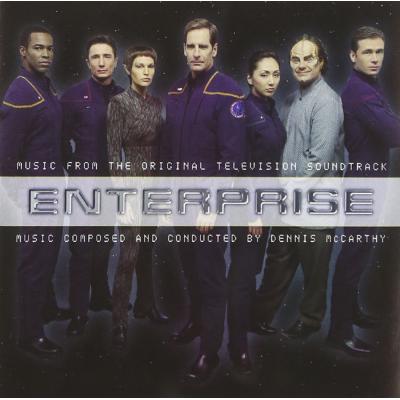
Enterprise (Star Trek) Album Cover

"Enterprise (Star Trek)" Soundtrack Lyrics

Movie • 2002

Track Listing


“Star Trek: Nemesis — Music From the Original Motion Picture Soundtrack” Soundtrack Description

Star Trek: Nemesis (2002) trailer frame with the Scimitar looming against a green nebula
Star Trek: Nemesis — trailer still, 2002

Overview

This entry covers the 2002 feature Star Trek: Nemesis and its score album; it is not the TV series Star Trek: Enterprise (2001–2005). Jerry Goldsmith’s final Star Trek feature score folds Alexander Courage’s classic fanfare and Goldsmith’s own Motion Picture theme into a darker, more electronic palette built around a new five-note idea for Shinzon and the warship Scimitar.

The original album (Varèse Sarabande) presents a tight 48-minute program; a 2014 2-CD Deluxe Edition expands the score to ~115 minutes and adds source cues and alternates. On screen, the lone diegetic song is Irving Berlin’s “Blue Skies,” sung by Data at the wedding and echoed by B-4 in the coda. (Apple Music; Wikipedia soundtrack; Movie Music UK)

Trailer shot of Picard facing Shinzon in cold green light, reflecting the score’s darker harmonic language
Heroic legacy themes meet a new, colder antagonist color

Questions & Answers

Is there an official soundtrack album?
Yes. Star Trek: Nemesis — Music From the Original Motion Picture Soundtrack (Varèse Sarabande) was issued December 10, 2002 (14 tracks, ~48 min). A 2-CD Deluxe Edition followed January 6, 2014 (~115 min).
Who composed and recorded the score?
Jerry Goldsmith composed and conducted; recording took place August 13–15, 2002 at Paramount Scoring Stage M with the Hollywood Studio Symphony; Bruce Botnick engineered.
What themes are used?
Courage’s TV fanfare and Goldsmith’s Star Trek: The Motion Picture theme bookend the film; a new five-note motif represents Shinzon/Scimitar.
Are there any songs?
Yes—Irving Berlin’s “Blue Skies,” performed diegetically by Brent Spiner (Data) at the wedding; its melody reappears at the end via B-4 and in the End Title suite.
What’s different on the Deluxe Edition?
It restores the complete score cues, alternates, source music (“Riker’s Strut” piano cues), plus “Blue Skies” (Brent Spiner) and a closing “Director and Composer” studio epilogue.
Was this Goldsmith’s last Star Trek score?
Yes—his fifth and final Star Trek feature score, released two years before his passing in 2004.

Notes & Trivia

  • Original album length ~48:24; Deluxe Edition ~115 minutes and limited to 5,000 copies.
  • Recording venue: Paramount Scoring Stage M, August 13–15, 2002.
  • End Title suite intertwines Courage’s fanfare, the Goldsmith Motion Picture theme, and a nod to “Blue Skies.”
  • “Blue Skies” functions as a story bookend: Data at the wedding; B-4 humming it in the coda.
  • The Deluxe Edition’s final track, “Director and Composer,” captures Goldsmith’s last moments on the Trek scoring stage.

Genres & Themes

Hybrid orchestral with restrained electronics. Goldsmith’s brass-led heroism and string lyricism meet synth pulses and processed percussion for suspense and hardware awe.

Motivic map. Courage fanfare = legacy; Goldsmith TMP theme = Federation grandeur; five-note Shinzon/Scimitar motif = manipulation and fatalism; “Blue Skies” = memory/continuity.

Trailer shot of the Enterprise-E in battle, aligning with ostinatos and metallic percussion in the score
Ostinatos and metallic rhythm drive the Bassen Rift battle

Tracks & Scenes

Timestamps are approximate (hh:mm) for the 117-minute cut; diegetic = heard by the characters.

“Remus” — Jerry Goldsmith
Where it plays: ~00:01–00:03, Paramount fanfare/opening and the Romulan Senate prologue; non-diegetic.
Why it matters: Sets the cold, conspiratorial tone before the coup.

“The Box” — Jerry Goldsmith
Where it plays: ~00:03–00:05, thalaron device annihilates the Senate; non-diegetic.
Why it matters: Early shock cue; Shinzon’s threat enters with steely color.

“Blue Skies” — Irving Berlin; performed by Brent Spiner
Where it plays: ~00:06–00:09, Riker & Troi’s wedding reception; diegetic (on-stage vocal).
Why it matters: Human warmth and a franchise in-joke; later echoed by B-4 as a memory trace.

“Odds and Ends” — Jerry Goldsmith
Where it plays: ~00:18–00:22, Kolarus III dune-buggy retrieval of android parts; non-diegetic.
Why it matters: Classic Goldsmith propulsion for the Argo chase energy.

“Repairs” — Jerry Goldsmith
Where it plays: ~00:24–00:30, B-4 is reassembled aboard Enterprise; non-diegetic.
Why it matters: Gentle textures hint at kinship and unease.

“The Knife” — Jerry Goldsmith
Where it plays: ~00:45, first tense meeting with Praetor Shinzon; non-diegetic.
Why it matters: Introduces the five-note Shinzon/Scimitar motif in full glare.

“Ideals” — Jerry Goldsmith
Where it plays: ~00:49, Picard and Shinzon trade philosophies; non-diegetic.
Why it matters: Somber strings suggest false kinship and control.

“The Mirror” — Jerry Goldsmith
Where it plays: ~01:10–01:17, Picard’s capture and Data’s rescue aboard Scimitar; non-diegetic.
Why it matters: Suspense architecture blooms into release.

“The Scorpion” — Jerry Goldsmith
Where it plays: ~01:12–01:15, escape in the Scorpion fighter; non-diegetic.
Why it matters: Tight ostinatos and cutting brass for the breakout beat.

“Lateral Run” — Jerry Goldsmith
Where it plays: ~01:16–01:22, Reman boarding action on the Enterprise; non-diegetic.
Why it matters: Rhythmic drive under corridor skirmishes.

“Engage” — Jerry Goldsmith
Where it plays: ~01:33, Picard rams the Enterprise-E into the Scimitar; non-diegetic.
Why it matters: Hammering action cue for the franchise’s boldest collision.

“Final Flight” — Jerry Goldsmith
Where it plays: ~01:36–01:41, Picard’s final confrontation with Shinzon; non-diegetic.
Why it matters: Score apex—brutal momentum, then tragic weight.

“A New Friend” — Jerry Goldsmith
Where it plays: ~01:43–01:47, mourning Data; non-diegetic.
Why it matters: Elegy and a faint hope in B-4’s potential.

“A New Ending” — Jerry Goldsmith (End Title suite)
Where it plays: ~01:54–end, end credits; non-diegetic.
Why it matters: Courage fanfare + Goldsmith main theme + “Blue Skies” echo = a formal farewell.

Also on the Deluxe Edition (not all on the 2002 CD): “Riker’s Strut” source cues (piano by Mike Lang); “Blue Skies” complete (Brent Spiner); alternates and session epilogue “Director and Composer.”

Music–Story Links

Legacy themes frame the crew’s final big-screen chapter—comforting bookends around a story of clones and erasure. Shinzon’s motif corrodes scenes that should feel familial; when battle arrives, the score trades heroics for attrition. After Data’s sacrifice, an old standard—“Blue Skies”—quietly carries memory forward to B-4 and, later, to Star Trek: Picard’s opening callback.

Trailer close-up of Data and Picard, tying 'Blue Skies' to memory and legacy in the film’s coda
Memory as motif: “Blue Skies” threads Data to B-4 and beyond

How It Was Made

Sessions & personnel. Recorded August 13–15, 2002 at Paramount Scoring Stage M with the Hollywood Studio Symphony; Jerry Goldsmith conducting; Bruce Botnick recording/mixing; production by Goldsmith and Robert Townson; Jo Ann Kane Music Service as copyist.

Editions. The 2002 album presents highlights; the 2014 Varèse Sarabande CD Club Deluxe Edition (2-CD, 5,000 copies) restores the full score, alternates, source cues (including “Riker’s Strut”), and adds a brief studio documentary track titled “Director and Composer.” (TrekCore; Discogs)

Reception & Quotes

Reactions split between respect for craft and disappointment versus Goldsmith’s own high bar.

“Loud, suspenseful, pounding, and electronically diverse … ultimately tired and unoriginal.” Filmtracks
“‘Final Flight’ … the score’s apogee … enduring testimony to Goldsmith’s mastery.” Movie Music UK

Album availability and credits are documented via Apple Music and the Wikipedia soundtrack entry.

Additional Info

  • Original CD: 14 tracks, Varèse Sarabande (2002). Deluxe Edition: VCL-1213-1143 (2014), ~115 minutes.
  • The End Title weaves Courage’s fanfare, Goldsmith’s TMP theme, and a “Blue Skies” flourish.
  • “Blue Skies” resurfaces two decades later in Star Trek: Picard (arr. Jeff Russo), explicitly tying back to Nemesis.
  • Key tracks fans cite: “The Scorpion,” “Engage,” “Final Flight,” “A New Ending.”
  • The Deluxe booklet features notes by Jeff Bond and production details from the sessions.

Technical Info

  • Title: Star Trek: Nemesis — Music From the Original Motion Picture Soundtrack
  • Year: 2002 (film/album); 2014 (Deluxe Edition)
  • Type: Original score (orchestra + electronics), with one diegetic song
  • Composer/Conductor: Jerry Goldsmith
  • Recording: Paramount Scoring Stage M, Aug 13–15, 2002; Hollywood Studio Symphony; engineer Bruce Botnick
  • Label: Varèse Sarabande (original & Deluxe Edition)
  • Selected placements: “Blue Skies” — Data’s wedding vocal & B-4 coda; “The Scorpion” — fighter escape; “Engage” — Enterprise ramming; “Final Flight” — Picard vs. Shinzon; “A New Ending” — End Title suite
  • Availability: Streaming (Apple Music/Spotify) for the 2002 program; Deluxe Edition on CD (limited run)

Canonical Entities & Relations

SubjectRelationObject
Jerry Goldsmithcomposed & conductedStar Trek: Nemesis (score)
Alexander Couragewrote“Theme from Star Trek (TV Series)” (quoted in End Titles)
Irving Berlinwrote“Blue Skies” (diegetic song in film)
Brent Spinerperformed“Blue Skies” (wedding scene)
Hollywood Studio SymphonyperformedStar Trek: Nemesis score
Bruce Botnickengineeredrecording & mixing
Varèse Sarabandereleased2002 album & 2014 Deluxe Edition
Stuart BairddirectedStar Trek: Nemesis (film)
Paramount PicturesdistributedStar Trek: Nemesis (2002)

Sources: Apple Music; Wikipedia (film & soundtrack); Movie Music UK; Filmtracks; TrekCore; Discogs.

November, 09th 2025


A-Z Lyrics Universe

Lyrics / song texts are property and copyright of their owners and provided for educational purposes only.