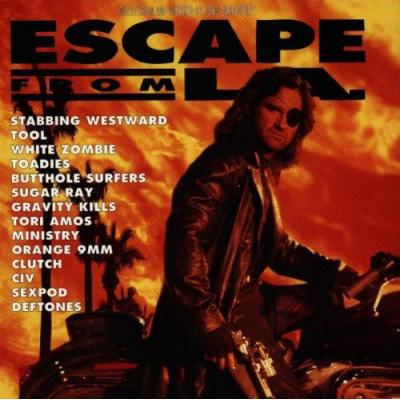
"Escape From L.A." Soundtrack Lyrics
Movie • 1996
Track Listing
Stabbing Westward
Tool
White Zombie
Toadies
Butthole Surfers
Sugar Ray & the Bluetones
Gravity Kills
Tori Amos
Ministry
Orange 9mm
Clutch
Civ
Sexpod
Deftones
"Escape from L.A.: Original Score Album From the Motion Picture" Soundtrack Description
Overview
How do you score a sunburned apocalypse that also cracks jokes? John Carpenter and Shirley Walker land on a hybrid: analog-synth pulse fused to muscular orchestra, with twangy guitar as Snake’s “cowboy” DNA. The core release is Escape from L.A.: Original Score Album From the Motion Picture (Milan Records, 1996). In 2014, La-La Land reissued an expanded program; a 25th-anniversary edition followed later.
Alongside the score, a companion compilation—Escape from L.A. (Music from and Inspired by the Film)—collects era-defining alt/industrial artists (Tool, White Zombie, Gravity Kills, Deftones, Stabbing Westward). Not every track appears on screen; several are album-only. AllMusic and MusicBrainz document editions and credits; La-La Land Records’ liner notes confirm expanded cues and personnel.
Questions & Answers
- Is there an official score album?
- Yes. Escape from L.A.: Original Score Album From the Motion Picture (Milan, Aug 27, 1996) composed by John Carpenter & Shirley Walker; later expanded by La-La Land Records.
- Is there a separate “songs” album?
- Yes. Escape from L.A. (Music from and Inspired by the Film) (1996), originally issued under the Atlantic/Lava umbrella; digital editions are marketed by Rhino/Warner.
- Which compilation tracks are actually heard in the film?
- Documented in-film uses include cuts by Stabbing Westward (“Dawn”), Tool (“Sweat”), White Zombie (“The One”), Butthole Surfers (“Pottery”), Sugar Ray (“10 Seconds Down”), Gravity Kills (“Blame” L.A. Remix), and Tori Amos (“Professional Widow” remix). Others are album-only.
- Who performed on the score?
- Session highlights include Nathan East (bass), John Robinson (drums), Nyle Steiner (EVI), Endre Granat (concertmaster), with orchestration support from Lolita Ritmanis and Michael McCuistion.
- Is there an expanded/collector’s edition?
- Yes. La-La Land’s expanded CD (2014) restores/extends cues; a 25th-anniversary program followed.
- Does “I Love L.A.” appear in the movie?
- Yes—used diegetically as an ironic needle-drop associated with Eddie’s “map-to-the-stars” recording; it’s a deliberate satirical flourish.
Notes & Trivia
- Carpenter returned to co-compose but leaned on Walker to upsize the orchestral footprint while keeping the franchise’s synth spine.
- La-La Land’s expansion reveals additional “Happy Kingdom” and Beverly Hills set-pieces that were truncated on the original album.
- The songs compilation pairs industrial/alt bands with Snake’s anti-hero mythology; several tracks never appear on screen.
- Randy Newman’s “I Love L.A.” is deployed as sardonic counterpoint—sunny anthem over dystopia.
- White Zombie’s “The One” and Gravity Kills’ “Blame (L.A. Remix)” were promoted to tie-ins around release.
Genres & Themes
Synth + orchestra = post-quake swagger. Low ostinatos and electronic pulse signal surveillance and decay; brass and battery punch up public mayhem (Coliseum, hang-gliders, street fights).
Guitar twang = Snake’s code. A laconic, Western-hued figure frames Plissken as a lone gun in a neon wasteland.
Industrial/alt cuts = 1996 Los Angeles texture. Tool/White Zombie/Sabbathy guitar weight stand in for concrete, dust, and aerosolized attitude; club-leaning remixes sell the city’s ironies.
Tracks & Scenes
“History of Los Angeles” — John Carpenter & Shirley Walker
Where it plays: Early briefing/prologue material (non-diegetic).
Why it matters: Establishes the city’s fall in terse statements; sets synth baseline the film keeps returning to.
“Sunset Boulevard Bazaar” — John Carpenter & Shirley Walker
Where it plays: Snake weaves through the shanty market; ambient menace, crowd noise, ad-hoc commerce (non-diegetic).
Why it matters: Pulses and hand percussion create heat shimmer; brass jabs warn of quick turns.
“Beverly Hills Surgeon General” — John Carpenter & Shirley Walker
Where it plays: Snake’s capture by the grotesque surgery cult (Bruce Campbell) (non-diegetic).
Why it matters: Horror color inside an action score—glissandi, warped electronics, and surgical percussion.
“Escape from Coliseum” — John Carpenter & Shirley Walker
Where it plays: The basketball gauntlet (non-diegetic).
Why it matters: Meter games track the ten-second beats; motif survival equals character survival.
“Hang Glider Attack” — John Carpenter & Shirley Walker
Where it plays: Rooftop assault toward the climax (non-diegetic).
Why it matters: Theme goes from stride to sprint; snares and cymbals sell altitude and risk.
“I Love L.A.” — Randy Newman
Where it plays: Heard diegetically with Eddie’s “map-to-the-stars” recording; also quoted as an ironic bumper.
Why it matters: Civic boosterism weaponized as satire; the film undercuts the anthem by context.
“Scalped” — Dick Dale
Where it plays: Associated with the infamous tsunami/surf run (diegetic feel via surf-guitar energy).
Why it matters: Surf rock in a disaster zone—LA kitsch colliding with end-times absurdity.
“The One (Soundtrack Version)” — White Zombie
Where it plays: In-film source use tied to street/club energy; full track on the compilation.
Why it matters: Industrial crunch mirrors Snake’s brute-force problem solving.
“Blame (L.A. Remix)” — Gravity Kills
Where it plays: Source-music layer (club/ambient system); full single pushed with the movie.
Why it matters: Late-90s industrial sheen as world-building texture.
“Sweat” — Tool
Where it plays: Brief in-film placement; complete track on the compilation.
Why it matters: Early Tool grind folds into the film’s metal-flecked sound design.
Album-only highlights
“Can’t Even Breathe” — Deftones; “Fire in the Hole” — Orange 9mm; “Escape from the Prison Planet” — Clutch. These do not have confirmed on-screen moments but define the companion album’s tone.
Music–Story Links
- Snake’s motif tracks agency: when he chooses, guitar-lead statements stand tall; when cornered, synth cells fray.
- Public spectacle (Coliseum; hang-gliders) swaps droning pads for snare-forward cues that mimic crowd adrenaline.
- Satire vs. swagger: “I Love L.A.” mocks civic mythmaking, while industrial tracks embody the city’s coarse survival instinct.
How It Was Made
Composers: John Carpenter and Shirley Walker. Walker produced the album and integrated live section leaders (Endre Granat, Jon Clarke) with electronics (Nyle Steiner’s EVI). Rhythm section pros Nathan East (bass) and John Robinson (drums) supply the bigger action footprint. Orchestration from Lolita Ritmanis and Michael McCuistion helped scale cues like “Hang Glider Attack.” The score album debuted via Milan (1996); La-La Land’s expansions later added restored/previously unreleased material from the sessions.
Reception & Quotes
“From minimalist beat to orchestral bombast… Walker brings muscular color to Carpenter’s synth DNA.” AllMusic
“A cowboy-tinged Snake theme rides electric bass; brass and samba-leaning action keep it lively.” Filmtracks
“Gonzo, darkly funny pulp with a score that sells the scale.” Contemporary reappraisals
Critical response to the film was mixed; the score’s hybrid approach earns steady praise in specialist outlets. The companion album is often remembered for its Tool/White Zombie/Deftones lineup.
Additional Info
- Score first release: Milan Records (CD/cassette), 1996; expanded La-La Land editions in 2014 and later anniversary reissues.
- Compilation album metadata in current stores credits Atlantic/Rhino (Warner) with original Lava/Atlantic catalog lineage.
- “Professional Widow” appears as Armand Van Helden’s club remix on the compilation.
- “I Love L.A.” is documented as an in-film diegetic needle-drop; used for irony rather than celebration.
- Musicians on the score include harmonica (Tommy Morgan) and hammer dulcimer (Daniel Greco), unusual colors for an action sequel.
Technical Info
- Title: Escape from L.A.: Original Score Album From the Motion Picture
- Year: 1996 (expanded reissues in 2014; 25th-anniversary edition later)
- Type: Film score (separate “music from & inspired by” album released in 1996)
- Composers: John Carpenter; Shirley Walker (album producer)
- Label(s): Milan Records (1996 score); La-La Land Records (expanded editions). Songs album: Atlantic/Lava (1996); current digital via Rhino/Warner.
- Notable placements: “I Love L.A.” (diegetic); “Scalped” (surf sequence association); “Blame (L.A. Remix)” / “The One” / “Sweat” used in-film as source.
- Availability: Score on streaming; expanded CDs periodically limited. Compilation widely available on major DSPs.
Canonical Entities & Relations
| Subject | Relation | Object |
|---|---|---|
| John Carpenter | co-composed | Escape from L.A. score album |
| Shirley Walker | co-composed & produced | Escape from L.A. score album |
| Milan Records | released | 1996 score album |
| La-La Land Records | reissued | expanded/anniversary score editions |
| Atlantic / Lava | released | 1996 songs compilation |
| Rhino (Warner Music) | markets | digital compilation catalog |
| Randy Newman | performed | “I Love L.A.” (diegetic use in film) |
| White Zombie | performed | “The One” (compilation; in-film source) |
| Gravity Kills | performed | “Blame (L.A. Remix)” (compilation; in-film source) |
| Tool | performed | “Sweat” (compilation; in-film source) |
Sources: AllMusic; MusicBrainz; La-La Land Records; Apple Music; Discogs; Ringostrack; Filmtracks; Wikipedia.
November, 09th 2025
A-Z Lyrics Universe
Cynthia Erivo Popular
Ariana Grande Horsepower
Post Malone Ain't No Love in Oklahoma
Luke Combs Good Riddance (Time of Your Life)
Green Day Bye Bye Bye
*NSYNC You're the One That I Wan
John Travolta & Olivia Newton-John I Always Wanted a Brother
Braelyn Rankins, Theo Somolu, Kelvin Harrison Jr. and Aaron Pierre The Power of Love
Frankie Goes to Hollywood Beyond
Auli’i Cravalho feat. Rachel House MORE ›