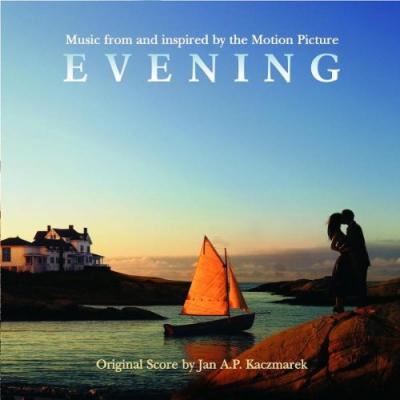
"Evening" Soundtrack Lyrics
Movie • 2007
Track Listing
Ella Fitzgerald
Polish Radio Orchestra
Steve Ash
Michael Buble
Peggy Lee
Polish Radio Orchestra
Before The Wedding
Peggy Lee
Polish Radio Orchestra
Sarah Vaughan
Polish Radio Orchestra
Anita O'Day
Polish Radio Orchestra
"Evening (Music from and Inspired By the Motion Picture)" Soundtrack Description
Overview
Can a soundtrack feel like memory? Evening pairs Jan A.P. Kaczmarek’s lyrical score with mid-century jazz standards to mirror the film’s two timelines: a 1950s Newport wedding weekend and the present-day reverie of an older Ann. The music moves between intimate piano-strings and ballroom swing, so scenes shift from hush to sparkle without losing emotional thread.
The album curates eight cues from Kaczmarek alongside recordings by Ella Fitzgerald, Peggy Lee, Sarah Vaughan, and Michael Bublé, plus cocktail-jazz source cuts. Period songs play diegetically at parties; the score handles confession, regret, and warmth. Verve issued the compilation in 2007, and it’s widely available on streaming.
Questions & Answers
- Is there an official soundtrack album?
- Yes. Verve released a 15-track compilation in 2007 combining Kaczmarek’s score with period vocals. It’s on Apple Music and Spotify.
- Who composed the score?
- Jan A.P. Kaczmarek wrote the original score. (Associated Press reported his passing in 2024.)
- What song is sung at the wedding?
- The 1947 standard “Time After Time” (Sammy Cahn/Jule Styne). Ann sings it at Lila’s reception; Harris joins briefly.
- Does Claire Danes sing in the film?
- Yes. She performs “Time After Time” at the reception and the lullaby “I See the Moon” in a domestic memory scene. Her vocals aren’t on the album.
- Which recording of “I’ve Got the World on a String” is used?
- Michael Bublé’s version is the featured sync in a dance sequence at the mansion.
- Who supervised the music?
- Linda Cohen served as music supervisor (IMDb/TCM credits).
Notes & Trivia
- Common confusion: the wedding song is the 1947 standard “Time After Time,” not the 1984 Cyndi Lauper hit.
- Claire Danes’ on-screen vocals are not on the official album; fans asked for them frequently after release.
- Michael Bublé’s “I’ve Got the World on a String” is licensed via Reprise/Warner; it also appears on his 2007 album Call Me Irresponsible.
- Kaczmarek’s cues favor piano, strings, and woodwinds; several were recorded with the Polish Radio Orchestra.
- Verve’s release mixes “score + standards” into one concise listen rather than a full cues-only album.
Genres & Themes
Cabaret & cocktail jazz signal social polish and class codes at the Wittenborn mansion—surface elegance masking romantic misalignment.
Jazz ballads (Lee, Vaughan, Fitzgerald) underline longing and second chances; light swing cues let the party breathe, then tilt toward intimacy.
Orchestral lyricism (Kaczmarek) frames memory work: motifs return softly “time after time,” turning the mother–daughters thread into something tender and cyclical.
Tracks & Scenes
“Time After Time” — Ann (on-screen vocal; 1947 Cahn/Styne standard)
Scene: Mid-reception at the Newport mansion, Ann sings to steady Lila; Harris steps in on a verse. Diegetic, in-room band. A simple arrangement keeps the vocals exposed.
Why it matters: It hints at the triangle and Ann’s buried feelings while staying “appropriate” for the party—subtext carried by a familiar standard.
“I See the Moon” — Claire Danes (traditional lullaby)
Scene: Brief memory fragment with Ann singing to her young daughters. Diegetic, near-whispered; no crowd, just a private room.
Why it matters: A maternal counterpoint to the wedding spectacle; the melody becomes a memory trigger later.
“I’ve Got the World on a String” — Michael Bublé
Scene: Dance-floor sequence at the mansion party; guests loosen up, Ann and Harris trade glances. Non-diegetic playback over dancing with cuts to dialogue.
Why it matters: Optimistic swagger sells possibility—for a few minutes the film lets romance feel easy.
“You’re My Thrill” — Peggy Lee
Scene: Used to shade a quiet, post-reception passage; the room dims, voices drop. Primarily non-diegetic over intercut looks and pauses.
Why it matters: Lee’s smoky vibrato folds desire and doubt into the same breath, matching Ann’s wavering resolve.
“Stairway to the Stars” — Sarah Vaughan
Scene: Late-night coda energy; lights are low, the party thins. Non-diegetic needle-drop that smooths a time jump.
Why it matters: Vaughan’s legato line makes the cut feel like a sigh—soft approval and inevitability at once.
“Gee Baby, Ain’t I Good to You” — Peggy Lee
Scene: Social-hour chatter before the vows; clinking glassware, soft laughter. Diegetic-feeling placement with room tone prominent.
Why it matters: A velvet veneer for a weekend built on compromise.
“Pretend” — Steve Ash
Scene: Cocktail interlude while side characters shuttle messages. Piano-led source track, low in the mix.
Why it matters: Title as comment—the party keeps pretending nothing is off-kilter.
“Perdido” — The West Coast All Stars
Scene: A brisk passage on the reception floor; background dancers, quick cuts. Non-diegetic, tempo lift.
Why it matters: Injects kinetic contrast before the film slides back into confession.
Note: Exact timestamps vary by cut/format; placements above reflect how the film uses these cues (album includes some alternates).
Music–Story Links
- Ann’s wedding rendition of “Time After Time” lets her say the unsayable in plain sight—lyrics as coded confession, duet as fleeting consent.
- Bublé’s “World on a String” frames the brief fantasy that Ann and Harris could bend fate; the swing collapses when real obligations resurface.
- The lullaby “I See the Moon” anchors mother–daughter memory; when the present timeline returns, you hear the echo even without the tune.
- Lee and Vaughan’s ballads function like voice-over without words: they supply interiority for characters who can’t speak plainly.
How It Was Made
Composer Jan A.P. Kaczmarek shaped a chamber-leaning orchestral palette (piano, strings, woodwinds) recorded with Polish players credited on the album. Music supervisor Linda Cohen cleared the period standards and coordinated the blend of diegetic party cues with non-diegetic romance cues. Verve packaged both strands into a single release rather than issuing a stand-alone score album. IMDb and TCM list Cohen; Verve’s issue notes track sources and clearances.
Reception & Quotes
Critics praised the elegance of the selections even when the film itself divided opinion. Specialty outlets highlighted the score’s warmth and the smart use of jazz ballads.
“Eight graceful score cues sit alongside smoky period vocals—classy, restrained, and deeply romantic.” Movie Music UK
“Fans lament the missing Claire Danes vocal, but Kaczmarek’s cues carry the heart.” MovieXclusive
“The wedding performance becomes one of the film’s emotional high points.” Spirituality & Practice
Additional Info
- Album title: Evening (Music from and Inspired By the Motion Picture) — Verve, 2007.
- Claire Danes’ “Time After Time” is heard on screen; the album instead uses Ella Fitzgerald’s studio recording of the standard.
- Michael Bublé’s sync is courtesy of Reprise Records (Warner Music) and also appears on his 2007 LP.
- Source cues by Andy Farber (“One for Ernie,” “Midnight Cocktail”) cover the elegant-lounge texture between dialogue scenes.
- The film is set in Rhode Island (Newport/Tiverton); the music leans into seaside-estate chic rather than big-band bombast.
- Streaming availability is stable; the original CD carried a Verve UPC and shipped late June 2007.
- The Associated Press obituary (2024) provides concise career context for Kaczmarek beyond this title.
Technical Info
- Title: Evening — Music from and Inspired By the Motion Picture
- Year: 2007 (film runtime 117 min)
- Type: Compilation (score + licensed recordings)
- Composer: Jan A.P. Kaczmarek
- Music Supervision: Linda Cohen
- Key licensed recordings: Peggy Lee (“You’re My Thrill”, “Gee Baby, Ain’t I Good to You”), Sarah Vaughan (“Stairway to the Stars”), Ella Fitzgerald (“Time After Time”), Michael Bublé (“I’ve Got the World on a String”)
- Label / Album status: Verve (CD & digital); widely streaming
- Notable omissions: Claire Danes’ on-screen “Time After Time” and “I See the Moon” vocals not included on the album
- Release context: U.S. theatrical release June 2007; album shipped late June 2007
Canonical Entities & Relations
| Subject | Relation | Object |
|---|---|---|
| Lajos Koltai | directed | Evening (2007) |
| Jan A.P. Kaczmarek | composed score for | Evening (2007) |
| Linda Cohen | music supervised | Evening (2007) |
| Verve | released | Evening (Music from and Inspired By the Motion Picture) |
| Focus Features | distributed | Evening (2007) |
| Claire Danes | performed on-screen | “Time After Time”; “I See the Moon” |
| Michael Bublé | performed | “I’ve Got the World on a String” (feature sync) |
| Peggy Lee | recording used | “You’re My Thrill”; “Gee Baby, Ain’t I Good to You” |
| Sarah Vaughan | recording used | “Stairway to the Stars” |
Sources: IMDb; Wikipedia; Verve; Apple Music; Spotify; Discogs; Movie Music UK; MovieXclusive; SoundtrackINFO; RingoStrack; Movienco; Associated Press; TCM; ProductionBeast; YouTube/official clips.
November, 09th 2025
A-Z Lyrics Universe
Cynthia Erivo Popular
Ariana Grande Horsepower
Post Malone Ain't No Love in Oklahoma
Luke Combs Good Riddance (Time of Your Life)
Green Day Bye Bye Bye
*NSYNC You're the One That I Wan
John Travolta & Olivia Newton-John I Always Wanted a Brother
Braelyn Rankins, Theo Somolu, Kelvin Harrison Jr. and Aaron Pierre The Power of Love
Frankie Goes to Hollywood Beyond
Auli’i Cravalho feat. Rachel House MORE ›