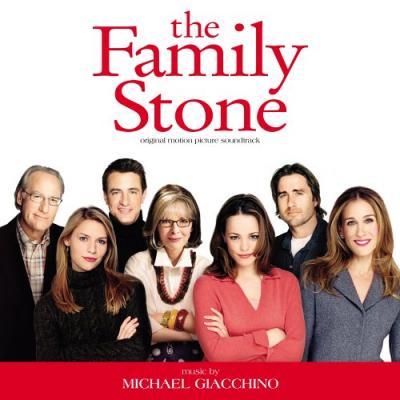
"Family Stone" Soundtrack Lyrics
Movie • 2006
Track Listing
Suite
Dean Martin
Jingle Bells
Traditional
Traditional
Elvin Bishop
Jefferson Starship
Jefferson Starship
Maxine Nightingale
Judy Garland
"The Family Stone (Original Motion Picture Soundtrack)" Soundtrack Description
Overview
Can a holiday family dramedy live on waltz time? Michael Giacchino answers with a chamber-sized score that keeps emotions close: a lilting main waltz for the Stones’ rituals, gentle woodwinds for private doubts, and warm strings that refuse cynicism. Around that score, a handful of curated needle-drops — from Maxine Nightingale to Jefferson Starship — tip scenes from brittle to tender in a bar, a living room, or over the closing credits.
The album dropped in December 2005 with 23 cues (≈44 minutes) and has since circulated widely on digital services; a physical CD shipped shortly after the new year. Release metadata and timings match across Apple’s storefront and Varèse Sarabande’s catalog notes, while session coverage at ScoringSessions.com places the recording at the Newman Scoring Stage earlier that fall. AllMusic later logged credits and reception.
Questions & Answers
- Is there an official soundtrack album?
- Yes. The Family Stone (Original Motion Picture Soundtrack) contains Michael Giacchino’s score (23 tracks; ≈44:00). A CD edition followed soon after the digital release.
- Who composed the score?
- Michael Giacchino. The album is entirely his score, with one classical excerpt (“Trepak” from The Nutcracker) credited on the disc.
- 2005 or 2006 — which year is “correct” for the film and album?
- The film opened December 16, 2005 (U.S.). The score album released December 6, 2005; a retail CD shipped in late January 2006.
- What song does Meredith dance to in the bar?
- Maxine Nightingale’s “Right Back Where We Started From.” The scene begins under Elvin Bishop’s “Fooled Around and Fell in Love.”
- Is Judy Garland actually heard in the movie?
- Yes — a character watches Meet Me in St. Louis; Judy Garland’s “Have Yourself a Merry Little Christmas” is heard onscreen.
- What plays over the end credits?
- Jefferson Starship’s “Count on Me.”
- Who released the album?
- Digital release carries Hollywood Records credit (℗ Twentieth Century Fox Film Corporation); the CD was issued by Varèse Sarabande.
Notes & Trivia
- The score recording took place at Fox’s Newman Scoring Stage in early September 2005.
- “Right Back Where We Started From” is the jukebox cue Meredith calls and dances to; it follows Bishop’s “Fooled Around and Fell in Love.”
- End credits use Jefferson Starship’s soft-rock hit “Count on Me.”
- The album’s shortest cues (“Hi,” “Dawn”) are under a minute — editorial glue between bigger dramatic turns.
- Giacchino threads a family waltz across scenes; a holiday-classic excerpt (“Trepak”) appears diegetically.
Genres & Themes
Warm chamber score → complicated love. Clarinet and strings soften conflicts, even when dialogue sharpens; the waltz motif says “tradition” without sentimentality.
’70s soft-rock & disco pop → social lubrication. Barroom tracks lower defenses; when Meredith finally moves to the jukebox groove, the film exhales.
Golden-age holiday standards → memory. The Garland clip isn’t just Christmas décor; it’s a family choosing comfort when change hurts.
Tracks & Scenes
“Right Back Where We Started From” — Maxine Nightingale
Where it plays: Meredith and Ben at the bar; she calls the song on the jukebox and dances; source, fully diegetic.
Why it matters: The first genuine thaw — a pop classic reframes her stiffness as energy.
“Fooled Around and Fell in Love” — Elvin Bishop
Where it plays: Same bar sequence, earlier in the scene; source playback.
Why it matters: Sets an easy, confessional mood that makes the Nightingale switch feel earned.
“Count on Me” — Jefferson Starship
Where it plays: End credits, after the film’s time jump; non-diegetic needle-drop.
Why it matters: A plainspoken vow after a year of change — the lyric fits the Stones’ new equilibrium.
“Have Yourself a Merry Little Christmas” — Judy Garland
Where it plays: On a TV during Meet Me in St. Louis; the family watches together; diegetic.
Why it matters: Holiday melancholy acknowledged — love means living with the ache.
“Trepak (Cossack Dance)” — P. Tchaikovsky
Where it plays: Holiday source cue (diegetic), used as sparkling contrast to family tension.
Why it matters: Seasonal color that reminds us the house is alive even when conversations stall.
“Jingle Bells” — Johnny Mercer (version)
Where it plays: Seasonal ambience within the house (source placement).
Why it matters: Period croon grounds the film in classic-holiday sound without turning to pastiche.
“Let It Snow! Let It Snow! Let It Snow!” — Dean Martin
Where it plays: Brief holiday source cue within domestic montage.
Why it matters: A warm, vintage gloss over fraying nerves.
Music–Story Links
Waltz = family code. The main theme binds scenes — a ritual heartbeat — so that bar jukebox music feels like stepping outside the family’s rules.
Needle-drops as permission. When disco and soft-rock arrive, characters risk being seen; the score then re-enters to hold the consequence.
Carols as memory work. Garland’s performance cues collective remembrance; characters sit with absence and still choose togetherness.
How It Was Made
Sessions ran at the Newman Scoring Stage (20th Century Fox) in early September 2005 with Tim Simonec conducting and orchestrations by Simonec, Jack Hayes, Chris Tilton, Adam Cohen, and Jennifer Hammond. Editorially, the album favors short, scene-specific cues, with the waltz motif sequenced up front and a suite to close. Trade and label notes attribute the 2005 digital release to Hollywood Records (under Fox’s copyright), with a Varèse Sarabande CD shipping January 2006.
Reception & Quotes
“A gentle, heartfelt work… Giacchino resists schmaltz and lets the melody do the talking.” Movie Music UK
“Elegant economy: small ensemble, big sincerity.” Filmtracks
Critical response to the film was mixed, but the score’s restraint and melodic clarity drew consistent praise in soundtrack circles.
Additional Info
- Album structure: many cues under two minutes — built to match tight scene pivots.
- Physical CD credits list the “Trepak” excerpt explicitly alongside the original score.
- The bar sequence’s two-song handoff (Bishop → Nightingale) is widely cited by fans as the film’s loosest, most joyful beat.
- Closing cue choice (“Count on Me”) links thematically to the film’s one-year-later epilogue.
- Score availability is broad on DSPs; the original CD carries 2006 shipping data.
Technical Info
- Title: The Family Stone (Original Motion Picture Soundtrack)
- Film/Year: 2005 feature (opened Dec 16, 2005)
- Composer: Michael Giacchino
- Key personnel: Tim Simonec (conductor/orchestrations); additional orchestrations by Jack Hayes, Chris Tilton, Adam Cohen, Jennifer Hammond
- Album: 23 tracks; ≈44 minutes
- Labels: Digital — Hollywood Records (℗ Twentieth Century Fox Film Corporation); CD — Varèse Sarabande (retail ship Jan 31, 2006)
- Notable song placements: “Right Back Where We Started From” (bar dance); “Fooled Around and Fell in Love” (bar intro); Judy Garland’s “Have Yourself a Merry Little Christmas” (Meet Me in St. Louis clip); “Count on Me” (end credits)
- Recording: Newman Scoring Stage (20th Century Fox), Sept 2005
Canonical Entities & Relations
| Entity | Relation | Entity |
|---|---|---|
| Michael Giacchino | composed | The Family Stone original score |
| Tim Simonec | conducted & orchestrated | The Family Stone score |
| Hollywood Records | released (digital) | The Family Stone soundtrack (2005) |
| Varèse Sarabande | released (CD) | The Family Stone soundtrack (2006) |
| Maxine Nightingale | song featured | “Right Back Where We Started From” |
| Elvin Bishop | song featured | “Fooled Around and Fell in Love” |
| Jefferson Starship | song featured | “Count on Me” |
| Judy Garland | performance heard via | Meet Me in St. Louis clip |
Sources: Apple Music; Varèse Sarabande; ScoringSessions.com; AllMusic.
November, 09th 2025
A-Z Lyrics Universe
Cynthia Erivo Popular
Ariana Grande Horsepower
Post Malone Ain't No Love in Oklahoma
Luke Combs Good Riddance (Time of Your Life)
Green Day Bye Bye Bye
*NSYNC You're the One That I Wan
John Travolta & Olivia Newton-John I Always Wanted a Brother
Braelyn Rankins, Theo Somolu, Kelvin Harrison Jr. and Aaron Pierre The Power of Love
Frankie Goes to Hollywood Beyond
Auli’i Cravalho feat. Rachel House MORE ›