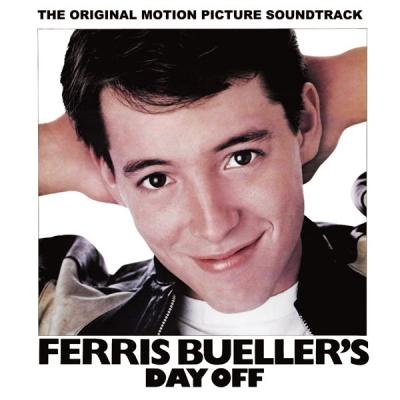
"Ferris Bueller's Day Off" Soundtrack Lyrics
Movie • 1986
Track Listing
Sigue Sigue Sputnik
TeeVee Toons
Yello
The Flowerpot Men
Big Audio Dynamite
John Willliams
The Dream Academy
Wayne Newton
The Beatles
Zapp
Blue Room
General Public
The Dream Academy
The (English) Beat
Yello
Sigue Sigue Sputnik
The (English) Beat
"Ferris Bueller’s Day Off — Limited Edition (La-La Land Records)" Soundtrack Description
Overview
What makes a day off feel epic? In this case, a needle-drop arsenal that swings from Swiss electro to Beatles bravado to a Smiths cover that turns a museum visit into a gut punch. The film’s music is functional first—motivating gags, pace, and place—yet it quietly maps Ferris, Cameron, and Sloane’s inner weather.
The 2016 Limited Edition finally assembled the mix fans chased for decades: Yello’s “Oh Yeah,” Wayne Newton’s “Danke Schoen,” The Dream Academy cues, Zapp, Big Audio Dynamite, and Ira Newborn’s puckish score. Not every famous cue could be licensed for the disc, but the album still captures the movie’s tonal spread: prankster synths, pre-rock croon, parade brass, and a late-run adrenaline sprint. Trusted source: La-La Land Records.
Questions & Answers
- Why wasn’t there a 1986 soundtrack album?
- Director John Hughes felt the songs wouldn’t cohere as an LP and instead mailed a 7″ single to a fan list. Trusted source: Wikipedia (Music section).
- What’s the art-museum track everyone asks about?
- An instrumental cover of The Smiths’ “Please Please Please Let Me Get What I Want” by The Dream Academy—used over the contemplative montage.
- Did the 2016 CD include every iconic song?
- No. Several high-profile cues were excluded due to licensing, though most others—and Newborn’s score—were included. Trusted source: La-La Land Records.
- Which song re-charted because of the film?
- The Beatles’ “Twist and Shout” returned to the Billboard Hot 100 in 1986 after the parade sequence rekindled interest.
- What’s playing during Ferris’s sprint home?
- “March of the Swivelheads” (a remix of “Rotating Heads”) by The (English) Beat—an urgent, running-gag in song form.
- Is “Oh Yeah” used just once?
- No. It scores the Ferrari reveal and returns over the end credits, bookending Ferris’s brand of wish-fulfillment.
- Who steered the music picks day-to-day?
- Music supervisor Tarquin Gotch worked alongside Hughes and editor Paul Hirsch; the final sequencing/editing shaped how cues land on screen.
Notes & Trivia
- “Twist and Shout” in the film features extra marching-band brass; Paul McCartney disliked the overdub—yet it helped the sequence feel “live.”
- Hughes mailed a ~100,000-copy 7″ to fans featuring “Beat City” and another track—effectively the only 1986 “soundtrack.”
- The parade float performance was staged amid a real Chicago parade, captured with a multi-camera setup in limited takes. Trusted source: Entertainment Weekly.
- “Beat City” and Blue Room’s “I’m Afraid” made rare, first-time CD debuts on the 2016 album.
- “Oh Yeah” became pop-culture shorthand for lust/consumer craving—forever linked to Ferris and that Ferrari reveal.
Genres & Themes
Electro/new wave (Yello, Sigue Sigue Sputnik): pranks, postmodern cool, and consumer “want”—the film’s mischievous engine.
Old-school pop standard (Wayne Newton): Ferris’s cheeky charm—irony weaponized; when he croons, adults melt.
Indie melancholy (The Dream Academy, via The Smiths): Cameron’s interiority; a quiet intermission that reframes the day as a Cameron story.
Ska/Two-Tone & alt-rock (The [English] Beat, General Public, Big Audio Dynamite): velocity and urban texture—parking garages, sprints, and street-level bustle.
Classical/polka & parade brass: surface polish and civic spectacle—Chez Quis elegance vs. crowd euphoria.
Tracks & Scenes
“Love Missile F1-11” — Sigue Sigue Sputnik
Scene: Ferris throws open the curtains and gears up for mischief ({00:03:25}); non-diegetic. ~1–2 min on screen.
Why it matters: Announces a day ruled by style over rules; a synthy manifesto.
“Danke Schoen” — Wayne Newton
Scene: Shower croon ({00:05:07}); diegetic (Ferris sings/lip-syncs). Returns at parade.
Why it matters: Ferris disarms authority with schmaltz; a running gag that becomes crowd control later.
“Jeannie (Theme from I Dream of Jeannie)” — Hugo Montenegro
Scene: Ferris dances across his room ({00:11:58}); playful, non-diegetic wink.
Why it matters: TV nostalgia amplifies the meta-“wish fulfillment” vibe.
“Oh Yeah” — Yello
Scene: The garage doors rise; the Ferrari 250 GT California gleams ({00:26:14}); non-diegetic.
Why it matters: Desire distilled to a bass throb—consumer lust, teenage awe, and a running punchline.
“Beat City” — The Flowerpot Men
Scene: The trio heads downtown after Sloane’s pickup ({00:30:56}); non-diegetic road energy.
Why it matters: Switches the movie from suburban scheme to city caper.
“B.A.D.” (“Bad”) — Big Audio Dynamite
Scene: At the parking garage check-in ({00:34:19}); likely diegetic background.
Why it matters: Urban edge cues the upcoming valet joyride trouble.
“Main Title / Rebel Blockade Runner” — John Williams
Scene: Valets launch the Ferrari, slo-mo air time ({00:54:38}); non-diegetic quotation gag.
Why it matters: Mythicizes the theft; the joke only lands with that fanfare.
“Please Please Please Let Me Get What I Want” (instrumental) — The Dream Academy
Scene: Art Institute montage ({00:56:07}); non-diegetic.
Why it matters: The film pauses. Cameron’s stare at Seurat mirrors the cue’s ache. The day briefly belongs to him.
“Danke Schoen” → “Twist and Shout” — Wayne Newton → The Beatles
Scene: Ferris takes the float mic (start ~{01:01:07}); then explodes into “Twist and Shout” (~{01:02:52}); diegetic performance with parade brass overlay.
Why it matters: Crowd becomes cast; the movie’s communal heart. It even pushed “Twist and Shout” back onto the charts that year.
“Radio People” — Zapp
Scene: Post-garage mileage panic in the car ({01:11:20}); diegetic car stereo feel.
Why it matters: Rubber-band funk undercuts the boys’ dawning dread.
“I’m Afraid” — Blue Room
Scene: Cameron zones out near the pool/beach ({01:13:06}); non-diegetic mood bed.
Why it matters: Names his anxiety outright; an under-sung placement rescued for the 2016 disc.
“Taking the Day Off” — General Public
Scene: Poolside/hot-tub sequence while Cameron sits on the board ({01:14:49}); diegetic vibe.
Why it matters: The lyric winks at the plot—a literal theme song—yet it’s one of the tracks missing from the 2016 CD.
“The Celebrated Minuet” — Luigi Boccherini
Scene: Chez Quis restaurant ({~00:40:35}); source music, diegetic.
Why it matters: Fancy varnish for Ferris’s Abe Froman con.
“The Edge of Forever” — The Dream Academy
Scene: Ferris and Sloane’s goodbye near the end ({01:29:26}); non-diegetic.
Why it matters: A gentle landing before the sprint—bittersweet afterglow.
“March of the Swivelheads” — The (English) Beat
Scene: Ferris’s backyard-to-backyard dash ({01:31:02}); non-diegetic.
Why it matters: Motorik urgency; pure forward motion edits perfectly with sight gags.
“Oh Yeah” — Yello
Scene: Closing credits ({01:38:49}); non-diegetic.
Why it matters: A cheeky curtain call for Ferris and the Ferrari.
Trailer/TV spots: marketing cuts leaned on the same iconography and often on “Oh Yeah.” Notable omissions from the 2016 CD: “Twist and Shout,” “Taking the Day Off,” “March of the Swivelheads.”
Music–Story Links
Ferris’s shameless charm has a sonic emblem: “Danke Schoen.” Once he lip-syncs it on the float, the song stops being a joke and becomes social glue. Cameron, by contrast, is scored internally; the Dream Academy cue reframes him as the day’s real protagonist. And when responsibility finally bites, “Swivelheads” snaps the film into a kinetic morality play: can charisma outrun consequences?
How It Was Made
Ira Newborn’s score stitches the caper beats, while music supervisor Tarquin Gotch funneled Hughes’s taste into licensable options. Editor Paul Hirsch’s reshuffle—moving the museum sequence and dialing in the Dream Academy cue—changed how the film breathes. The parade was captured amid a real city event using multiple cameras; Matthew Broderick reportedly learned and performed the moves under pressure. Trusted source: Entertainment Weekly.
Rights remained thorny for decades; hence the long-delayed album and some absences on the 2016 disc. When it finally arrived, producers folded in unused cues and even the parade’s “Twist and Shout” marching-band overlay.
Reception & Quotes
“One of the most innocent movies in a long time… a sweet, warm-hearted comedy.” Roger Ebert
“‘Oh Yeah’ became synonymous with avarice… that deep voice rumbles, ‘Oh yeah…’” Jonathan Bernstein
“We moved the float into a real parade… and then we got one take.” Kenny Ortega, interview coverage
The soundtrack itself earned cult status precisely because it didn’t exist commercially for years; the 2016 release sold through quickly, validating the film’s musical afterlife. Trusted source: Pitchfork.
Additional Info
- 2016 CD run: 5,000 copies; now out of print.
- “Beat City” appears in a new mix approved by its creators.
- The film’s “Twist and Shout” helped the 1963 recording re-enter U.S. charts in 1986.
- Hughes’s fan-club 7″ is the only “original-era” physical release tied to the movie.
- “Star Wars” fanfare is a sanctioned needle-drop gag for the valet flight.
- General Public’s Dave Wakeling has a cameo at Wrigley; later, The Beat’s members formed General Public—tying two cues together.
- Parade day was staged across real crowd logistics; extra shots came after radio call-outs to locals.
- La-La Land’s booklet features fresh interviews with Newborn, Gotch, Hirsch, and James Hughes.
Technical Info
- Title: Ferris Bueller’s Day Off — Limited Edition (Original Motion Picture Soundtrack)
- Film Year: 1986 (U.S. release: June 11, 1986)
- Album Year: 2016 (September 13)
- Type: Various Artists + Original Score (Ira Newborn)
- Composers: Ira Newborn (score); source tracks by Yello, The Beatles, The Dream Academy, etc.
- Music Supervision: Tarquin Gotch
- Label: La-La Land Records (LLLCD 1391); limited 5,000; sold out
- Notable placements: “Oh Yeah” (Ferrari reveal; end credits), “Twist and Shout” (parade), Dream Academy instrumental (museum), “Swivelheads” (sprint), “Beat City” (drive downtown)
- Availability: Secondary market; digital playlists exist but are unofficial composites
Canonical Entities & Relations
| Subject | Relation | Object |
|---|---|---|
| John Hughes | wrote & directed | Ferris Bueller’s Day Off (film) |
| Ira Newborn | composed | Original score |
| Tarquin Gotch | supervised | Music selection & licensing |
| Paul Hirsch | edited | Film; re-sequenced scenes affecting music |
| Paramount Pictures | distributed | Film |
| La-La Land Records | released | 2016 official soundtrack CD |
| Yello | performed | “Oh Yeah” |
| The Beatles | performed | “Twist and Shout” |
| The Dream Academy | performed | Instrumental “Please Please Please Let Me Get What I Want” |
| The (English) Beat | performed | “March of the Swivelheads” |
| General Public | performed | “Taking the Day Off” |
| Wayne Newton | sang | “Danke Schoen” |
Sources: La-La Land Records; Wikipedia; Entertainment Weekly; Pitchfork; Wired; IMDb (Soundtracks); The Ferris File.
November, 09th 2025
A-Z Lyrics Universe
Cynthia Erivo Popular
Ariana Grande Horsepower
Post Malone Ain't No Love in Oklahoma
Luke Combs Good Riddance (Time of Your Life)
Green Day Bye Bye Bye
*NSYNC You're the One That I Wan
John Travolta & Olivia Newton-John I Always Wanted a Brother
Braelyn Rankins, Theo Somolu, Kelvin Harrison Jr. and Aaron Pierre The Power of Love
Frankie Goes to Hollywood Beyond
Auli’i Cravalho feat. Rachel House MORE ›