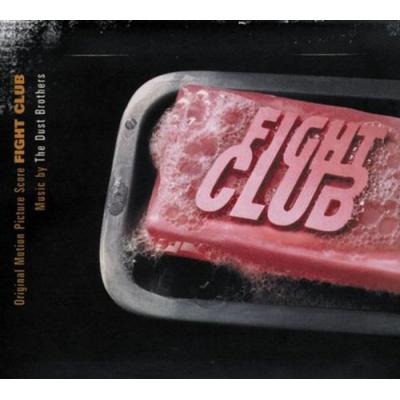
"Fight Club" Soundtrack Lyrics
Movie • 1999
Track Listing
Daniel May
Vas
Cezame Argile
Junk Ferry
The Odditorium
Tom Waits
Marlene Dietrich
The Pixies
"Fight Club (Original Motion Picture Score)" Soundtrack Description
Overview
Can a score feel like an adrenaline spike and a panic attack at once? The Dust Brothers’ electronics do exactly that—buzzing breakbeats and sample grit that mirror the film’s split identity. Where many late-’90s dramas reached for orchestras, Fight Club doubles down on drum loops, glitch, and bass pressure.
The album—released by Restless Records in 1999—plays like an industrial-trip-hop suite: “Corporate World” snaps under the IKEA montage; “Hessel, Raymond K.” needles the famous convenience-store epiphany; and the curtain drop belongs to Pixies’ “Where Is My Mind?” over the skyline implosion. Trusted source: AllMusic.
Questions & Answers
- Who composed the score?
- The Dust Brothers (Michael Simpson & John King) wrote and produced the electronic score; it’s their only full film score release.
- What’s the end-scene song?
- Pixies’ “Where Is My Mind?”—it starts as buildings detonate and runs into credits.
- Is “Goin’ Out West” in the movie?
- Yes—Tom Waits plays in the bar when the Narrator meets Tyler after the apartment explosion.
- Was Radiohead ever attached?
- Thom Yorke was approached but declined; Fincher then hired The Dust Brothers. Trusted source: NME.
- Is Marla’s singing diegetic?
- Yes—Helena Bonham Carter sings “Theme from ‘Valley of the Dolls’” on screen as Marla leaves Tyler’s house.
- Was the score reissued?
- Mondo reissued it on 2×LP “pink soap” vinyl in 2016. Trusted source: Pitchfork.
- Are all songs on the album?
- No—several source cues (e.g., Tom Waits, Marlene Dietrich, library tracks) are not on the Dust Brothers’ album.
Notes & Trivia
- Workprint title sequence temp-tracked with Foo Fighters’ “Everlong”; final film uses Dust Brothers.
- The score was recorded/mixed at P.C.P. Labs, Los Angeles.
- The soundtrack received a BRIT Award nomination (lost to Notting Hill).
- Project Mayhem’s chanted energy frequently rides on distorted drum loops rather than traditional thematic leitmotifs.
- “This Is Your Life” exists as an album cut with Tyler Durden dialogue; it’s not a diegetic film performance.
Genres & Themes
Breakbeat & trip-hop → alienation with momentum. Cut-up drums and bit-crushed textures match the Narrator’s insomnia spikes and Tyler’s kinetic sales pitch.
Industrial glitches & bass drones → menace and systems control. These underpin corporate spaces and the escalation to Project Mayhem.
Vintage standards & lounge cues → irony. Dietrich and library waltzes sweeten scenes just as relationships curdle.
Alt-rock coda → catharsis with an asterisk. Pixies close the film on a tone that reads as release yet questions reality.
Tracks & Scenes
"Corporate World" – The Dust Brothers
Scene: IKEA “nesting” montage (early act). Non-diegetic; catalogs glide past as the Narrator itemizes identity by SKU. Why it matters: frames consumer hypnosis with rigid, quantized rhythm.
"Goin’ Out West" – Tom Waits
Scene: Bar meeting after the condo explosion (~00:30). Source in-bar. Why it matters: swaggering stomp sets Tyler’s outlaw charisma against the Narrator’s ruin.
"Smokestack" – Junk Ferry
Scene: Briefly under the same bar exchange. Why it matters: grimy underscoring that keeps the room’s grit alive between dialogue beats.
"Coffee Store Zak" – Rolfe Kent
Scene: Late-night infomercial viewing (~00:13). Source on TV. Why it matters: chirpy ad music needles the insomnia spiral.
"Cafeteria" – Christian Poulet (library)
Scene: Airport/security sequence; luggage talk. Source cue. Why it matters: sterile muzak against the film’s obsession with rules and risk.
"Look Me Over Closely" – Marlene Dietrich
Scene: Marla’s apartment phone call; loneliness and pills. Source. Why it matters: smoky cabaret warmth undercuts the scene’s danger.
"Theme from ‘Valley of the Dolls’" – Helena Bonham Carter
Scene: Marla sings as she exits Tyler’s house (~00:59). Diegetic performance. Why it matters: character POV through song—fragility, bravado, denial.
"Hessel, Raymond K." – The Dust Brothers
Scene: Convenience-store “apply or die” mugging. Non-diegetic. Why it matters: clipped percussion mirrors Tyler’s cold methodology during the forced awakening.
"Stealing Fat" – The Dust Brothers
Scene: Night raid on the liposuction dumpster. Non-diegetic with comic menace. Why it matters: makes grotesque heist feel perversely playful.
"Easy, Smack It Up" – The Odditorium (remix)
Scene: Paper Street party when Fight Club overflows into communal living (~01:30). Source. Why it matters: rowdy pulse marks the movement’s shift from catharsis to chaos.
"Tzigany/Tzingany Waltz" – production library
Scene: Late-film restaurant conversation where the Narrator warns Marla. Source. Why it matters: genteel waltz against imminent violence—pure irony.
"Where Is My Mind?" – Pixies
Scene: Final skyline demolition (~02:05) through credits. Non-diegetic. Why it matters: the film’s iconic sonic signature—sweetness over annihilation—seals the unreliable-narrator reveal.
Trailer usage
Most trailers cut to Dust Brothers cues; TV spots varied by release. Not all promotional music appears on the album.
Music–Story Links
Consumer trance → rupture. “Corporate World” quantizes the Narrator’s catalog life so the first basement fight hits like a tempo break.
Tyler’s myth → bar blues. Waits’ “Goin’ Out West” paints Tyler as American outlaw before the rules of Fight Club are even spoken.
Epiphany by threat. The spartan “Hessel, Raymond K.” reduces harmony to pulse—Tyler’s philosophy as percussion.
Marla’s voice → agency. Her “Valley of the Dolls” moment isn’t background; it’s a flare—she’s not just a plot device, she’s singing herself out of the frame.
How It Was Made
David Fincher sought a non-traditional score; The Dust Brothers built it from breakbeats, samples, and bass design rather than orchestra. Recording and mix: P.C.P. Labs (Los Angeles). Trusted source: Wikipedia.
Before that hire, Thom Yorke was approached and declined; years later, the score returned to vinyl via Mondo’s 2016 2×LP. Fincher’s opening titles were once temped with Foo Fighters’ “Everlong” in a workprint; the final film uses Dust Brothers in the main titles.
Reception & Quotes
“Fincher wanted to break new ground… a nontraditional score helped achieve that.” Michael Simpson
“One of the best [soundtracks] in recent memory; intensity and obscurity ooze from every track.” Sputnikmusic
The film’s climactic pairing with Pixies has since become a pop-culture shorthand for beautiful catastrophe. The album continues to stream widely; collectors prize the 2016 LP reissue.
Additional Info
- BRITs: the soundtrack was nominated; it lost to Notting Hill.
- Not on the album: Tom Waits, Marlene Dietrich, several library cues.
- Album cut: “This Is Your Life” (with sampled Tyler dialogue) is album-only.
- Vinyl variant: Mondo’s 2×LP pressed on “Pink Soap” 180-gram.
- Regional library names differ: “Tzigany/Tzingany Waltz” appears under multiple catalogue spellings.
- Promo/game remixes: later remixes surfaced around the tie-in video game era; not canonical to the 1999 film mix.
- Score credit: The Dust Brothers; music editing by Brian Richards; sound design by Ren Klyce (film credits).
Technical Info
- Title: Fight Club (Original Motion Picture Score)
- Year: 1999
- Type: Feature film score (album)
- Composers/Producers: The Dust Brothers (Michael Simpson, John King)
- Label: Restless Records (CD/digital); Mondo (2016 vinyl reissue)
- Recording: P.C.P. Labs, Los Angeles
- Select notable placements: “Corporate World” (IKEA montage); “Hessel, Raymond K.” (convenience-store epiphany); Pixies “Where Is My Mind?” (finale)
- Release context: U.S. theatrical 15 Oct 1999; album 27 Jul 1999
- Availability: Major streamers; 2016 limited vinyl reissue
Canonical Entities & Relations
| Subject | Relation | Object |
|---|---|---|
| David Fincher | directed | Fight Club (1999) |
| The Dust Brothers (Michael Simpson, John King) | composed | Fight Club (Original Motion Picture Score) |
| Pixies | performed | “Where Is My Mind?” |
| Restless Records | released | Fight Club (Original Motion Picture Score) |
| 20th Century Fox | distributed | Fight Club (film) |
| Helena Bonham Carter | sang (diegetic) | “Theme from ‘Valley of the Dolls’” |
| Tom Waits | licensed track | “Goin’ Out West” (bar scene) |
Sources: AllMusic; Wikipedia; Pitchfork; Discogs; MusicBrainz; ScreenRant; WhatSong; The Fincher Analyst; Financial Times.
November, 09th 2025
A-Z Lyrics Universe
Cynthia Erivo Popular
Ariana Grande Horsepower
Post Malone Ain't No Love in Oklahoma
Luke Combs Good Riddance (Time of Your Life)
Green Day Bye Bye Bye
*NSYNC You're the One That I Wan
John Travolta & Olivia Newton-John I Always Wanted a Brother
Braelyn Rankins, Theo Somolu, Kelvin Harrison Jr. and Aaron Pierre The Power of Love
Frankie Goes to Hollywood Beyond
Auli’i Cravalho feat. Rachel House MORE ›